ladbible homepage
ladbible homepage
  • Home
  • News
    • UK
    • US
    • World
    • Ireland
    • Australia
    • Science
    • Crime
    • Weather
  • Entertainment
    • Celebrity
    • TV
    • Film
    • Music
    • Gaming
    • Netflix
    • Disney
  • Sport
  • Technology
  • Travel
  • Lifestyle
  • Money
  • Originals
    • FFS PRODUCTIONS
    • Say Maaate to a Mate
    • Daily Ladness
    • UOKM8?
    • FreeToBe
    • Citizen Reef
  • Videos
  • Advertise
  • Terms
  • Privacy & Cookies
  • License Our Content
  • About Us & Contact
  • Jobs
  • Latest
  • Archive
  • Topics A-Z
  • Authors
Facebook
Instagram
X
Threads
Snapchat
TikTok
YouTube
Submit Your Content Here
  • GAMINGbible
  • LADbible Group
  • UNILAD
  • SPORTbible
  • Tyla
  • FOODbible
  • UNILAD Tech
Scientists get unexpected deep sea visitor when inspecting gas line 3,000ft underwater
Home>News>Science
Published 11:17 3 May 2024 GMT+1

Scientists get unexpected deep sea visitor when inspecting gas line 3,000ft underwater

It wasn't a gas line they came face to face with...

Niamh Spence

Niamh Spence

google discoverFollow us on Google Discover

The scary thing about diving into the deepest parts of the ocean is that there is so much you can't see, and you don't always know what you will meet.

And that is exactly what happened for a group of scientists in 2006, who dived down 3,000 feet in the ocean to explore a gas line.

They instead were met with something much more unexpected.

Advert

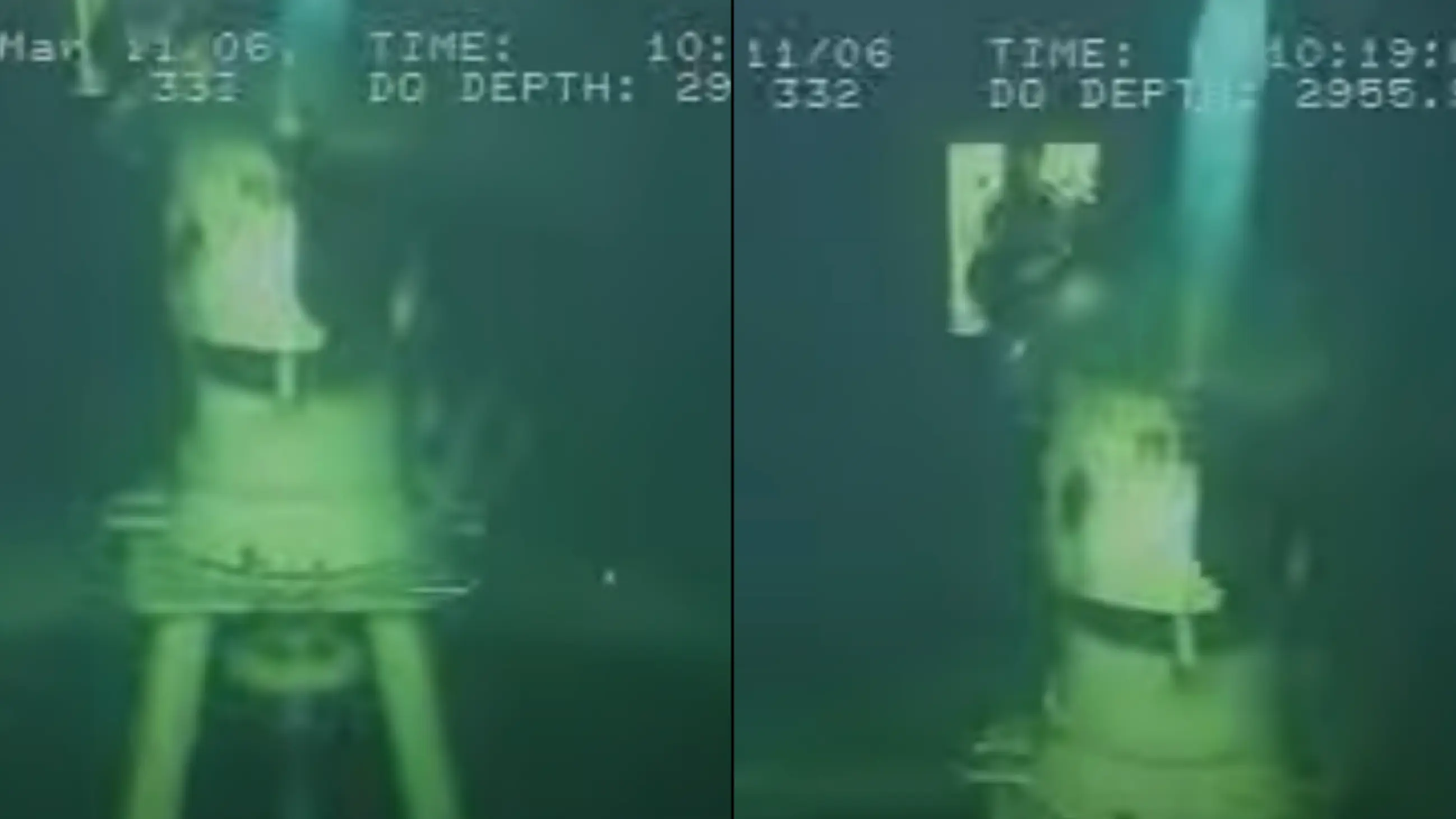
A video of the exploration has been shared online, showing scientists diving to inspect a gas line owned by Helix Energy Solutions.

Their work is suddently disturbed by a huge sea creature that moves into view on their camera on their Canyon Offshore ROV.

The scientists were greeted by a sperm whale who had joined them at 3,000 feet deep, with the creature being seen gliding past and heading deeper into the water.

Sperm whales can reach lengths of 60 feet and weigh as much as 125,000 pounds— about as much as a fully-loaded Boeing 737 airplane - so it's no wonder this one seems huge as it glides past the camera blocking everything else in view.

While the quality of the footage isn't amazing, a sperm whale is seen gliding past the camera and heading even deeper into the ocean. (Helix Energy Solutions)

The clip of the whale was shared on YouTube and has been shared on Twitter/X, with some pointing out how amazing it was that an animal can be found so deep in the ocean.

One person wrote: "Amazing how a biological creature with bone and organs can withstand the intense pressure that deep. We need to build machines with very thick metal to get that deep, and even then they are sometimes crushed like tin cans.

"Also The fact that whales can't breathe under water yet he is just cruising along the bottom 3000ft deep."

"It's crazy to think we haven't explored the deeeeeeeeeeeeep ocean. What's down there?" asked another.

A third person wrote: "Make us realize that we still have no idea from what is down there, like from the few creatures we have seen before on certain deep sea videos, I'm sure there is way more down there.

Sperm Whales have been known to dive down to below 3,000 feet, and have been spotted at oil rigs previously. (Pexels)

"Do we can fly to planets SO far away, but still can't go to the bottom of wherever it might be ?"

This isn't the first time that whales and deep sea divers have come face to face near an oil rig either, as it appears that whales like to pop up there now and then.

In Mexico, there can be as many as 3,000 endangered sperm whales found in the northern Gulf.

These animals are most often found in waters deeper than 3,000 feet, including the area around the Deepwater horizon drill rig near Mexico, but can end up being disturbed by noises and activities such as drilling or building.

Featured Image Credit: Helix Energy Solutions

Topics: Animals, Science, World News

Niamh Spence
Niamh Spence

Journalist.

X

@missnspence

Recommended reads

How Caroline Flack paid tribute to 'beautiful soul' Sophie Gradon on Love Island AftersunITVSharon Stone 'sick' for whole month from marijuana withdrawal as she shares impact quitting had on herGilbert Flores/Variety via Getty ImagesOprah Winfrey explains her real name after using the ‘wrong’ one for 50 yearsMatt Winkelmeyer/Getty ImagesWoman, 39, dying from incurable disease after being refused screening despite family historyKennedy News and Media

Advert

Choose your content:

4 hours ago
5 hours ago
8 hours ago
  • Kennedy News and Media
    4 hours ago

    Woman, 39, dying from incurable disease after being refused screening despite family history

    Chantelle Van Der Watt had previously received annual screenings in South Africa

    News
  • Southeastern Ohio Regional Jail
    5 hours ago

    Dad in Ohio house of horrors case where 16 'feral' children discovered makes fresh plea

    His lawyer has made the request for him before things go to trial

    News
  • MI News/NurPhoto via Getty Images
    5 hours ago

    Falkland Islands athlete slams Argentina’s 'disappointing’ World Cup banner following controversy

    Athelete Cecil Alexander shared his frustration at the Argentinian team's unfurling the banner on the pitch

    News
  • Alex Pantling - FIFA/FIFA via Getty Images
    8 hours ago

    World Cup winners Spain dragged into probe as FIFA told to investigate seven matches

    The game was later cleared of suspicion and it was ruled a 'remarkable result'

    News
  • People ‘terrified’ of deep sea after seeing eerie underwater footage of prehistoric creature
  • Truth behind mysterious deep sea 'bloop' that had scientists convinced they'd found giant Megalodon
  • Horrifying footage shows moment tourist plunges 40ft when zip line malfunctions
  • Danger to life when huge underwater volcano explodes explained with 'sea floor collapse' possible