• iconNews
  • videos
  • entertainment
  • Home
  • News
    • UK News
    • US News
    • Australia
    • Ireland
    • World News
    • Weird News
    • Viral News
    • Sport
    • Technology
    • Science
    • True Crime
    • Travel
  • Entertainment
    • Celebrity
    • TV & Film
    • Netflix
    • Music
    • Gaming
    • TikTok
  • LAD Originals
    • FFS PRODUCTIONS
    • Say Maaate to a Mate
    • Daily Ladness
    • UOKM8?
    • FreeToBe
    • Citizen Reef
  • Advertise
  • Terms
  • Privacy & Cookies
  • LADbible Group
  • UNILAD
  • SPORTbible
  • GAMINGbible
  • Tyla
  • UNILAD Tech
  • FOODbible
  • License Our Content
  • About Us & Contact
  • Jobs
  • Latest
  • Topics A-Z
  • Authors
Facebook
Instagram
X
Threads
Snapchat
TikTok
YouTube

LAD Entertainment

YouTube

LAD Stories

Submit Your Content
Astronomer who unveiled 'Pale Blue Dot' photo of Earth sent a chilling message to our planet

Home> News> Science

Updated 16:31 3 Oct 2024 GMT+1Published 13:46 3 Oct 2024 GMT+1

Astronomer who unveiled 'Pale Blue Dot' photo of Earth sent a chilling message to our planet

The astronomer believed the image should be a stark reminder to all of mankind

Brenna Cooper

Brenna Cooper

The astronomer who unveiled the 'Pale Blue Dot' in the 1990s has explained why he believed the image was so important for all of mankind to see.

Throughout his life, legendary planetary scientist Carl Sagan dedicated his work to furthering our understanding of space and the possibility of extraterrestrial life (aka aliens) existing.

Often described as 'the scientist who made the Universe clearer to the ordinary person', Sagan took the complex - and often mind-boggling - world of astrophysics and made it easily accessible to the likes of you and I.

In 1990, Sagan unveiled an image called the 'Pale Blue Dot' to the world, take a look at the image below:

Advert
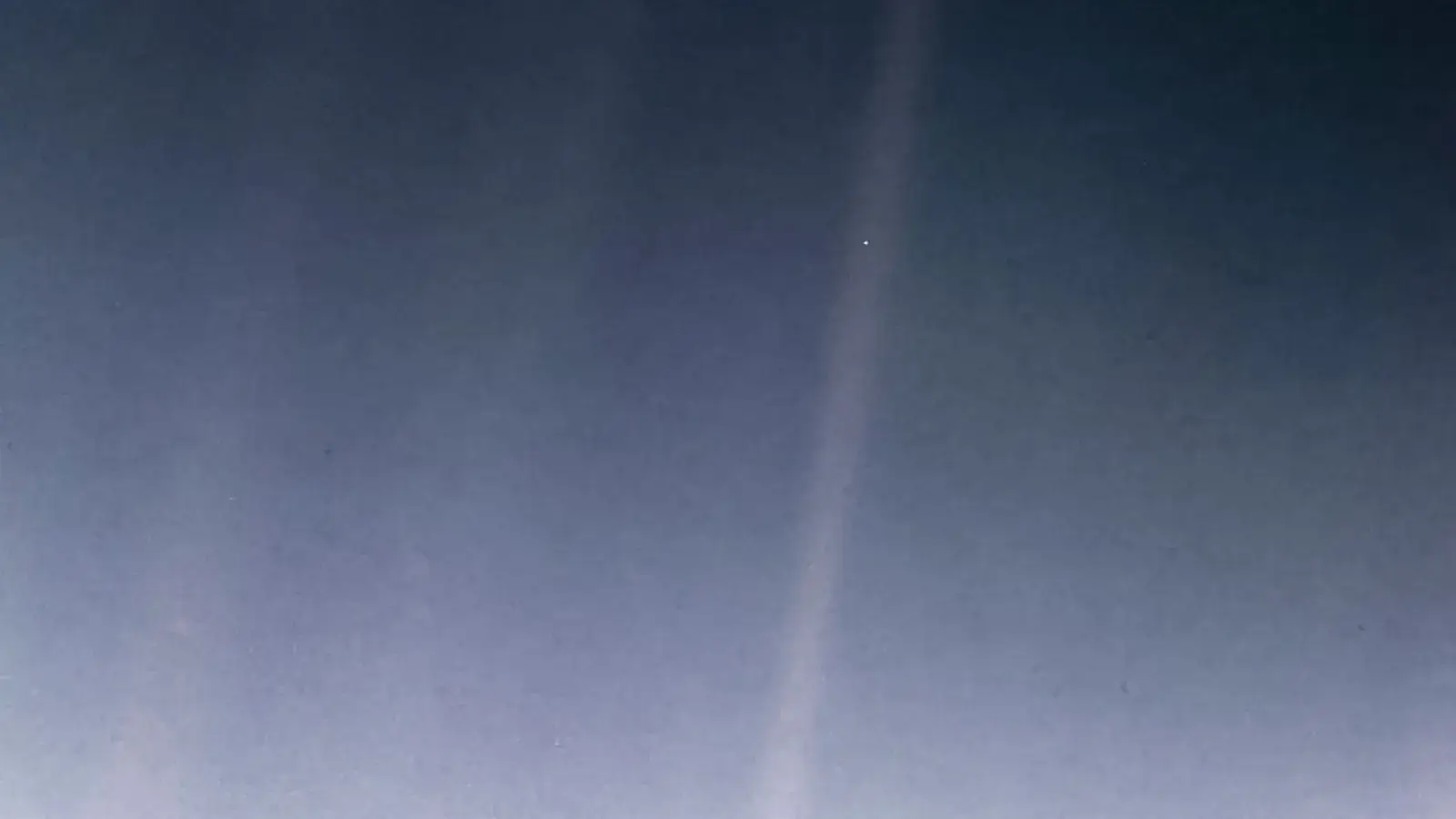
The image was released in 14 February 1990 (NASA/JPL-Caltech)

Now, upon first glance I know this photo looks like an image of the night sky taken in your back garden on an old mobile phone.

However, I assure you this is not an average photo of the night sky, but instead an image captured by by NASA’s Voyager 1 around 3.7 billion miles (6 billion kilometers) from the Sun.

The subject of this photo? Planet Earth.

Look closely at the photo and you'll notice a small pale blue dot just off centre in the upper right part of the image, that's us.

After seeing the images, Sagan was inspired to use it as a way to drive home just how unique our situation is in the universe.

Talking about the lack of interstellar life in a press conference for the image, Sagan said: "For me, that underscores the rarity and preciousness of the Earth and the life upon it.

"On that blue dot, that's where everyone you know. Everyone you ever heard of, and every human being who ever lived, lived out their lives."

Urging others to use the image as inspiration to look after our collective home, he continued: "Just speaking for myself, I think this perspective underscores our responsibility to preserve and cherish that blue dot, the only home we have."

I can think of a few people who could use such a reminder, that's for sure.
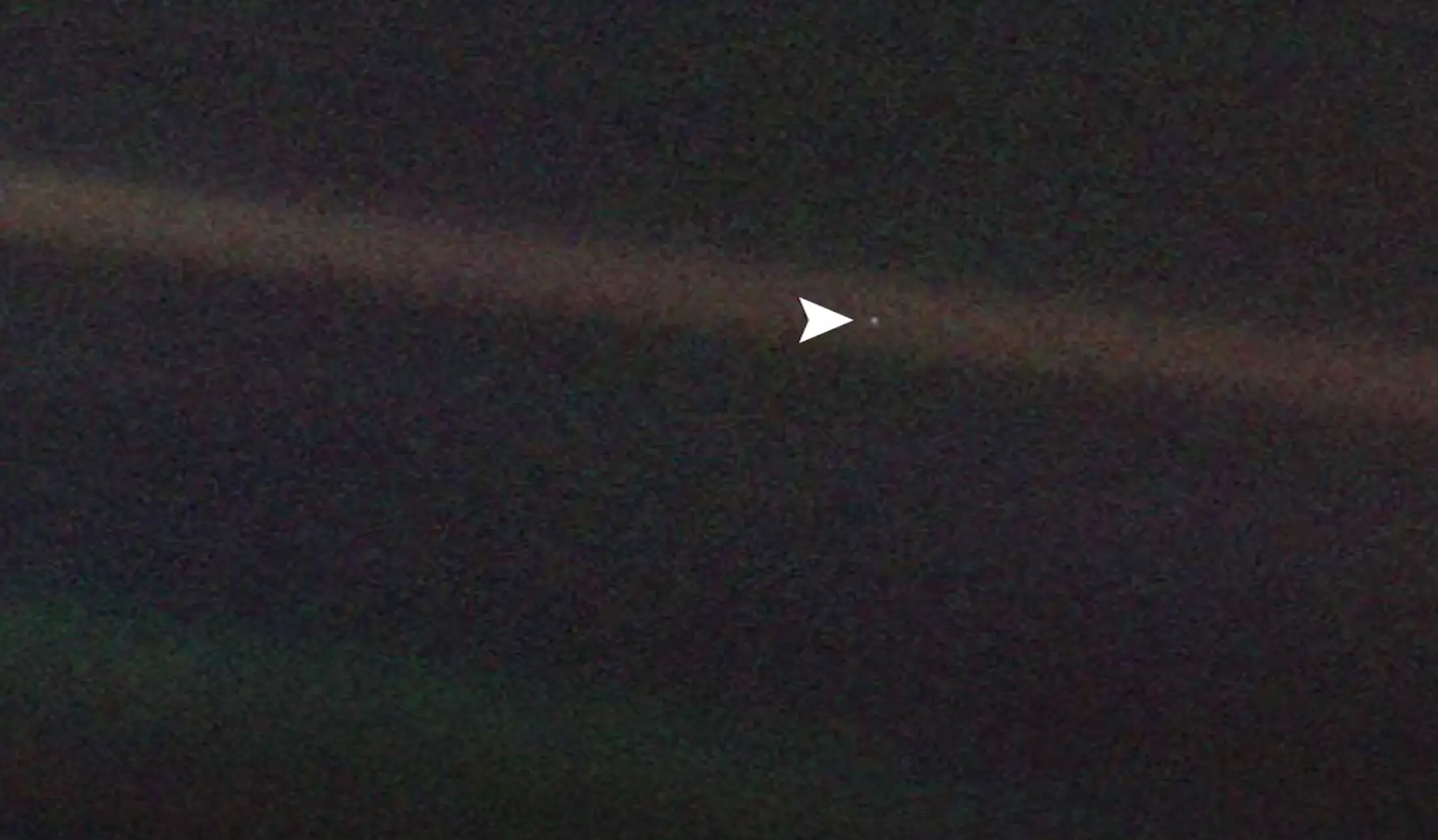
That's us, the blue dot (YouTube/The Planetary Society)

Like the astronauts who've spoken candidly about the impact of the 'Overview Effect', the image leave a lasting impact on Sagan. He would later go on to name his 1994 book Pale Blue Dot: A Vision of the Human Future in Space after the image.

Proving this photo is definitely not your typical image of the night sky.

The legacy of the 'Pale Blue Dot' has gone on to inspire more than Sagan in the subsequent years as well, with Garry Hunt telling the BBC in 2020 that he often uses the image as a way to drive home the importance of taking climate change seriously.

"Every time I give a climate talk and I talk about what you're doing now to make a change - I show this picture because it shows the Earth is an isolated speck. This tiny blue dot is the only place we can possible live, and we're making a jolly good mess of it," he said in the interview.

Featured Image Credit: ( YouTube/ The Planetary Society)

Topics: Science, Space, NASA, Technology, Environment

Brenna Cooper
Brenna Cooper

Brenna Cooper is a journalist at LADbible. She graduated from the University of Sheffield with a degree in History, followed by an NCTJ accredited masters in Journalism. She began her career as a freelance writer for Digital Spy, where she wrote about all things TV, film and showbiz. Her favourite topics to cover are music, travel and any bizarre pop culture.

X

@_brencoco

Advert

Advert

Advert

  • £150k of business support up for grabs via entrepreneurship scheme
  • James Webb Space Telescope makes 'weird' discovery from beginning of the universe that has left scientists puzzled
  • James Webb Space Telescope detects signs of atmosphere on 'super-Earth' planet made entirely out of diamond
  • ‘Planet killer’ asteroid set to come close to Earth in coming days and you’ll be able to see it

Choose your content:

9 hours ago
10 hours ago
11 hours ago
  • Chip Somodevilla/Getty Images
    9 hours ago

    Trump mixes Greenland up with another country in major speech blunder despite demanding to own it

    The US President appeared to misspeak on multiple occasions while onstage at the World Economic Forum

    News
  • Harun Ozalp/Anadolu via Getty Images
    10 hours ago

    Donald Trump makes major U-turn as 'future deal' over Greenland made following meeting with Nato leader

    Donald Trump has issued a statement about Greenland on Truth Social

    News

    breaking

  • Ben Birchall/PA Wire
    10 hours ago

    British mum of 10 who kept woman as slave for 25 years had chilling response when asked if sorry for crimes

    Amanda Wixon forced the victim to care for her kids and clean her squalid home for more than a quarter of a century

    News
  • Getty Stock Image
    11 hours ago

    Doctor issues severe warning about 'toasted skin syndrome' you can get from using a laptop

    Medics have urged people to stop 'slow roasting' their skin

    News