ladbible homepage
ladbible homepage
  • Home
  • News
    • UK
    • US
    • World
    • Ireland
    • Australia
    • Science
    • Crime
    • Weather
  • Entertainment
    • Celebrity
    • TV
    • Film
    • Music
    • Gaming
    • Netflix
    • Disney
  • Sport
  • Technology
  • Travel
  • Lifestyle
  • Money
  • Originals
    • FFS PRODUCTIONS
    • Say Maaate to a Mate
    • Daily Ladness
    • UOKM8?
    • FreeToBe
    • Citizen Reef
  • Videos
  • Advertise
  • Terms
  • Privacy & Cookies
  • License Our Content
  • About Us & Contact
  • Jobs
  • Latest
  • Archive
  • Topics A-Z
  • Authors
Facebook
Instagram
X
Threads
Snapchat
TikTok
YouTube
Submit Your Content Here
  • GAMINGbible
  • LADbible Group
  • UNILAD
  • SPORTbible
  • Tyla
  • FOODbible
  • UNILAD Tech
What damage 50-year-old spacecraft could do when it hits Earth at 17,000mph in just weeks
Home>News>Science
Published 19:36 29 Apr 2025 GMT+1

What damage 50-year-old spacecraft could do when it hits Earth at 17,000mph in just weeks

It comes from a failed Russian attempt to reach Venus in the 70s

Joe Harker

Joe Harker

google discoverFollow us on Google Discover

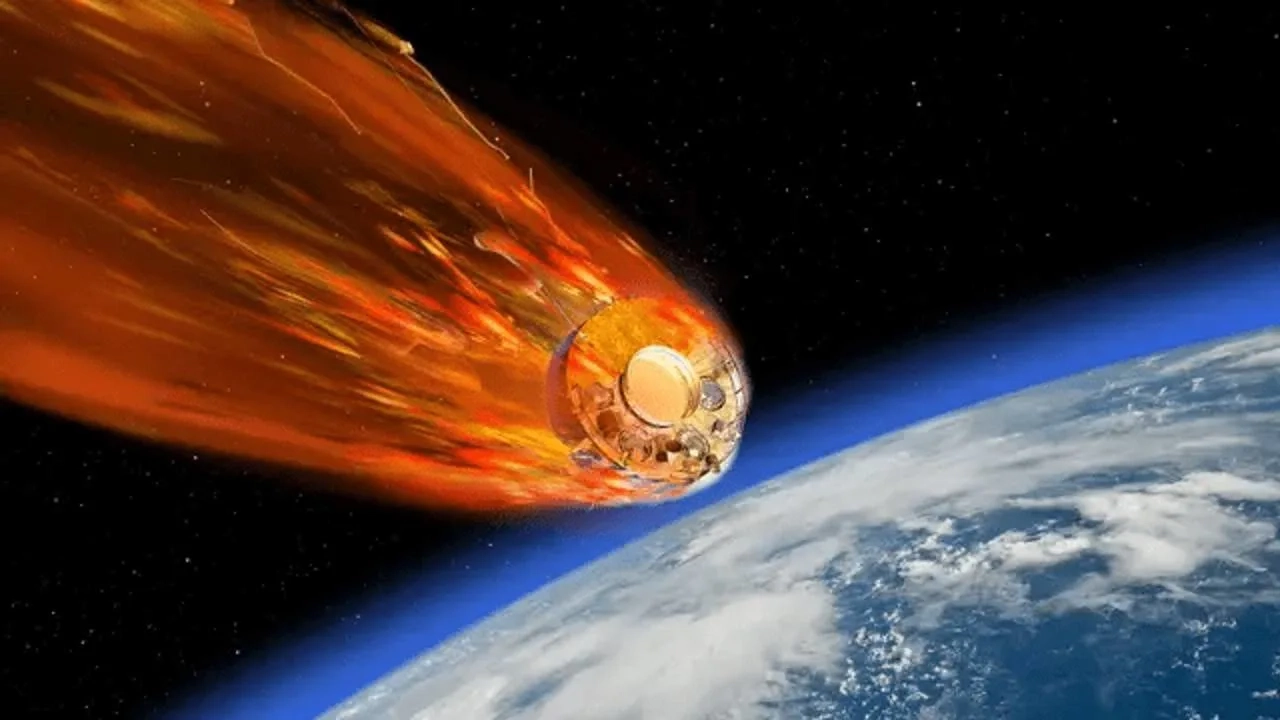
A chunk of a spacecraft which was sent on a mission more than 50 years ago is expected to come plummeting down to Earth in the coming weeks at a speed of 17,000mph.

That's roughly the same speed as the average Brit at a party when they hear the buffet is ready.

This old spacecraft is a Russian vehicle known as Kosmos 482 and it failed in its mission to reach Venus in 1972 as it couldn't get out of Earth's low orbit.

Some pieces of it came crashing back to Earth a while ago, with a bunch of titanium alloy balls crashing into a farm in New Zealand where they scorched some crops, with the Soviet Union pretending they didn't know anything about it.

Advert

However, other pieces of the spacecraft remain in orbit and are expected to finally end more than 50 years circling the planet in the next few weeks.

This particular craft failed in its mission to reach Venus over 50 years ago, now it's crashing back down (Sovfoto/Universal Images Group via Getty Images)

According to Space, the landing module of Kosmos 482 is expected to begin an 'uncontrolled re-entry' sometime around 9 or 10 May.

To maintain a stable orbit around the Earth as this spacecraft has done, an object needs to be travelling at about 17,000mph, but as it re-enters our atmosphere the craft will start to slow down.

Hopes that the craft will just burn up in the atmosphere as it comes down are slim, as this thing was designed to spend time on the inhospitable surface of Venus.

Kosmos 482's sister probe, Venera 8, did successfully make it to Venus and managed to survive on the surface for 50 minutes before being destroyed there.

So this thing is probably going to survive long enough to come down and hit something, the question then is where it will hit and what damage it will do.

A piece of this is coming down and is expected to do about as much damage as a meteorite, so not much (Sovfoto/Universal Images Group via Getty Images)

Forbes reports that astrophysicist Jonathan McDowell puts the chances of this space debris actually hitting a person at about '1 in 10,000', so we'd have to be supremely unlucky for this small chunk of space junk to land on anyone.

However, they add that the spacecraft coming down will be about the same size as the surviving chunk of a meteorite that exploded over Russia in 2013.

That meteorite did cause some damage in the immediate vicinity with buildings smashed and windows shattered from the energy, but the surviving chunk was found at the bottom of a lake and fished out.

Given that our planet's surface is 70 percent water and much of the land is uninhabited the odds of this coming down on someone are very slim indeed.

Featured Image Credit: ESA/David Ducross

Topics: Space, Science, World News

Joe Harker
Joe Harker

Joe graduated from the University of Salford with a degree in Journalism and worked for Reach before joining the LADbible Group. When not writing he enjoys the nerdier things in life like painting wargaming miniatures and chatting with other nerds on the internet. He's also spent a few years coaching fencing. Contact him via [email protected]

X

@MrJoeHarker

Recommended reads

Nationwide confirm who won't get 'free' bonus £100 paymentKaty Blackwood/NurPhoto via Getty ImagesGemma Collins says she makes more money than Prime Minister as she shares 'earnings'Karwai Tang/WireImageHilaria Baldwin shares secret to 14-year marriage with Alec Baldwin despite 26-year age gapStephanie Augello/Variety via Getty ImagesCountries at risk if ‘Doomsday Glacier’ size of Britain collapses into seaGetty stock

Advert

Choose your content:

9 hours ago
10 hours ago
  • Katy Blackwood/NurPhoto via Getty Images
    9 hours ago

    Nationwide confirm who won't get 'free' bonus £100 payment

    The bonus payment isn't for everybody

    News
  • Stephanie Augello/Variety via Getty Images
    9 hours ago

    Hilaria Baldwin shares secret to 14-year marriage with Alec Baldwin despite 26-year age gap

    Hilaria Baldwin opened up about her relationship with the star

    News
  • Getty stock
    10 hours ago

    Countries at risk if ‘Doomsday Glacier’ size of Britain collapses into sea

    The glacier sits at the northern edge of the West Antarctic Ice Sheet, and if it melts, it means bad things for the world

    News
  • Getty Stock Photo
    10 hours ago

    Maps show how 'Super El Niño' that will have catastrophic global consequences will impact US

    It is a mighty and dangerous weather event

    News
  • Pentagon releases 50 new UFO videos with 'orbs swarming in all directions'
  • Mysterious interstellar object tracked by 'alien-hunting spacecraft' as it passes Earth
  • 'Potentially hostile' alien threat could attack Earth in the coming months, according to scientists
  • NASA could uncover four-billion-year-old secret in 2027 trip to the Moon