ladbible homepage
ladbible homepage
  • Home
  • News
    • UK
    • US
    • World
    • Ireland
    • Australia
    • Science
    • Crime
    • Weather
  • Entertainment
    • Celebrity
    • TV
    • Film
    • Music
    • Gaming
    • Netflix
    • Disney
  • Sport
  • Technology
  • Travel
  • Lifestyle
  • Money
  • Originals
    • FFS PRODUCTIONS
    • Say Maaate to a Mate
    • Daily Ladness
    • UOKM8?
    • FreeToBe
    • Citizen Reef
  • Videos
  • Advertise
  • Terms
  • Privacy & Cookies
  • License Our Content
  • About Us & Contact
  • Jobs
  • Latest
  • Archive
  • Topics A-Z
  • Authors
Facebook
Instagram
X
Threads
Snapchat
TikTok
YouTube
Submit Your Content Here
  • GAMINGbible
  • LADbible Group
  • UNILAD
  • SPORTbible
  • Tyla
  • FOODbible
  • UNILAD Tech
Once-in-a-lifetime star ‘explosion’ set to light up the sky could happen any moment from now
Home>News>Science
Published 15:15 9 Jun 2024 GMT+1

Once-in-a-lifetime star ‘explosion’ set to light up the sky could happen any moment from now

The explosion could happen any moment

Anish Vij

Anish Vij

google discoverFollow us on Google Discover

Hopefully the explosion doesn't happen before this article gets published otherwise my copy is ruined.

Aside from that, stargazers across the world could quite possibly witness a 'once-in-a-lifetime' event this summer.

Sorry Brits, we are not talking about a week of warm weather.

Instead, scientists say that a nova explosion of the binary star system T Corona Borealis is predicted to take place in the coming months.

Advert

The last time the T Coronae Borealis was visible from Earth was in 1946.

What is a nova explosion?
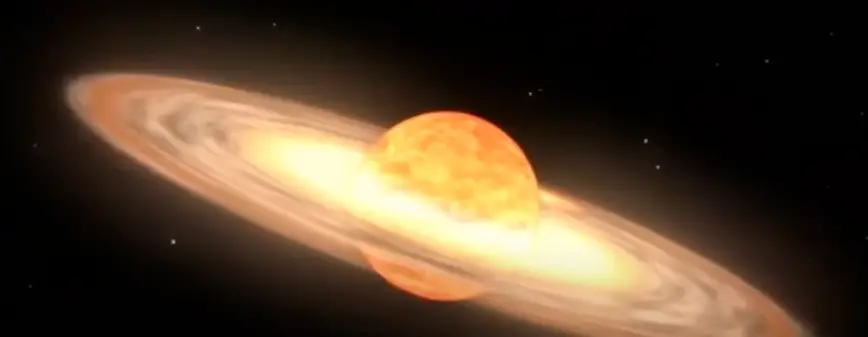
(NASA)
(NASA)

The T Coronae Borealis is 3,000 light years away from Earth and lies within the Northern Crown constellation of the galaxy.

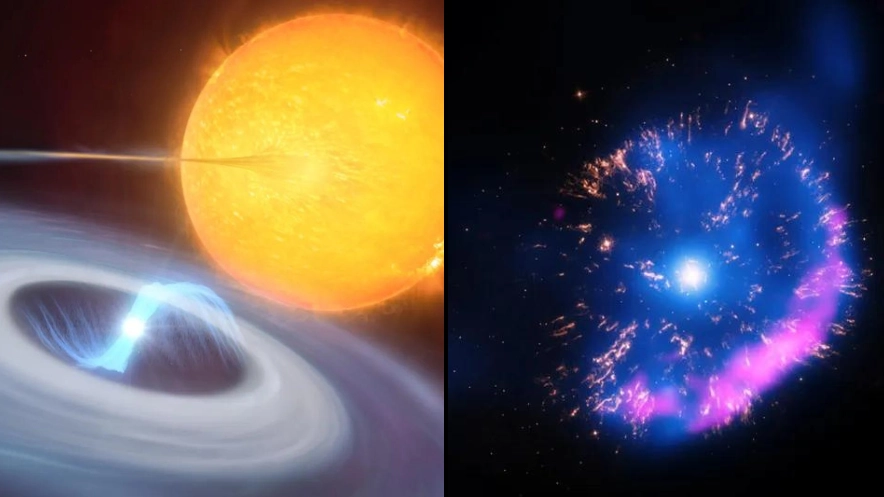
The star system is made up of two types of stars - a white dwarf and an ancient red giant.

Because of gravity, the white dwarf will gradually rip away hydrogen from the other star.

As this happens, it causes a build up of gas which triggers a thermonuclear explosion, otherwise known as a nova explosion.

This is different to a supernova, which is the final explosion of a dying star.

“It’s a once-in-a-lifetime event that will create a lot of new astronomers out there, giving young people a cosmic event they can observe for themselves," said Dr. Rebekah Hounsell, a NASA assistant research scientist.

"It's incredibly exciting to have this front row seat."

When will we see it?
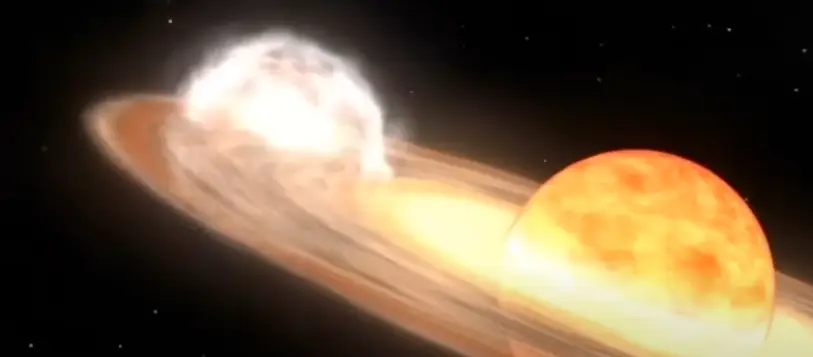
The last time the T Coronae Borealis was visible from Earth was in 1946. (Nasa)

Scientists are predicting that the explosion will take place any time, from now until September.

They say it will be so bright that the nova will be visible from Earth with the naked eye.

If/when it does happen, the explosion will be visible for a whole week.

What do we look out for?

"Novae are binary star systems, where two stars closely orbit each other," Dr Darren Baskill told BBC Science Focus.

"Around half the stars in the night sky are binary systems.

"This sudden onset of nuclear fusion makes this surface layer of gas even hotter, triggering even more nuclear reactions to take place resulting in a dramatic chain reaction and a dramatic brightening of the star – a nova explosion,"

Dr Elizabeth Hays, chief of the Astroparticle Physics Laboratory at NASA Goddard, said: “Citizen scientists and space enthusiasts are always looking for those strong, bright signals that identify nova events and other phenomena.

“Using social media and email, they’ll send out instant alerts, and the flag goes up. We’re counting on that global community interaction again with T Coronae Borealis."

Featured Image Credit: ESO/M. Kornmesser, L. Calçada/NASA

Topics: Science, Space, UK News

Anish Vij
Anish Vij

Anish is a Journalist at LADbible Group and is a GG2 Young Journalist of the Year 2025. He has a Master's degree in Multimedia Journalism and a Bachelor's degree in International Business Management. Apart from that, his life revolves around the ‘Four F’s’ - family, friends, football and food. Email: [email protected]

X

@Anish_Vij

Recommended reads

Lad shares update after 320 days of only training one trap to completely transform one side of his bodyInstagram/@thecrookedman10Psychic who ‘predicted’ Spain’s Euro 2024 win reveals how far England will go in World CupMatt McNulty - FIFA/FIFA via Getty ImagesKnicks radio host caught on hot mic saying 'unfortunate' thing to Taylor SwiftAl Bello/Getty ImagesEngland fans baffled by what they did to pitch after huge thunderstorm delayed match with Costa RicaEddie Keogh - The FA/The FA via Getty Images

Advert

Choose your content:

an hour ago
2 hours ago
  • Matt McNulty - FIFA/FIFA via Getty Images
    an hour ago

    Psychic who ‘predicted’ Spain’s Euro 2024 win reveals how far England will go in World Cup

    Nicolas Aujula thinks Rashford’s ‘legs’ and Kane’s ‘temper’ will lead to a ‘dramatic’ few weeks for England at the World Cup

    News
  • Eddie Keogh - The FA/The FA via Getty Images
    2 hours ago

    England fans baffled by what they did to pitch after huge thunderstorm delayed match with Costa Rica

    England thumped Costa Rica 3-0 in the final warm-up game before the World Cup

    News
  • Carl Recine/Getty Images Europe
    2 hours ago

    FIFA has World Cup 30-minute emergency rule that could delay matches by hours

    The new 30-minute rule introduced by FIFA could impact fans watching the games just as much as the players at the World Cup

    News
  • Sam Hodde/Getty Images
    2 hours ago

    FIFA president Gianni Infantino tells critics to ‘chill’ following World Cup backlash

    The Fifa boss reminded people they're not 'kings of the world' as fans slam 'World Cup of Chaos'

    News
  • When to see the biggest full moon since 2019 as supermoon set to light up the sky
  • ‘Once-in-a-lifetime’ explosion so bright it’ll be visible from Earth could happen any time now
  • Incredible animation shows the moment extremely rare black hole rips apart star in explosion
  • New research says 'precursor for life' could happen on one of Saturn's moons