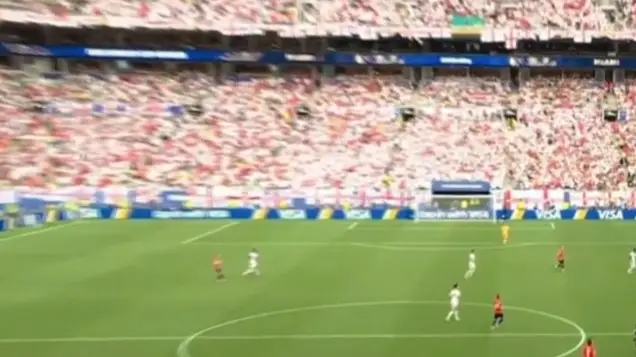
New angle shows why England’s goal vs Norway should not have been allowed

A new angle shows that England’s equaliser against Norway should have been disallowed.
The Three Lions faced Norway at the Hard Rock Stadium in Miami for the World Cup quarter final clash.
England appeared to start strong but then looked to lose momentum and it was Norway who took the lead, thanks to a 36 minute goal from Andreas Schjelderup. But England put the pressure on after an equaliser from Jude Bellingham just ahead of half time.
However, a new angle reveals that the equaliser likely should have been disallowed.
Advert
Replays of the moment showed on Fox revealed that when Orjan Nyland took the goal kick, the ball flew up and hit the sky camera above the pitch.
The ball then flicked back down to the pitch and landed at the feet of Elliot Anderson, who passed it to Anthony Gordon, who wasted no time in setting up Bellingham for the goal.
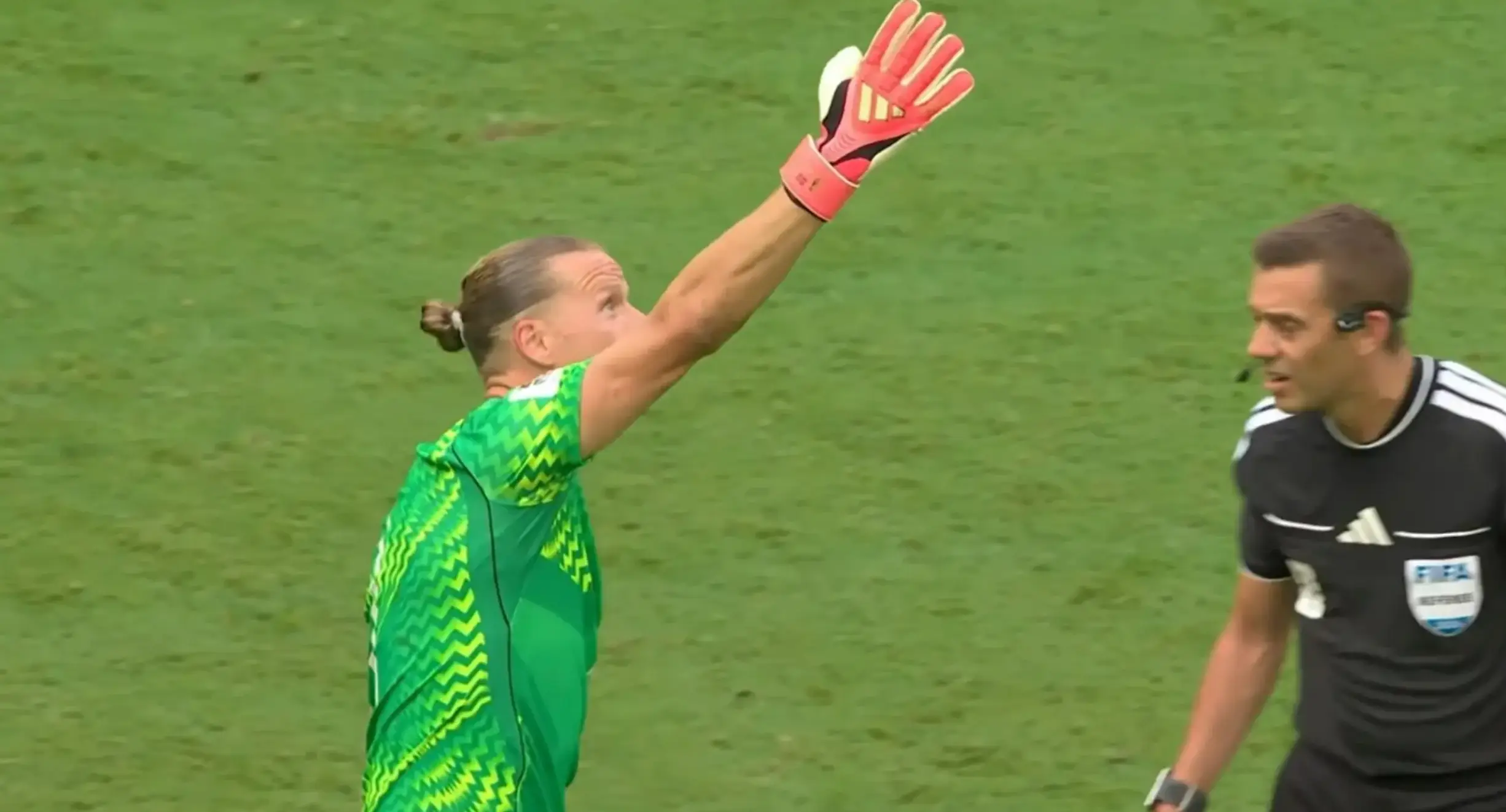
But according to FIFA rules, there should have been a drop ball when it hit the camera above the pitch.
This means that the goal would not have stood and that VAR could have been used.
Ex-Premier League referee Mark Clattenburg said on Fox: “VAR can interfere if that contact of the ball on the camera cable is part of a reviewable incident, an attacking phase of play leading to a goal is part of the var reviewable incident.
“It should have been picked up the VAR.”
Players from the Norway team appeared to gesture towards the camera while talking to the referee.
Later on in the game, Norway had a goal disallowed.
Torbjorn Heggem scored in the 55th minute, giving Norway the lead.
However, after a brief VAR review officials removed the second goal after concluding that Erling Haaland had committed a foul against England’s Elliot Anderson just moments before Heggem put it into the net.
New rules for the FIFA World Cup 2026
This year, there’s been a whole host of rule changes, many of which are designed to speed up the game and penalise players who drag things out. Some of the new regulations are likely to prove controversial.
10-second substitution
Subbed players now have to get a move on and leave the pitch within ten seconds by the nearest exit point. If they haven’t, their replacement will get held up by one minute until the next stoppage of play, and until then, their side will have to play with 10 men.
5-second throw-ins and goal kicks
If a referee thinks a player is taking too long for a throw-in or goal kick, they’ll start a five-second countdown, by which time the ball needs to be back in play. If it’s not, for throw-ins the opposing team will get their own throw-in, or for a goal kick the other side gets a corner.
Injured players to remain off the pitch for one minute
An injured player treated by medical staff off-field has to stay off the pitch for one minute, leaving their side with just 10 players.
More VAR
VAR can now be used to review an incorrectly awarded corner kick; second yellow cards resulting in a red card; when a player is incorrectly awarded a yellow or red card for another player’s actions; and any attacking fouls that occur before the ball is in play.
Players can’t cover their mouths
Players who cover their mouths in confrontational situations will be handed a red card. It’s believed players might cover their mouths to guard against lip readers while racially abusing other players, which some suspect has happened in the past.
Red cards for players leaving the pitch
Any player who leaves the pitch in protest over a referee’s decision will be handed a red card, and if a team walks off and causes a match to be abandoned, they’ll forfeit the game.
Topics: World Cup
 Claire Reid