ladbible homepage
ladbible homepage
  • Home
  • News
    • UK
    • US
    • World
    • Ireland
    • Australia
    • Science
    • Crime
    • Weather
  • Entertainment
    • Celebrity
    • TV
    • Film
    • Music
    • Gaming
    • Netflix
    • Disney
  • Sport
  • Technology
  • Travel
  • Lifestyle
  • Money
  • Originals
    • FFS PRODUCTIONS
    • Say Maaate to a Mate
    • Daily Ladness
    • UOKM8?
    • FreeToBe
    • Citizen Reef
  • Videos
  • Advertise
  • Terms
  • Privacy & Cookies
  • License Our Content
  • About Us & Contact
  • Jobs
  • Latest
  • Archive
  • Topics A-Z
  • Authors
Facebook
Instagram
X
Threads
Snapchat
TikTok
YouTube
Submit Your Content Here
  • GAMINGbible
  • LADbible Group
  • UNILAD
  • SPORTbible
  • Tyla
  • FOODbible
  • UNILAD Tech
Stephen Hawking once faked his own death during a BBC interview
Home>News
Published 15:48 29 Sep 2022 GMT+1

Stephen Hawking once faked his own death during a BBC interview

As well as having a brain the size of a planet, the professor also had a famously fantastic sense of humour

Jake Massey

Jake Massey

google discoverFollow us on Google Discover

In March 2018, we lost Professor Stephen Hawking - one of the world's finest scientific minds, and a half decent comedian too.

In 2004, BBC science correspondent Pallab Ghosh went to interview Hawking at his office in Cambridge, and he said the esteemed physicist immediately put him at ease.

However, the calm didn't last long, with a camera operator making a blunder which Hawking capitalised upon brilliantly, tricking the poor crew into thinking they'd accidentally killed him.
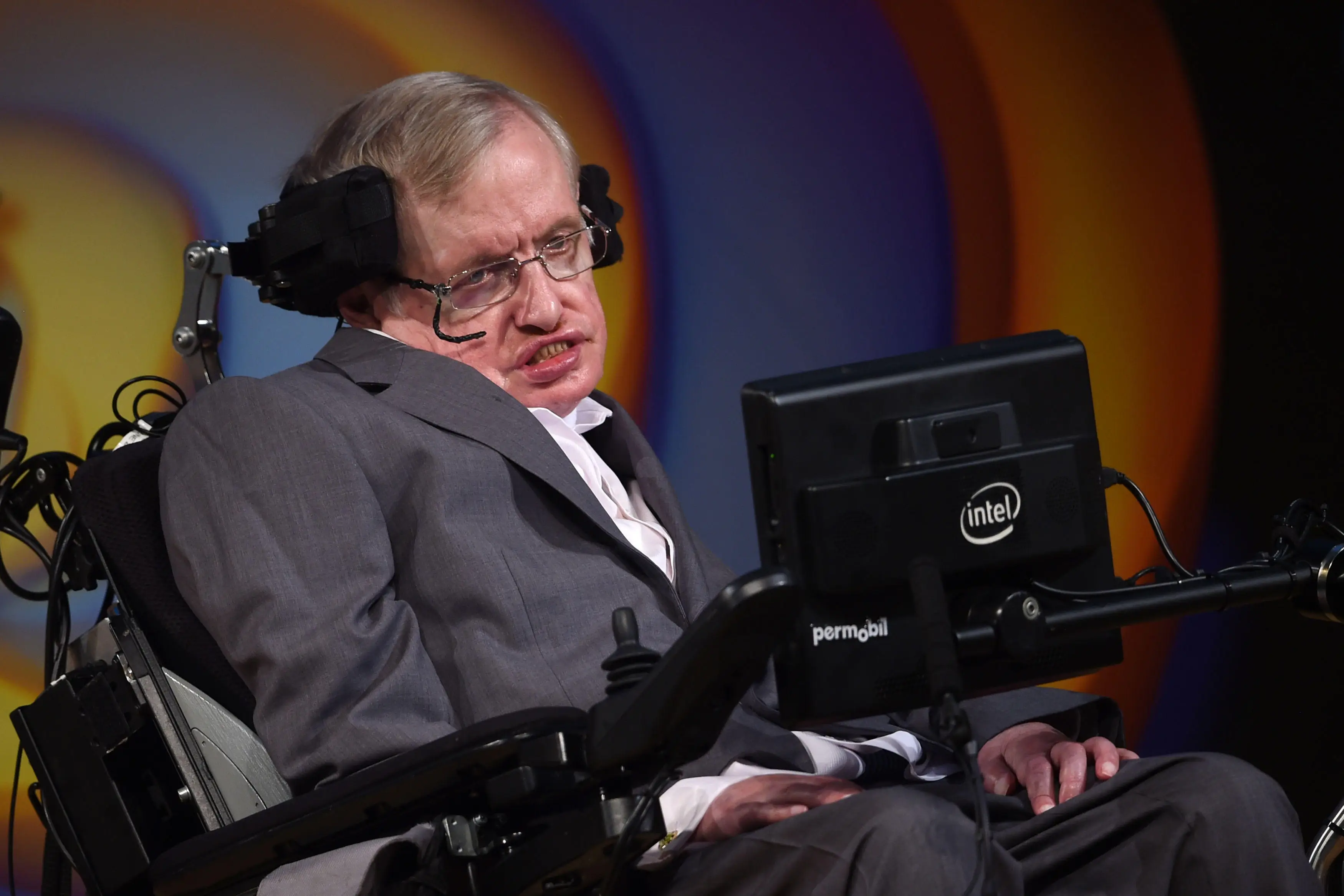
Hawking did 'em dirty.
PA Images / Alamy Stock Photo

Advert

Ghosh recalled the professor's 'huge joke' on The One Show , and also wrote about his 'wicked sense of humour'.

"I felt a mixture of awe and excitement as I waited for the man who for years had been my idol," he recalled. "He seemed to smile at me as he entered the room which immediately put me at my ease.

"The camera operator I was with wanted to make a last minute adjustment to his lighting and so he asked Prof Hawking's staff if he could pull out one of the plugs in the office so that he could use the socket for his equipment.

"Without waiting for a response he pulled the plug and the room was filled with a deafening siren.

"Prof Hawking then slouched forward and I feared that my colleague had inadvertently unplugged a vital piece of life-support equipment.

"Fortunately, it was the alarm to the uninterruptable power supply to his office computer and he was slouched forward with mirth at our incompetence."

Surely they've got to release the footage of the BBC team absolutely s****ing themselves, right?

Hawking was born on January 8 1942 in Oxford, the eldest of four children, and went on to become one of the world’s most acclaimed cosmologists.

He was diagnosed with amyotrophic lateral sclerosis (ALS), a rare form of motor neurone disease, in his 20s, and eventually had to use a wheelchair and was dependent on a computerised voice system for communication.

Hawking did not let his disease stop him having a huge impact on the world.
UPI/Alamy Stock Photo

But despite this, he continued to travel the world giving science lectures and writing scientific papers about the basic laws which govern the universe.

With Roger Penrose, he showed that Einstein's General Theory of Relativity implies space and time would have a beginning in the Big Bang and an end in black holes.

These results indicated that it was necessary to unify general relativity with quantum mechanics, the other great scientific development of the first half of the 20th century.

He also discovered that black holes should not be completely black, but rather should emit radiation and eventually evaporate and disappear – this radiation is now called Hawking Radiation.

His book, A Brief History Of Time, has sold more than 10 million copies.

Featured Image Credit: BBC/ Liam White/Alamy Stock Photo

Topics: Science, Stephen Hawking, BBC

Jake Massey
Jake Massey

Jake Massey is a journalist at LADbible. He graduated from Newcastle University, where he learnt a bit about media and a lot about living without heating. After spending a few years in Australia and New Zealand, Jake secured a role at an obscure radio station in Norwich, inadvertently becoming a real-life Alan Partridge in the process. From there, Jake became a reporter at the Eastern Daily Press. Jake enjoys playing football, listening to music and writing about himself in the third person.

X

@jakesmassey

Recommended reads

Woman says she's a 'real-life vampire' due to rare condition that leaves her hospitalised after minutes in the sun(Supplied/Emily Richardson)Norway's football team ship traditional food to its US World Cup training base to avoid eating American foodMark Smith/ISI Photos/ISI Photos via Getty ImagesJeremy Clarkson says he's 'cheated death twice' as he opens up on cancer diagnosis for first time(Jeff Spicer/Getty Images)London runner to tackle 'extreme' Australian outback in 3,800km world-record attemptSupplied

Advert

Choose your content:

8 mins ago
21 mins ago
an hour ago
  • (Supplied/Emily Richardson)
    8 mins ago

    Woman says she's a 'real-life vampire' due to rare condition that leaves her hospitalised after minutes in the sun

    She needs to wear full UV protection whenever she leaves her home

    News
  • Mark Smith/ISI Photos/ISI Photos via Getty Images
    21 mins ago

    Norway's football team ship traditional food to its US World Cup training base to avoid eating American food

    Anything to keep Haaland happy

    News
  • Aphantasia is thought to impact 10% of the global population. (Jacob Wackerhausen/Getty Images)
    an hour ago

    Millions of people have 'mind blindness' and don't realise it

    There a people out their who live with a condition called Aphantasia, which affects them on a daily basis and they don't even know it.

    News
  • Some people don't think in words. (Daniel Lozzano Gonzalez/Getty Images)
    an hour ago

    This is how people with no internal monologue really think

    Cognitive scientist Johanne Nedergård has explained how minds without an inner monologue work.

    News
  • Stephen Hawking seen between two women in bikinis in newest Epstein file release
  • Stephen Hawking shared final warning for humanity shortly before he died
  • Stephen Hawking had one final warning for humanity before he died
  • Mortician who encountered his first dead body as a child reveals what death 'smells like'