Two thirds of Gen Z have been watching porn since they were kids. So now what?

Whether it’s spicy content creators popping up in your reels with their day-to-days or 'stars' like Bonnie Blue and Lily Phillips garnering headlines and controversy, porn is everywhere.
We’re 18 years on from both PornHub and the iPhone launching, bringing with them a legion of streaming tech that allowed viewers to watch porn more frequently and more up close and personal than ever.
This boom in porn has led to huge concerns about what it's doing to young people. It’s been linked to an uptick in violent sex and rape, misogyny, racism, body image issues, addiction and mental health issues; various countries have tried to restrict or ban it.
This summer, though, the UK Government took its biggest step to try to make it harder - no pun intended - for anyone to access porn. Age gating now requires viewers to prove they’re over 18 before accessing anything spicy.
This new rule has gone down about as well as a lock-jawed fluffer, with campaigners concerned about privacy and censorship. Use of VPNs to get around the ban has skyrocketed, too.
Was this really the solution to all of porn’s problems? Most of us have grown up with porn, and our generation is the one most likely to watch porn, according to a YouGov survey. But this billion-pound industry isn’t going anywhere soon. And maybe it’s worth a bit more discussion…
That’s why LADbible surveyed over 5,300 18-28 year olds to understand how we all engage with porn, how it makes us feel and how it’s affecting our lives. And we’ve made some seriously eye-opening discoveries.

We're all into it
Though no porn publisher would ever say how many young people use their services, we found that 88% of us watch porn and 63% either stumbled upon or actively sought out spicy content before turning 16.
When did you first access porn?
- 5% under 10 (6% of men, 4% of women)
- 24% between 11-13 (29% men, 15% women)
- 34% between 14-16 (37% men, 31% women)
- 22% between 17-18 (18% men, 28% women)
- 11% between 19-21 (8% men, 15% women)
- 5% from 21+ (2% men, 7% women)
Plus, the younger you are, the more likely it is that you first viewed porn before 16, working out to:
- 75% of 18-20 year olds
- 75% of 21-24 year olds
- 51% of 25-29 year olds.
Before the age gating, it was far easier for young people to find porn appearing in social media feeds or in pop-up windows.
Dr Paula Hall, a sex and relationship therapist at Pivotal Recovery, which helps people with problematic porn use, says peer pressure plays a role, too.
"If everyone around you is talking about porn and you haven’t seen it yet, there’s a reasonable chance you’re going to seek it out, either out of curiosity, or to fit in," she said.
What do we learn from porn?
Porn was what introduced most of us to sex, as one respondent said: "I knew about porn a lot longer before I got taught sex education at school."
65% of young people said that porn was their first exposure to sex:
- 70% of men
- 57% of women
45% of young people said that porn was one of their main sources of information about sex:
- 49% of men
- 38% of women
Just 12% of young people said other sources like non-porn sites, TV and films, lessons in school, partners, friends, or family were the main way they learned about sex. For half of the men who learned about sex through porn, one man summed it up: "I mean it’s really the only way to learn things."
With 70% of us watching it weekly, and 21% being daily viewers, porn has had an impact on what we want from sex - 76% of us want to try something that porn’s showed us, but also what we expect from it.
49% of all respondents and 60% of daily viewers said porn shaped expectations of sex. And plenty said these expectations were unrealistic, making us worried about how we’ll act in bed - one woman said: "I still play up to trying to act like a pornstar."
Another guy told us that 'porn is more abusive', and a woman said 'it makes me expect rougher sex' and what we should look like.
Body image came up for 45% of men and 41% of women, who said they compare their own bodies to porn performers.
One woman said that porn made her think she needed to do 'whole body cleaning/shaving sessions prior to a hook-up', and one man explained that 'porn makes unreal expectations about sizes of parts of your body'.
Some men also worry that porn creates an expectation around duration, with one saying: "It used to make me think it is a normal thing for penetrative sex to last longer than usual."
Nick Dunne is the Director of the Global Community Men's Health Program at Movember and says that porn has influenced people’s understanding 'around bodies and what people need to be doing with these bodies'.
"There’s an expectation around dominance, aggression and performative sex."
However, 'they're not having that space for that kind of exploration, critical thinking about what they're absorbing'.

Porn comes with some positives
It’s not all bad, though: 47% felt satisfied after watching porn, and many said it increased pleasure, understanding of sex and their sex lives. Only 16% of men and 14% of women said that they felt no benefit could come from watching porn.
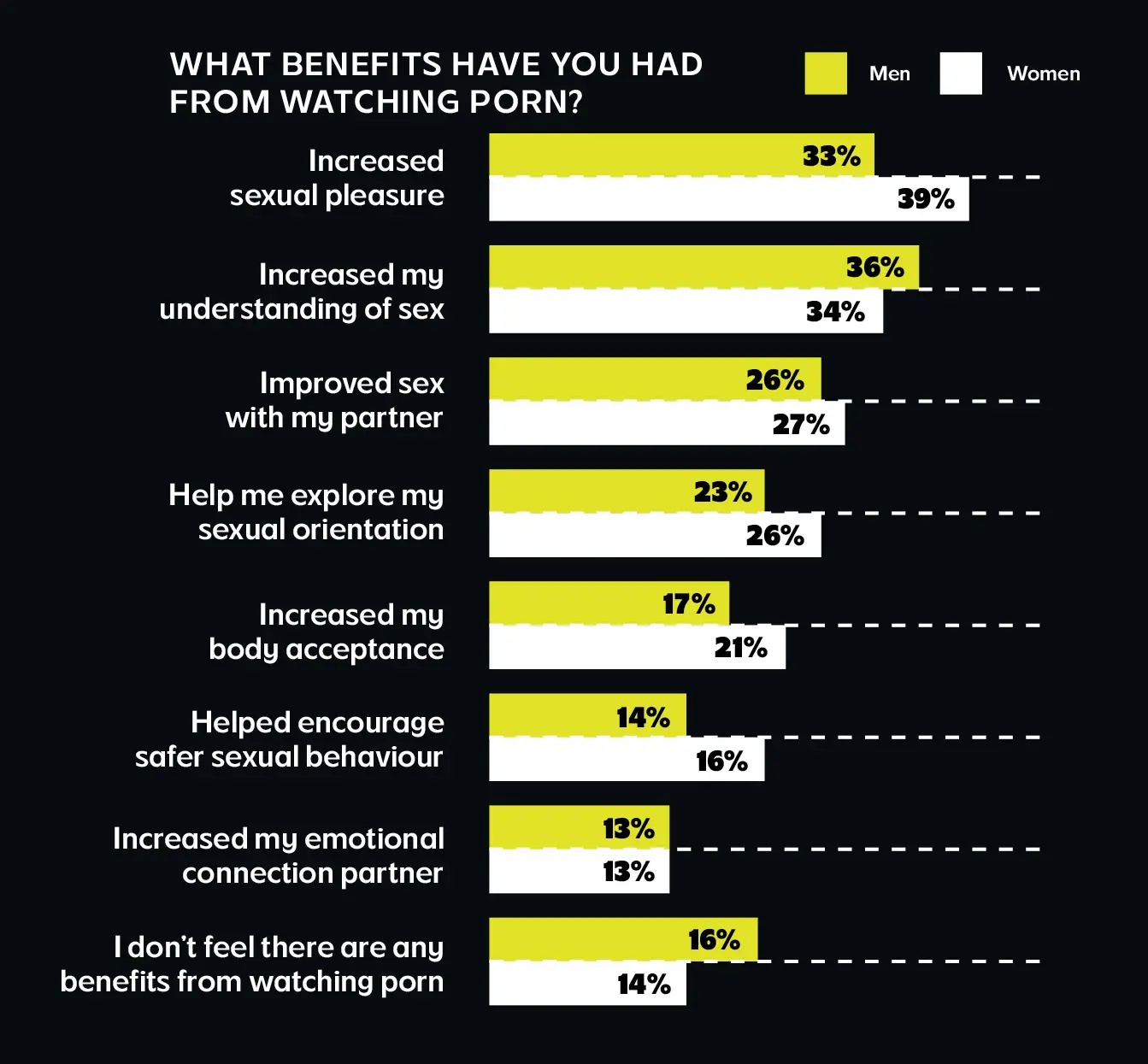
Dr Hall, who applies a sex-positive lens to her work, says: "Porn can lead to greater acceptance of your body image, of your sexuality, of your sexual taste, because if you're into particular kink, if you're trans, if you’re queer, you’re going to find it there."
And 23% of men and 26% of women back this up, saying it has helped them explore their sexual orientation.
One woman told us that porn taught her about 'the use of a strap on' and a man shared that porn 'helped me realise I am gay'.
Dr Hall adds that any positives of porn will ultimately 'depend on what you're looking at, and on whether you're coming from a place of reasonable confidence in the first place'.
Porn can get in the way
It’s that reasonable confidence that seems to be lacking, though, because while our stats show a third of porn users say it positively affects sex lives, the same proportion said porn was getting in the way of sex.
And what’s really interesting - considering so much previous research has shown how badly porn depicts and treats women - is that men are more likely to feel negatively towards porn.
When we asked why people are driven to watch it, they scored higher for negative drivers like boredom, temptation, habit and low self-esteem.
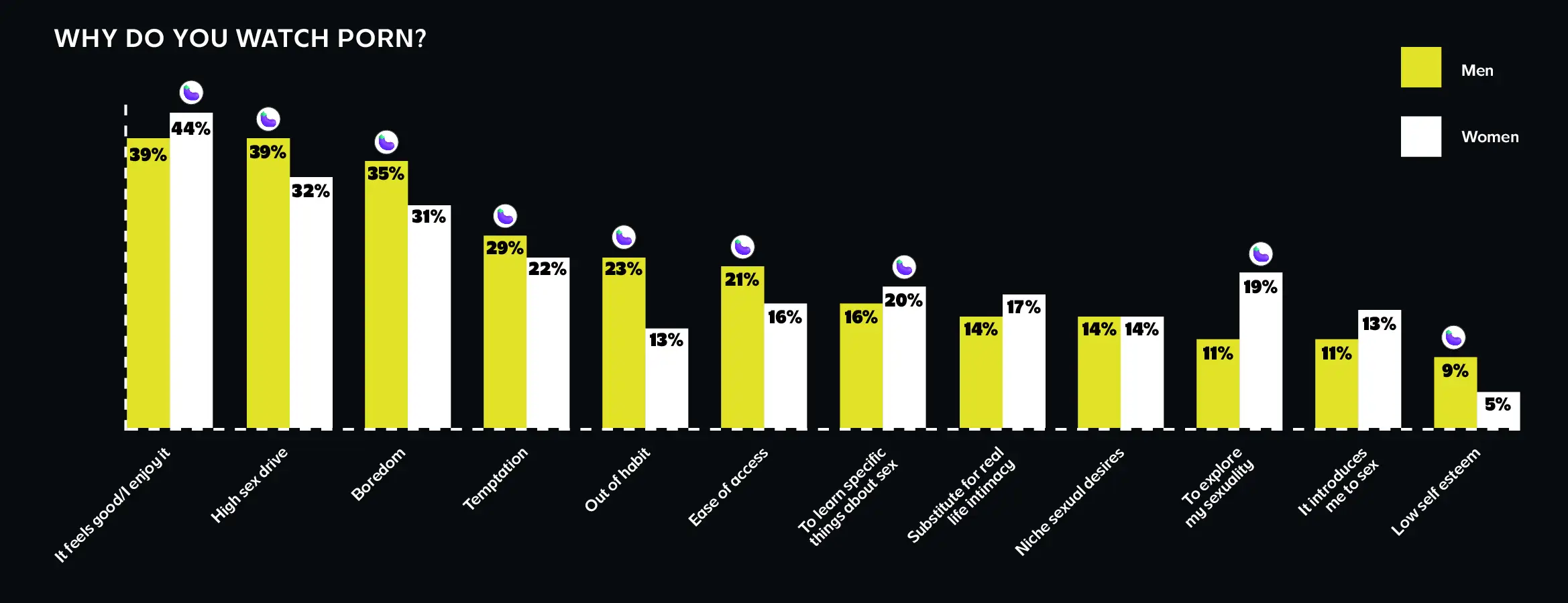
As for after watching porn, women were more likely to report feeling positive, citing feelings like satisfaction, energisation and excitement. While men were more likely to pick out negative feelings like guilt, shame and numbness.
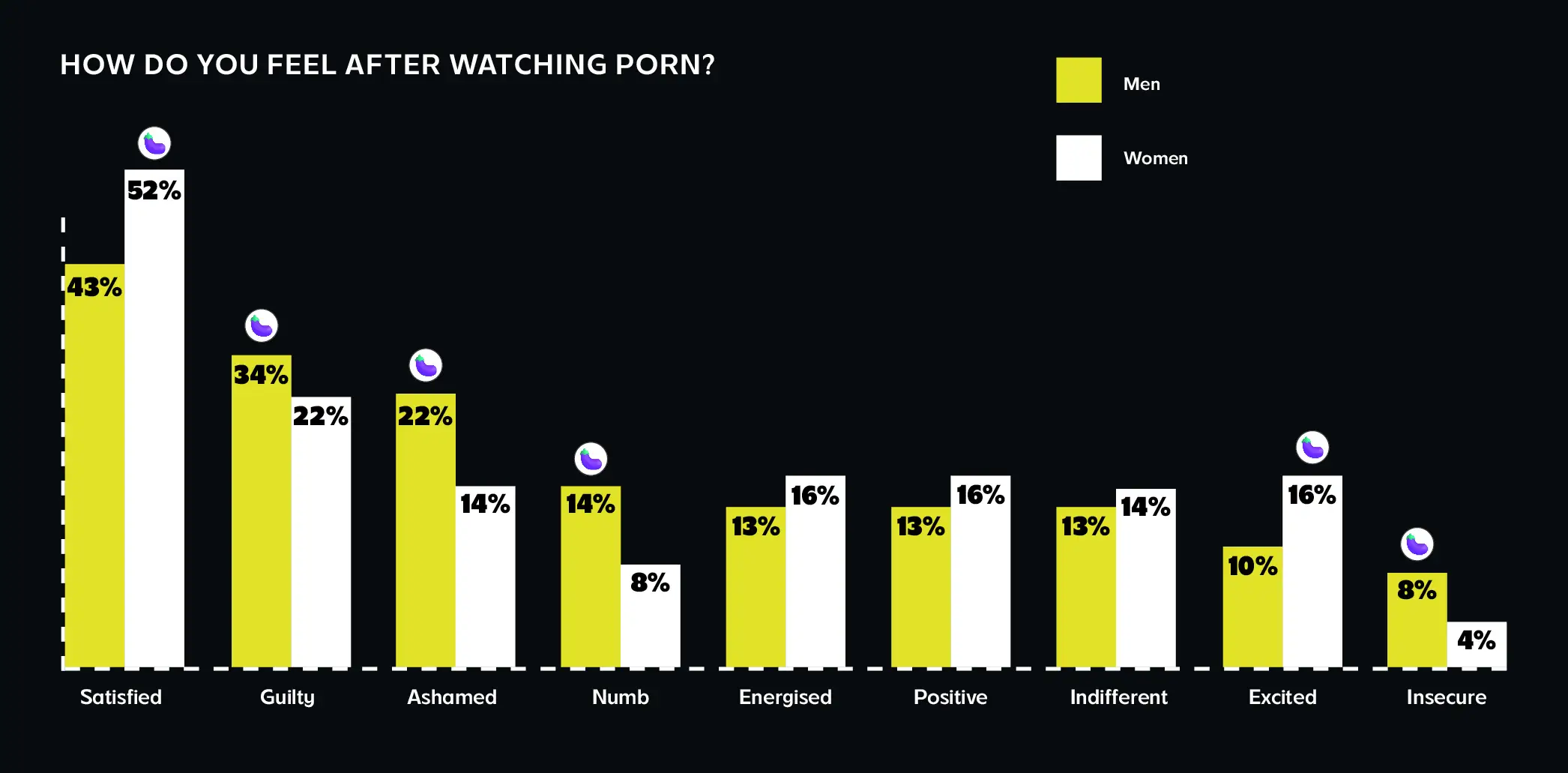
Porn has an impact away from our screens, and when it comes down to interest in sex and performance in bed, men were way more likely to say that porn had impacted them negatively:
34% of respondents said they had suffered increased sexual dysfunction (difficulty maintaining an erection, delayed ejaculation or inability to reach orgasm) after watching porn:
- 37% of men
- 28% of women
- 54% of daily viewers
32% said that interest in real-life sex has decreased since consuming porn:
- 37% of men
- 25% of women
- 49%of daily viewers
And men were again more likely to have concerns around their porn intake. 54% of men worry they watch too much porn (33% of women do), and 49% of men worry they struggle to quit porn or reduced intake (33% of women).
Men were also more likely to find that porn had impacted their mental health and sense of well-being: 52% of men said it had impacted their self-esteem (compared to 41% of women), while 45% of men said it contributed to symptoms of anxiety or depression ( 32% of women).
What’s causing men to feel so much worse about porn?
We do know that men are more likely to be daily viewers (24% to 11%) and more likely to have started watching porn at a young age (71% to 50%).
Dr Hall, who says 90% of her service users are male, explains that men watch porn more than women and they 'feel more shame around the amount of time they're spending on it or watching types of porn they're not happy with'.
"If this porn is misogynistic and violent, and most of them watching are nice guys, they’re likely to feel more shame about it."
When asked questions that didn’t even bring up dependency, some men said porn had really messed with them, saying things like: "It is only with being distanced from porn is when you realise it's damaged your brain," and: "It’s made my life hell and it seems disgusting."
One even warned: "Trying to imitate sex scenes with your partner in real life ruins relationships. I speak from experience."
Addiction is also a real concern amongst some men.
"It's not the porn per se that they have a problem with," says Dr Hall: "It's the fact that they know they're quite dependent. Watching porn can be an effective way of managing difficult emotions, but as you increase in dependency, it creates them.
"Let’s say you felt depressed because you're away at university and you're away from your family. So you lock yourself in on your own, leave the party early, turn up to a seminar late, so you can watch loads of porn.
"That increases your sense of isolation and depression, and then you need to escape from it even more. The problem is with the cycle that people get trapped in."
For Dunne, it’s that porn promises a release it doesn’t always deliver on: "There isn't much joy in the world for young men. The only activities really that they can do for cheap are the gym, which brings up a whole load of other issues around ripped bodies, gaming, or watching porn."
"A lot of boys I speak to say they want something in their spare time that gives them pleasure, but they realise afterwards that they feel a little bit empty," he added.
Ultimately, porn is everywhere
No matter what we think about it, porn is seen as an acceptable go-to for self-pleasure. And the obvious problem isn’t that porn exists, but that we’ve been given a window to a wild west of supposed sex without enough conversation around to set our expectations right and give a clearer idea of what real sex and pleasure look and feel like.
Some people told us their way of dealing with porn’s unreality is to search for more authentic-looking content.
Amateur porn is one of men’s top choices; as one guy told us: "I tend to watch leaks because they’re real."
For women, the top choice was 'romantic/softcore', with one telling us: "It doesn't involve any violence e.g choking or slapping."
Some guys were very insistent that it’s not that deep, though.
One said: "I never used it to learn or educate, as I know it's very unrealistic," and another said: "I always knew that porn was kind of fake and not truly real so I didn’t let it dictate how I have sex with my partner."
Dunne is also a therapist who’s spent 20 years working in sex education, and says these men’s attitudes could reflect society’s pressure for boys to be sex experts: "They almost think they know it all now, because they've seen it online, and that's the expectation on them as young men."
"They have to be the ones in control, they have to show a strong masculinity, but what that masculinity looks like has been skewed again by what they're seeing and consuming," he added.
Dr Hall points out that for some young men, porn seems like a better alternative to having real life sex, including parts of sex that carry expectations set up by…porn.
"You haven’t got to chat first, you haven’t got to ask for consent, so porn’s a lot more straightforward, especially when there’s an expectation in dating and sex that guys will take the lead."
It seems that, for those who can truly tell that porn’s not real, that men don’t have to be tough bosses and women don’t have to be moaning submissives, porn isn’t so much of a problem.
How we got here
The only way to tell that porn isn’t real, is to know what real sex actually is. That would mean proper sex education, but it’s taken far too long for the UK to deliver that.
Way back in 2000, before many of us were even born, online porn got its first namecheck in Parliament. Baroness Thornton told the House of Lords: “Porn sites and the web pages [are] depicting violent or racist images,” that are 'grossly offensive' and 'highly unsuitable for children'.
Yet it was only 19 years later that England and Wales got statutory sex and relationships education. Technically, every schoolchild should be learning about sex and relationships - including porn - in an age-appropriate way.
But there are major issues concerning access to decent sex ed, Dunne says: "Teachers are doing an amazing job, but some might have as little as an hour’s training, when it’s meant to be a specialist subject."
He adds that the cut off for sex education comes too soon: "Mandatory sex education stops at 16, which is the age the majority of young people are starting to have sex."
There could be a drop off in people accessing porn, sure - while 51% of respondents reckon the Online Safety Act’s restrictions on porn access won’t be effective, some said it has led to a welcome reduction in their own porn use.
Regardless of the ban, though, an entire generation has already been raised on porn. Our report shows it as clear as day - we’ve been watching porn for a long time, from a young age, and that’s set in stone some massive expectations around sex that just don’t fit with reality or help us encounter it.
As some respondents put it: "I found myself not knowing how sex should really work," and: "Watching porn people think it's so perfect and easy, but in real life it takes a lot."
So, what next?
The solution is clear. While some of us - mainly men - want porn to be banned entirely, the majority of us - 79% - want it to be more educational and realistic, with plenty saying that consent, different body types and more intimacy should be prioritised over depictions of long-lasting rough sex.
Dr Hall says it’s vital that any effort to solve our issues with porn isn’t fear-driven: “There’s got to be education about pornography, but it's got to not be scaremongering. It's got to become part of a standard part of the curriculum, because porn is here to stay.”
Dunne agrees: “We can't out-shout porn and we can't we can't get rid of porn. It's not going to happen, but we can try and educate”.
LADbible’s For F*ck Sake report is full of so much interesting insight into porn and sex, but what it’s really meant to springboard is a campaign to change things, to make porn, education and conversations about it a better way for you to learn about sex.
Words by Sophie Wilkinson
Topics: Sex and Relationships, PornHub, Mental Health
 The LADbible Team