
NASA releases new images of 'potentially hostile alien threat' 3I/ATLAS after 'heartbeat' detected

NASA has published new pictures of 3I/ATLAS after a ‘heartbeat’ was detected from the ‘comet’, leaving scientists baffled.
This planetary rock has been causing a lot of confusion since it was first spotted in space.
The space object, which NASA confirmed to be a comet, has been seen displaying bizarre behaviours.
For example, it didn’t have a tail for the longest time, which is something required of a comet.
Advert
It also began to change its trajectory, seemed to slow its speed, move in strange ways, and now, has a ‘heartbeat’.
All in all, it’s throwing scientists off, with one believing it’s actually an alien ship.
According to a Harvard astrophysicist, 3I/ATLAS has been seen dimming itself before brightening, like a pulse.
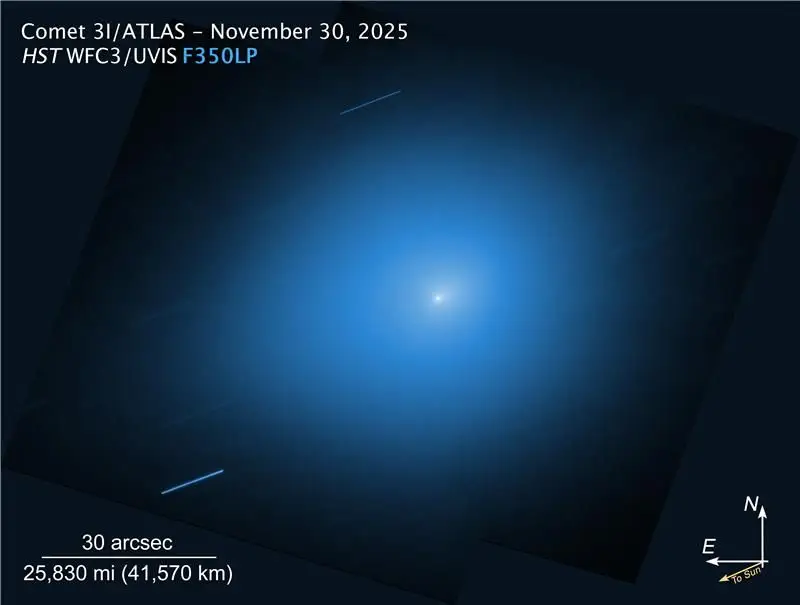
The new images come ahead of its planned close encounter with Earth on 19 December, which was captured by the Hubble Space Telescope at about 178 million miles away on 30 November.
The image shows the comet as nothing more than a white dot, which gets closer as it moves nearer to the Sun.
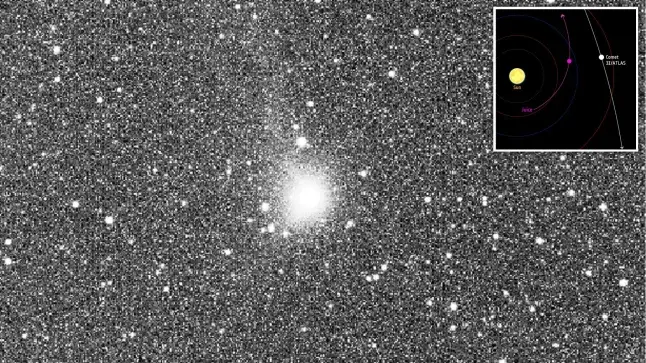
The European Space Agency’s (ESA) snaps are also pretty cool and were able to occur when the Jupiter Icy Moons Explorer (Juice) orbiter was 41 million miles away from the strange rock on 2 November.
The ESA explained what can be seen in the snaps, per Metro. Apparently, it might even have two tails at this time. The agency stated: “Not only do we clearly see the glowing halo of gas surrounding the comet known as its coma, but we also see a hint of two tails.
“The comet’s ‘plasma tail'– made up of electrically charged gas, stretches out towards the top of the frame.”
The ESA went on to say the second tail could be a ‘dust tail’, which is ‘made up of tiny solid particles’.
So, while it was seen without a tail for a long time, now it has two? Greedy.
Anyway, this heartbeat business has been causing a ruckus online, with Harvard astrophysicist Dr Avi Loeb claiming that the comet has jets coming from it at intervals of 16.16 hours.
This, he says, could signal that it is an alien craft manoeuvring around space, and not simply a comet.
But what’s causing it?
Per Dr Matthew Genge, a micrometeorite and cosmic dust specialist at Imperial College London, told the Metro that ‘there’s a periodic brightening of the comet...that’s actually nothing particularly unusual’.
He went on to say that if it really is a heartbeat, ‘then those aliens are really, really, super chill, because that’s incredibly slow'.
The reason for the pulsing could be due to ice on its surface, which turns into gas at a low temperature and then heats up as the comet rotates into the sunlight.
 Britt Jones