ladbible homepage
ladbible homepage
  • iconNews
  • videos
  • entertainment
  • Home
  • News
    • UK
    • US
    • World
    • Ireland
    • Australia
    • Science
    • Crime
    • Weather
  • Entertainment
    • Celebrity
    • TV
    • Film
    • Music
    • Gaming
    • Netflix
    • Disney
  • Sport
  • Technology
  • Travel
  • Lifestyle
  • Money
  • Originals
    • FFS PRODUCTIONS
    • Say Maaate to a Mate
    • Daily Ladness
    • UOKM8?
    • FreeToBe
    • Citizen Reef
  • Advertise
  • Terms
  • Privacy & Cookies
  • License Our Content
  • About Us & Contact
  • Jobs
  • Latest
  • Archive
  • Topics A-Z
  • Authors
Facebook
Instagram
X
Threads
Snapchat
TikTok
YouTube
Submit Your Content Here
  • SPORTbible
  • Tyla
  • GAMINGbible
  • LADbible Group
  • UNILAD
  • FOODbible
  • UNILAD Tech
NASA could find tiny aliens hidden under Mars’ surface as scientist says ‘we should be looking there’

Home> News> Science

Published 16:49 28 Oct 2024 GMT

NASA could find tiny aliens hidden under Mars’ surface as scientist says ‘we should be looking there’

It's one place we 'should be looking', according to one NASA scientist

Tom Earnshaw

Tom Earnshaw

google discoverFollow us on Google Discover

A new NASA study hints that alien life may be closer to home than we thought.

For decades, Mars has been the subject of scientific study when it comes to finding extraterrestrials.

It's also been the focus for many in Hollywood, with countless TV shows and films produced hypothesising the existence of other life forms on the planet closest to Earth.

Putting Mars Attacks! and Pierce Brosnan's head on a dog's body aside, though, and it seems like we're heading back in a direction where little green men could be a real thing.

Advert

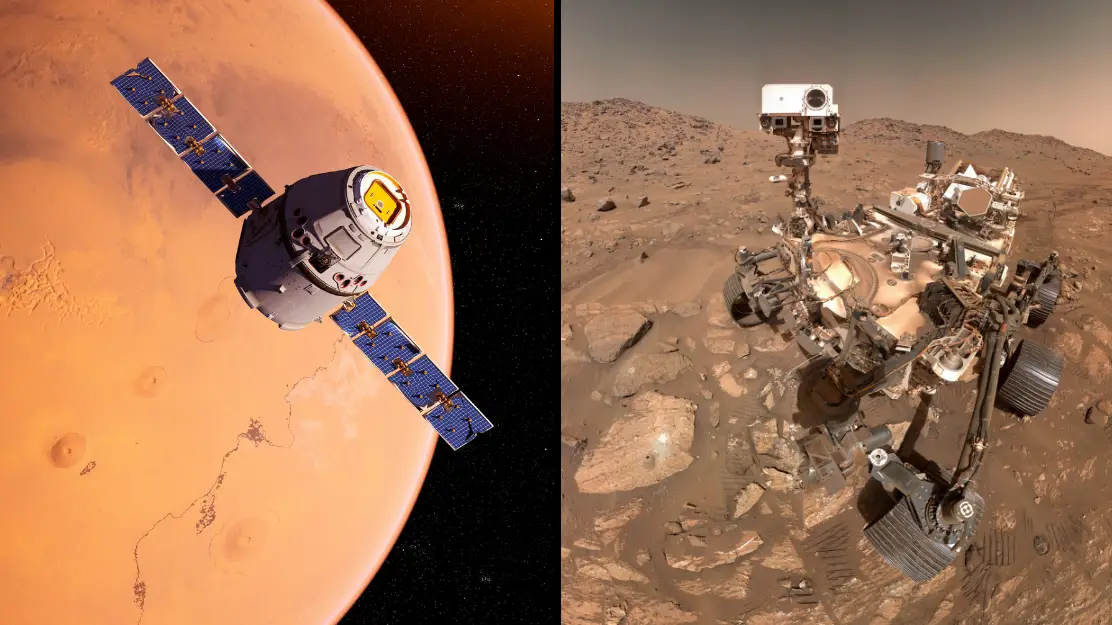
NASA’s Perseverance Mars rover on the Red Planet as we speak (NASA/JPL-Caltech/MSSS)

The big difference, in reality, is that they are likely to not be green, and will in fact be very, very small.

A new study by the Jet Propulsion Laboratory (JPL) at NASA has looked in to whether we should be once again actively investigating if there is life on Mars.

And according to the paper’s lead author, Aditya Khuller, the answer is 100 percent yes. Just not on its surface.

He says: "If we’re trying to find life anywhere in the universe today, Martian ice exposures are probably one of the most accessible places we should be looking."

Mars has for some time known to be home to water, and ot's believed to once have been full of the stuff.

On the planet, it manifests itself in to ice, of which there are two kinds: frozen water and frozen carbon dioxide.

The white edges here are thought to be home to dusty frozen ice, which could unlock the secrets of life elsewhere in the universe (NASA/JPL-Caltech/University of ArizonaFull)

For their paper, published in Nature Communications Earth & Environment, Khuller and colleagues looked at water ice, large amounts of which formed from snow mixed with dust that fell on the surface during a series of Martian ice ages in the past million years.

That ancient snow has since solidified into ice, still peppered with specks of dust - dust that is dark in colour and can absorb more sunlight.

The theory here is that this could potentially warm up the ice, causing it to melt up to a few feet below the surface.

From that, ancient life in the form of microbes could be surviving, and maybe even thriving, under the frozen water ice on Mars' surface, where photosynthesis could be happening.

Pools of water similar to those that could be on Mars exist on Earth and are full of life, from fungi to algae and microscopic cyanobacteria.

Maybe Bowie was right after all (Getty Stock Images)

The concept of whether ice can actually melt on the Martian surface remains up for debate, due to a terrible thin and dry atmosphere that is not like Earth's.

But, critically, the atmospheric effects that make melting difficult on the Martian surface wouldn’t apply below the surface of a dusty snowpack or glacier.

Co-author Phil Christensen, of Arizona State University in Tempe, said that ice melting from within is 'a common phenomenon on Earth'.

He said: "Dense snow and ice can melt from the inside out, letting in sunlight that warms it like a greenhouse, rather than melting from the top down."

The team now hope to re-create the dusty ice from Mars in a lab to study it under similar conditions to what you would find up on the Red Planet.

Featured Image Credit: Getty Stock Images / NASA / JPL-Caltech / MSSS

Topics: Aliens, NASA, Space, Weird, Science, World News

Tom Earnshaw
Tom Earnshaw

Tom joined LADbible Group in 2024, currently working as SEO Lead across all brands including LADbible, UNILAD, SPORTbible, Tyla, UNILAD Tech, and GAMINGbible. He moved to the company from Reach plc where he enjoyed spells as a content editor and senior reporter for one of the country's most-read local news brands, LancsLive. When he's not in work, Tom spends his adult life as a suffering Manchester United supporter after a childhood filled with trebles and Premier League titles. You can't have it all forever, I suppose.

X

@TREarnshaw

Recommended reads

Man drinks alcohol and lifts weight for 90 days straight to see how bad it actually is(YouTube/@Clawhammer Supply)How much a pint costs at the 2026 Grand National, get your overdraft readyCarl De Souza/GettyNASA 'anxious' as Artemis crew approach fireball return reaching 23,839 mph speeds(NASA via Getty Images)Extreme physical changes to Artemis II crew's body after 10 days in spaceNASA via Getty Images

Advert

Choose your content:

9 hours ago
10 hours ago
11 hours ago
  • Carl De Souza/Getty
    9 hours ago

    How much a pint costs at the 2026 Grand National, get your overdraft ready

    There will be plenty of sore heads on Sunday morning

    News
  • (NASA via Getty Images)
    10 hours ago

    NASA 'anxious' as Artemis crew approach fireball return reaching 23,839 mph speeds

    The crew's return to Earth is considered the 'most dangerous' part of the journey

    News
  • NASA via Getty Images
    10 hours ago

    Extreme physical changes to Artemis II crew's body after 10 days in space

    They're set to be welcomed back to Earth this evening

    News
  • (KENNEDY)
    11 hours ago

    Signs of throat cancer as man's diagnosis linked to oral sex decades ago

    Health experts have linked an increased risk of throat cancer to oral sex

    News
  • NASA scientist makes bold claim about why aliens haven’t contacted us yet
  • Big question asked as NASA releases ‘stunning’ image of Moon from Artemis II crew
  • People have huge question as NASA release 'spectacular' image of Earth from Artemis II crew
  • NASA admits no plan B to avert disaster as Artemis II enters most dangerous part of mission