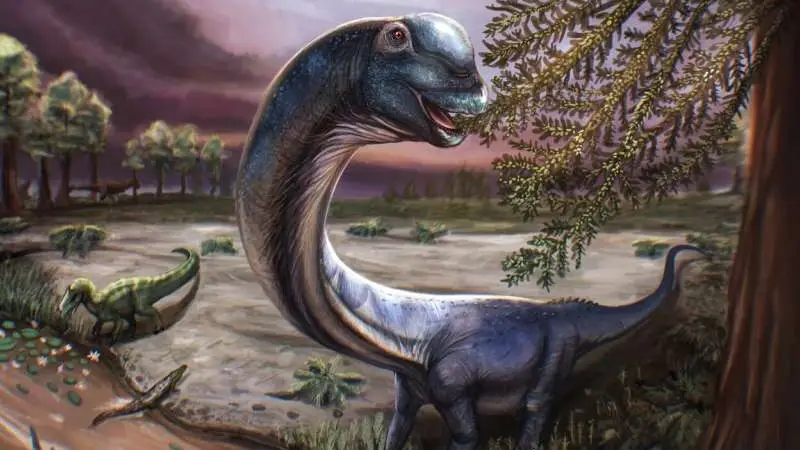
New 'Titan' dinosaur discovery is twice the size of T Rex and might be the last one ever found

Our obliterated jurassic predecessors just keep throwing up surprises for the world's scientists.
Per a new entry in Scientific Reports, it's been revealed that a team of researchers cobbled together from across University College London, Mahasarakham University, Suranaree University of Technology, and Thailand's Sirindhorn Museum have discovered another herbivore amongst the dinosaurs - the largest ever found in Southeast Asia.
Its bones were sitting at the edge of a pond in Thailand a decade ago, and it's since been named Nagatitan chaiyaphumensis.
'Naga' alludes to a mythological water-dwelling serpent from Asian folklore, while 'Titan' refers to the Greek giants of old.
Advert
Chaiyaphumensis means 'from Chaiyaphum', the Thai province in which the fossils were unearthed.
Incredibly, the scientists involved with the investigation measured the dino at 27 metres long, weighing in at around 27 tonnes. This is the equivalent of nine Asian elephants.
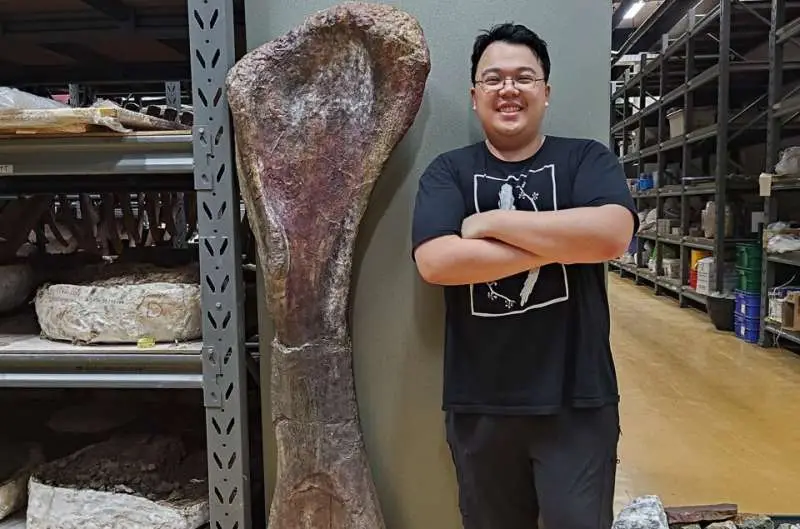
Discussing this historic discovery, UCL Earth Sciences student and lead author of the report, Thitiwoot Sethapanichsakul, said in a statement: "Our dinosaur is big by most people's standards – it likely weighed at least 10 tonnes more than Dippy the Diplodocus (Diplodocus carnegii). However, it is still dwarfed by sauropods like Patagotitan (60 tonnes) or Ruyangosaurus (50 tonnes).
"We refer to Nagatitan as 'the last titan' of Thailand. That is because it was discovered in Thailand's youngest dinosaur-bearing rock formation. Younger rocks laid down towards the end of the time of the dinosaurs are unlikely to contain dinosaur remains because the region by then had become a shallow sea. So this may be the last or most recent large sauropod we will find in Southeast Asia."
Nagatitan belongs to the sauropod family, which were enormously long-necked and long-tailed plant-munchers.
A lifesize reconstruction of the dino is now on display to enjoy at the Thainosaur Museum at Asiatique in Bangkok.
Sethapanichsakul went on to add: "My dream is to continue pushing to get Southeast Asian dinosaurs recognized internationally. More international collaborations between Thailand and other institutions like UCL can further our understanding of the region's paleobiology and apply it to a global context.
"This all starts with identifying and describing the specimens we have found first. We have a large collection of sauropod fossils that have not yet been formally described—these may include a number of new species. I've always been a dinosaur kid. This study doesn't just establish a new species but also fulfils a childhood promise of naming a dinosaur."
 Dan Seddon