ladbible homepage
ladbible homepage
  • Home
  • News
    • UK
    • US
    • World
    • Ireland
    • Australia
    • Science
    • Crime
    • Weather
  • Entertainment
    • Celebrity
    • TV
    • Film
    • Music
    • Gaming
    • Netflix
    • Disney
  • Sport
  • Technology
  • Travel
  • Lifestyle
  • Money
  • Originals
    • FFS PRODUCTIONS
    • Say Maaate to a Mate
    • Daily Ladness
    • UOKM8?
    • FreeToBe
    • Citizen Reef
  • Advertise
  • Terms
  • Privacy & Cookies
  • License Our Content
  • About Us & Contact
  • Jobs
  • Latest
  • Archive
  • Topics A-Z
  • Authors
Facebook
Instagram
X
Threads
Snapchat
TikTok
YouTube
Submit Your Content Here
  • SPORTbible
  • Tyla
  • GAMINGbible
  • LADbible Group
  • UNILAD
  • FOODbible
  • UNILAD Tech
Incredible timelapse shows the Sun's strongest solar flare in a decade
Home>News>Science
Published 20:19 15 May 2024 GMT+1

Incredible timelapse shows the Sun's strongest solar flare in a decade

NASA captured the mega flare

Jess Battison

Jess Battison

google discoverFollow us on Google Discover

An incredible timelapse shows the Sun’s strongest solar flare in a decade.

Following on from last week’s ‘severe’ solar storm, National Oceanic and Atmospheric Administration (NOAA) revealed the Sun had emitted it yesterday (14 May)

As described by NASA, a solar flare is a powerful burst of energy.

Essentially, it’s a sudden eruption of brightness from its surface and when the Sun’s very active there will be several flares each day.

Advert
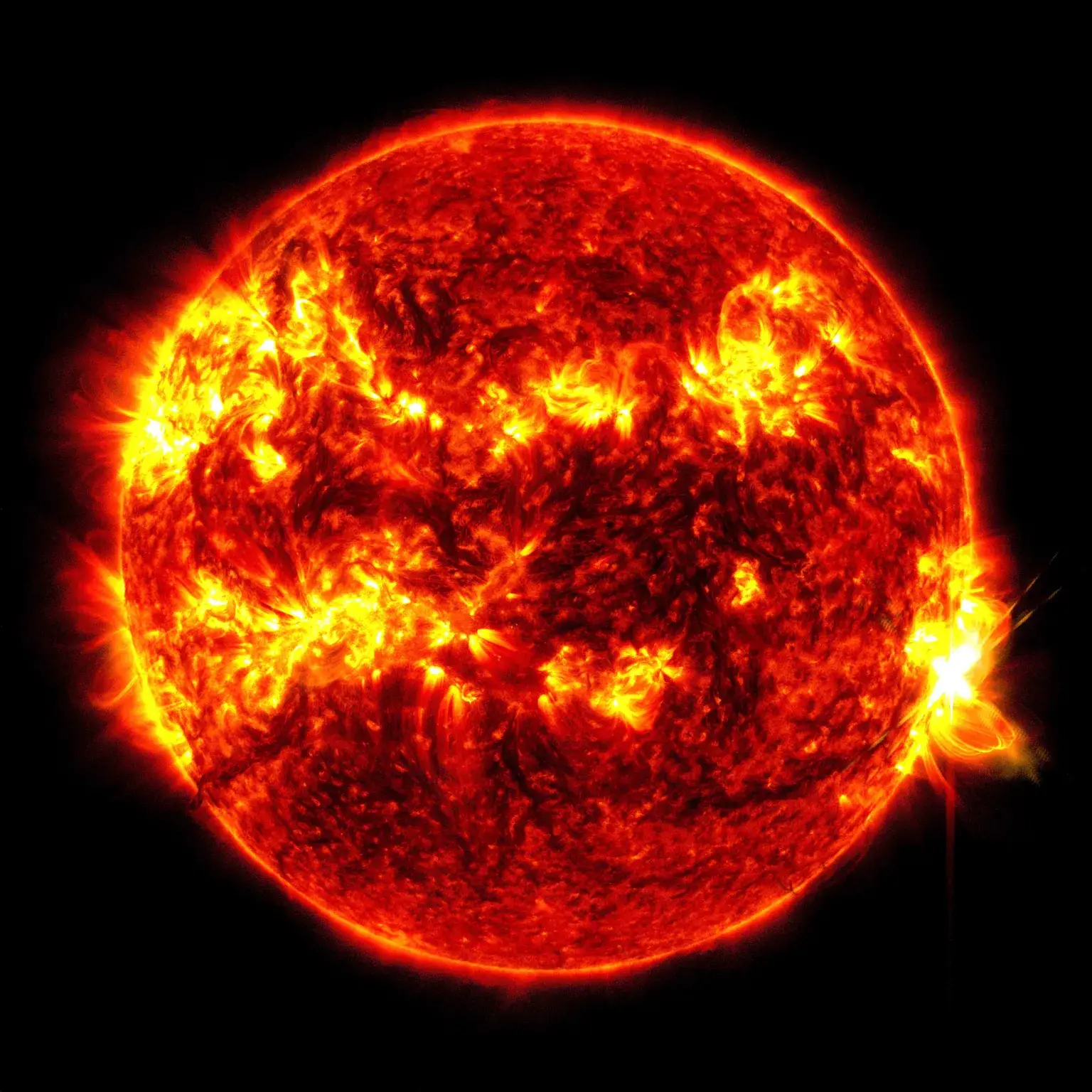
NASA’s Solar Dynamics Observatory caught this of the flare.(NASA/SDO)

But this big one yesterday has been classified as an X8.7 flare, making it the biggest event in the Sun’s current 11-year solar cycle.

The X-class denotes ‘the most intense flares’ and then the number provides further information about its strength.

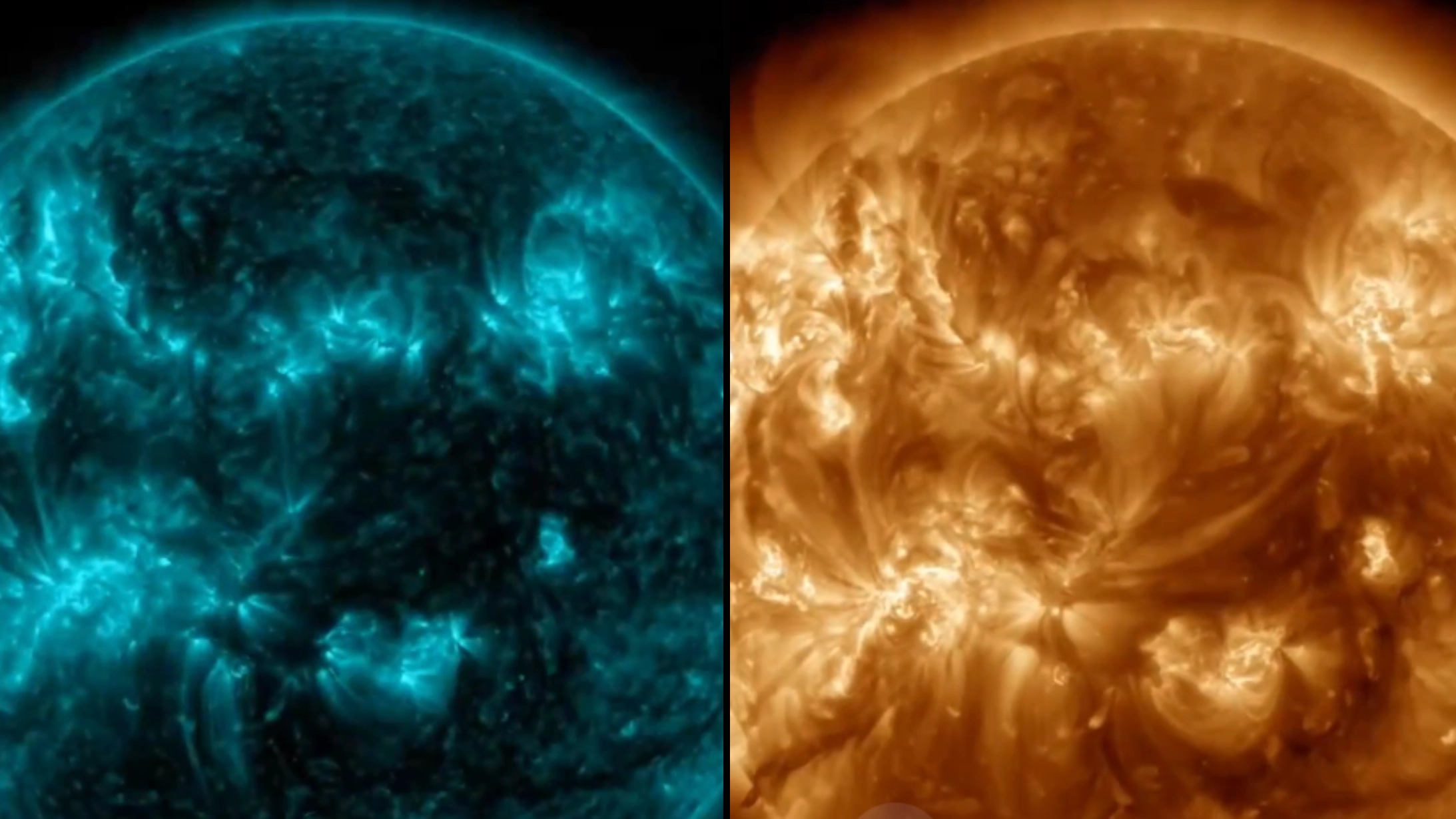
And incredible footage shared by NASA Sun and Space shows a ‘multi-wavelength look’ at the powerful burst of radiation yesterday.

While the solar flares see these ‘bursts of radiation’, the US space agency does add: “Harmful radiation from a flare cannot pass through Earth’s atmosphere to physically affect humans on the ground. However — when intense enough — they can disturb the atmosphere in the layer where GPS & communications signals travel.”

Flares and solar eruptions like this can have an impact on radio communications, electric power grids, navigation signals as well as posing risk to space crafts and astronauts.
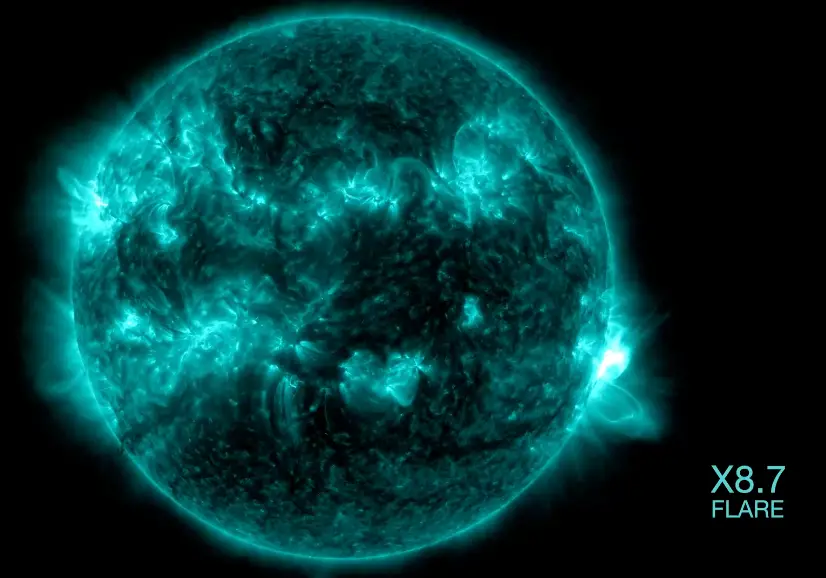
Footage shows the flare. (NASA Sun & Space)

And as well as all of that, solar flares can produce incredible light shows in the sky – auroras.

Of course, last week’s big solar activity had Brits flooding social media with photos as the Northern Lights were visible across the UK on Friday (10 May).

The ‘severe’ solar storm combined with the clear skies meant people across the country were spotting the incredible spectacle over the entire weekend.

However, as yesterday’s huge flare happened in a direction away from Earth, it’s unlikely we’d get to see the Northern Lights again because of it. I mean, once in a week is good enough for us.

Jim Wild, Professor of Space Physics at Lancaster University, told Metro: "Solar flares are unlikely to trigger displays of the Northern Lights.

"The aurora seen last weekend were caused by eruptions of solar material called coronal mass ejections impacting the Earth’s magnetic field.

"Flares and coronal mass ejections often happen at the same time, but yesterday’s flare didn’t launch any coronal mass ejections towards Earth."

Following yesterday’s whopper of a flare, the Sun also emitted a X2.9 flare at 3:38pm UK time today.

Featured Image Credit: X/@NASAGoddard

Topics: Science, Space, NASA

Jess Battison
Jess Battison

Jess is a Senior Journalist with a love of all things pop culture. With a specialism in entertainment, she's covered the updates live at major events from The Brits in London to Disney's D23 in California. Jess covers the latest breaking news stories across the UK and the globe as well as interviewing your favourite faces including the likes of Dwayne Johnson, Stephen Graham, Aubrey Plaza and Chris Hemsworth. She graduated with a first in Journalism from City, University of London in 2021.

X

@jessbattison_

Recommended reads

Gina Carano lost million-dollar Star Wars deal over one social media postPatrick T. Fallon / AFP via Getty ImagesNew study finds weight loss jabs could halve the number of sick days people take off workGetty Stock PhotoHayden Panettiere says she was 'groomed' as she opens up on dark side of growing up in HollywoodJon Kopaloff/Getty Images'Super El Nino' wiped out nearly all life in event worse than dinosaur apocalypseX/@forallcurious

Advert

Choose your content:

8 hours ago
9 hours ago
11 hours ago
12 hours ago
  • Getty Stock Photo
    8 hours ago

    New study finds weight loss jabs could halve the number of sick days people take off work

    A new study says it could free up millions of GP appointments too

    News
  • X/@forallcurious
    9 hours ago

    'Super El Nino' wiped out nearly all life in event worse than dinosaur apocalypse

    An 'El Nino' is a devastating weather phenomenon

    News
  • Mohamad Salaheldin Abdelg Alsayed/Anadolu via Getty Images
    11 hours ago

    Huge update on two orcas 'left for dead' in abandoned marine park

    The mother and son orcas might be able to be saved

    News
  • Getty Stock
    12 hours ago

    Common supplement could prolong your life by slowing down biological clock

    A new study examined the impact of the supplements over a two year period

    News
  • Incredible animation shows the moment extremely rare black hole rips apart star in explosion
  • NASA's Voyager 1 has just found a 50,000 Celsius 'wall of fire' at the edge of the solar system
  • Astronomers have just discovered 'incredible' new body in the solar system that could challenge major space theory
  • Scientists think they've worked out what unknown interstellar object in our solar system is