
SpaceX making major change to thousands of satellites amid growing fears of Kessler syndrome

Elon Musk's space firm has announced plans to make a major change to thousands of its Starlink satellites, in a desperate bid to improve space safety.
SpaceX currently has around 9,400 satellites in low Earth orbit, which are used to provide broadband internet all over the world, including many otherwise hard to reach locations.
However, the revolutionary technology has prompted a number of growing safety concerns, including contributing to the terrifying possibility of the Kessler syndrome theory.
Now, vice president of Starlink engineering at SpaceX, Michael Nicolls, has announced plans to lower nearly half of the satellites over the course of this year, from an altitude of around 550 kilometres to around 480 kilometres.
Advert
He shared the plans on social media, revealing the 'significant reconfiguration' of the constellation would 'increase space safety in a number of ways.'
Increasing space safety
Nicolls explained that atmospheric density decreases as solar minimum approaches, meaning the ballistic decay — the natural process where objects de-orbit and re-enter Earth's atmosphere — increases at any given altitude.
Therefore, spacecrafts will take less time to deorbit through atmospheric drag at lower altitudes, if they are unable to actively deorbit, particularly as solar minimum — a period of lowest activity in the Sun's roughly 11-year solar cycle — approaches.
Another benefit, which links back to growing fears around the Kessler syndrome theory, is a reduction in congestion.
According to Nicolls, 'the number of debris objects and planned satellite constellations is significantly lower below 500 km, reducing the aggregate likelihood of collision.'
What is the Kessler syndrome theory?
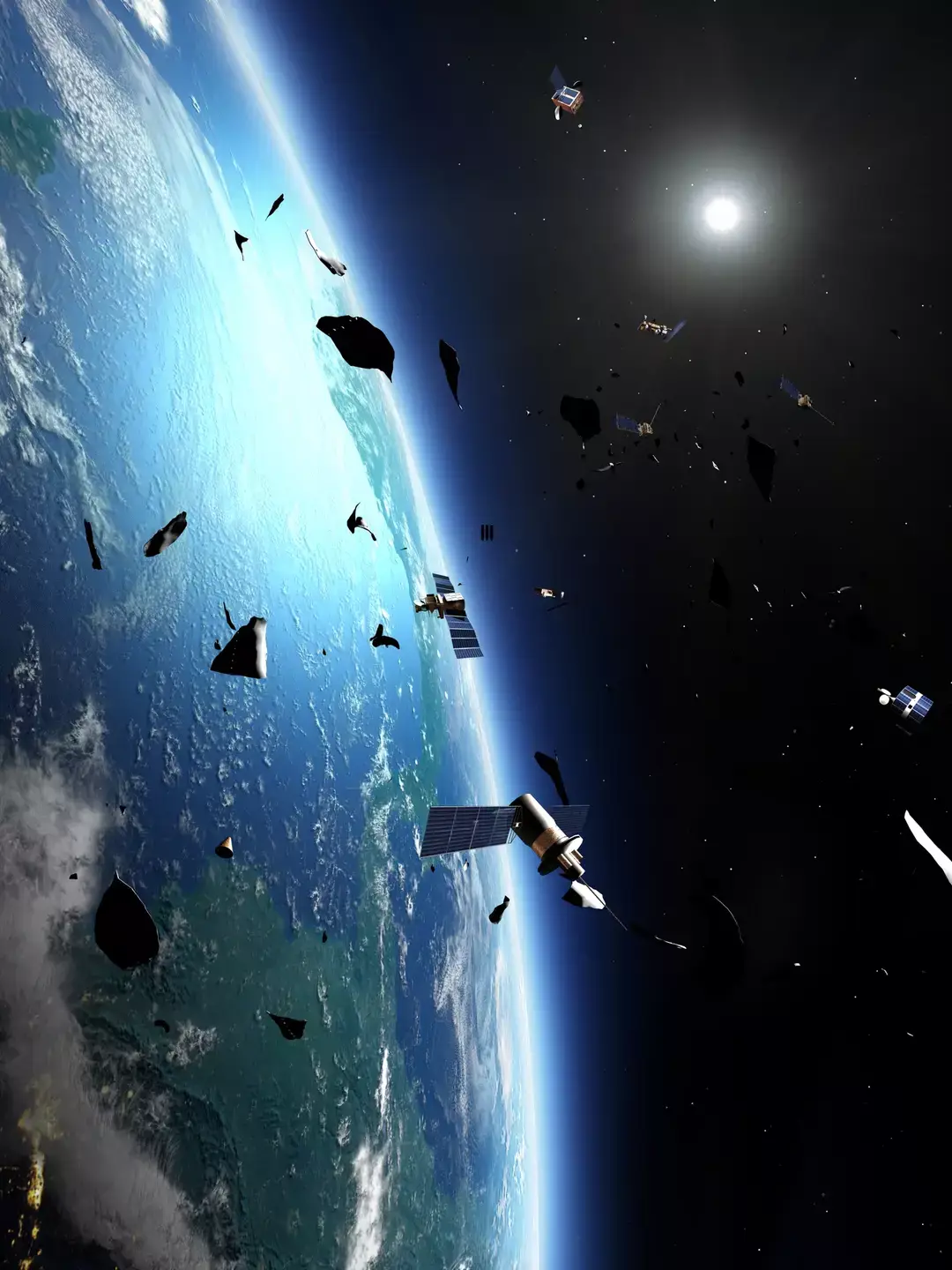
The Kessler syndrome theory was thought up by NASA scientists Donald Kessler and Burton Cour-Palais back in 1978, and follows the idea that objects orbiting Earth in close proximity to the planet will become so crowded that a chain reaction of collisions could begin.
And from there, it might not stop, destroying satellites essential to maintaining humanity as we know it - from crop production and internet connections to international travel and phone calls.
In the worst-case scenario, the area of space described as low Earth orbit will then become uninhabitable by new satellites due to the rings of debris whizzing around the planet.
"Spent rockets, satellites and other space trash have accumulated in orbit increasing the likelihood of collision with other debris," NASA has explained.
Recent Starlink safety concerns
Starlink's announcement comes after a number of safety concerns were raised when satellites began plummeting back towards Earth at an alarming rate, with as many as four devices deorbiting every single day, according to space trackers.
With Musk previously announcing plans to increase the number of satellites to 40,000, fears of overcrowding in low Earth orbit became significantly more real.
Last month, one particular Starlink device experienced an unspecified in-orbit anomaly, causing causing venting from a propellant tank and 'the release of a small number of trackable low-relative-velocity objects.'
Topics: Elon Musk, Science, Space, SpaceX, Technology, World News
 Emma Rosemurgey