
Christa Pike takes first steps after botched execution as lawyers reveal major health update

Christa Pike’s legal team have said she is ‘walking with assistance’ for the first time since her failed execution attempt.
Pike, 50, survived two doses of pentobarbital as Tennessee officials attempted to put her to death on 30 September.
She was then rushed to hospital, where her legal team said she was given immediate ‘life-saving’ care.
On 7 October, her lawyers confirmed that ‘against all odds’, Pike was ‘conscious, speaking, and continues to receive critical medical care’.
Advert
The statement said: "Despite the severe damage she endured to her arms, she is still handcuffed and shackled to the bed. Her recovery is medically unprecedented. Her prognosis remains unclear but, at a minimum, we expect a long recovery."
In a fresh update on her condition shared this evening, Pike’s legal team, made up of Randy Spivey and Kelly Gleason from the TN Office of the Post Conviction Defender, and Stephen Ferrell and Luke Ihnen from Federal Defender Services of Eastern Tennessee, said she was now able to walk and is ‘regaining movement’.

“The turnaround in Christa Pike’s health in the last three days has been profound and a credit to the medical team caring for her. She woke up from unconsciousness Tuesday morning (6 October) and began taking limited steps Wednesday afternoon (7 October),” the statement reads.
“Today, she is walking with some assistance, and her arms—which sustained significant injuries during the execution attempt—are healing and regaining movement and strength. Her lungs are clear, and she has started to eat a regular diet. Physicians are encouraged by her physical recovery.”
The statement went on to say that while her physical recovery had been ‘remarkable’ there were still ‘significant questions about the long-term effects of what she endured’.
The statement continued: “
Christa is dealing with the profound psychological trauma of having survived a failed execution, including the terror, pain and uncertainty of believing she was about to die. We cannot yet know the full emotional and psychological toll of that experience or how long it will take her to begin to heal.
“Even as she struggles to process what has happened, she continues to express concern for others, particularly the family of her victim Colleen Slemmer.
“Christa also continues to experience cognitive challenges with concentration and memory. Her physicians have cautioned that it may take months to fully understand whether she sustained lasting cognitive injuries.”
The lawyers concluded their statement by noting that during her time in prison, she had been diagnosed and treated for ‘bipolar disorder and PTSD caused by her upbringing’.
“Christa has endured more than enough. We continue to call on Gov. Lee to commute her death sentence to life in prison without the possibility of parole,” the team said.
“She should never be subjected to another execution attempt.”
Following the incident, the state of Tennessee said it was halting all scheduled executions until an investigation had been carried out.
Why was Christa Pike given the death penalty?
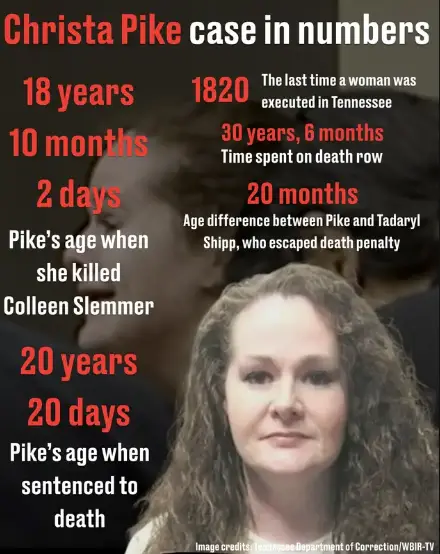
Pike was sent to death row for the murder of 19-year-old Colleen Slemmer in 1995.
On 12 January 1995, an 18-year-old Pike, her then-boyfriend Tadaryl Shipp, and friend Shadolla Peterson lured Slemmer to a secluded woodland in Knoxville.
According to court documents, Pike and Shipp then brutally attacked Slemmer, while Peterson kept watch.

The beating lasted around 30 minutes, and saw them carve a pentagram into Slemmer’s chest, before Pike then killed the 19-year-old by delivering a fatal blow to the head, court documents claimed.
During her incarceration, Pike’s legal team argued that she should not have been given the death penalty due to her age when committing the crime and her troubled background.
Assistant Federal Defender Stephen Ferrell said she was abused as a child and was later diagnosed with bipolar disorder and post traumatic stress disorder.
In her clemency petition, Pike wrote: “I was a mentally ill 18-year-old kid. It took me numerous years to even realise the gravity of what I’d done. Even more to accept how many lives I affected. I took the life of someone’s child, sister, friend. It sickens me now to think I had the ability to commit such a crime.”
Topics: US News, Death Row, Crime, True Crime
 Claire Reid