
ladbible homepage
ladbible homepage
  • Home
  • News
    • UK
    • US
    • World
    • Ireland
    • Australia
    • Science
    • Crime
    • Weather
  • Entertainment
    • Celebrity
    • TV
    • Film
    • Music
    • Gaming
    • Netflix
    • Disney
  • Sport
  • Technology
  • Travel
  • Lifestyle
  • Money
  • Originals
    • FFS PRODUCTIONS
    • Say Maaate to a Mate
    • Daily Ladness
    • UOKM8?
    • FreeToBe
    • Citizen Reef
  • Videos
  • Advertise
  • Terms
  • Privacy & Cookies
  • License Our Content
  • About Us & Contact
  • Jobs
  • Latest
  • Archive
  • Topics A-Z
  • Authors
Facebook
Instagram
X
Threads
Snapchat
TikTok
YouTube
Submit Your Content Here
  • GAMINGbible
  • LADbible Group
  • UNILAD
  • SPORTbible
  • Tyla
  • FOODbible
  • UNILAD Tech
New study supported by World Health Organisation explains link between mobile phones and brain cancer
Home>Lifestyle
Updated 18:07 17 Jul 2026 GMT+1Published 17:40 17 Jul 2026 GMT+1

New study supported by World Health Organisation explains link between mobile phones and brain cancer

The ubiquitous presence of smartphones in our daily lives has led to concerns about

Brenna Cooper

Brenna Cooper

google discoverFollow us on Google Discover

A new study has debunked fears that electromagnetic waves emitted by mobile phones increase a person's risk of developing cancer in the head, neck or brain.

According to a recent study shared by The Conversation, researchers looked into the results of 13 reviews commissioned by the World Health Organisation (WHO) on how electromagnetic waves may impact our health.

The results, published today, suggest there is currently no evidence that walking around while holding a smartphone to your ear increases the likelihood of developing certain cancers.

World Health Organisation commissions 13 reviews into electromagnetic waves and cancer

Back in 2019, the World Health Organisation (WHO) commissioned a series of reviews into whether or not exposure to electromagnetic waves caused health complications as part of its ongoing research into the topic, as part of its International EMF Project.

We're all glued to our smartphones these days, but is there a potential health risk (Getty Stock Images)

Advert

The researchers behind one of the reviews published their findings in the last edition of the New Zealand Medical Journal, with the findings showing no overall increased risk between mobile phone usage and an increased risk of developing head, brain and neck cancers, noting: "If there was an increased risk of brain cancer from mobile phone exposures, increases in the incidence would be expected."

The findings were the same for both adults and children.

The findings mirror guidance currently shared by Cancer Research UK, which notes that there is currently 'no reliable evidence' that mobile phone usage, as well as 4G and 5G mobile networks increase a person's likelihood of developing cancer, concluding: "It doesn't matter how much you use your phone or where you keep it. Large studies have not found a link between mobile phone use and cancer."

Despite concerns, there is no evidence which currently shows a link between mobile phones and cancer (Getty Stock Images)

The findings are the same for Bluetooth-enabled devices and wi-fi networks, which also run on radio waves.

This includes wireless earpods, with Healthline noting there is currently no evidence to suggest that wireless headsets increase a person's risk of developing cancer in the head and neck.

What are radio waves?

A type of electromagnetic radiation, radio waves have the lowest frequencies and longest wavelengths out of anything on the electromagnetic spectrum.

In fact, your mobile emits significantly less radiation than the sun.

At the higher end of the spectrum sit items such as X-rays and sunbeds, which emit higher-energy, ionising radiation, which has been linked with the development of certain cancers.

However, the stuff coming from your phone, as well as the TV, microwave, wi-fi router and radio, is non-ionising radiation, meaning it is unable to alter your DNA.
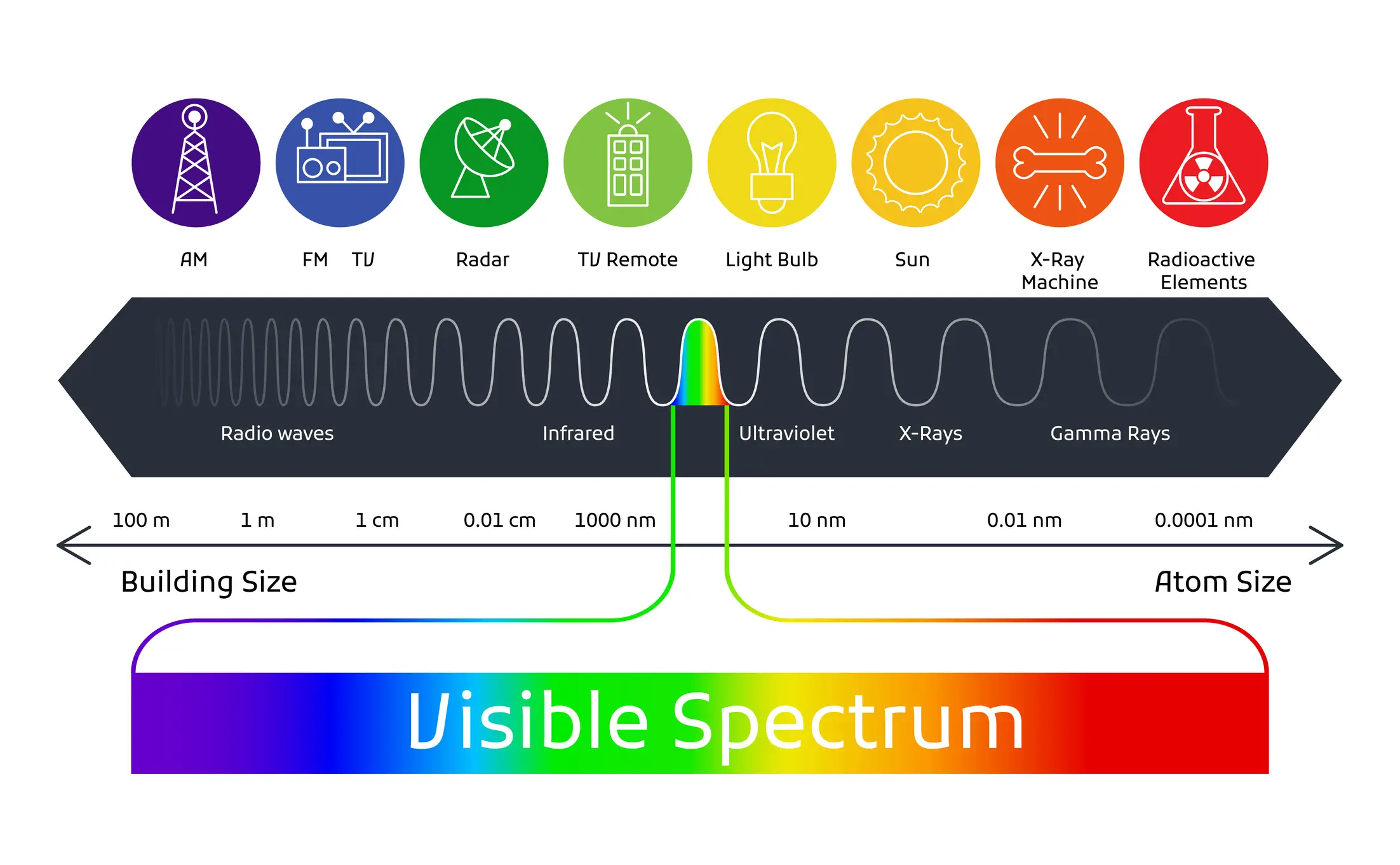
Who remembers learning about the electromagnetic spectrum? (Getty Stock Images)

More research needed

While current findings from researchers suggest no clear risk between radio waves and certain cancers, some of the research cited in the NZ Medical Journal was noted as being 'low' or 'very low' in its confidence.

This is where research didn't demonstrate high enough evidence to rule out the risk completely, with the authors noting that no science can 'prove' a complete absence of risk.

However, not all of the research examined was categorised as 'low', with the studies around mobile phones and brain cancer being given the highest possible rating.

Featured Image Credit: (Getty Stock Images)

Topics: Health, Technology, Cancer

Brenna Cooper
Brenna Cooper

Brenna Cooper is a journalist at LADbible. She graduated from the University of Sheffield with a degree in History, followed by an NCTJ accredited masters in Journalism. She began her career as a freelance writer for Digital Spy, where she wrote about all things TV, film and showbiz. Her favourite topics to cover are music, travel and any bizarre pop culture.

X

@_brencoco

Recommended reads

Doctor explains how to know if you have normal stomach bug or 'exploding Diarrhea' parasite outbreak that is hard to detectGetty Stock ImagesWoman who thought red patch on face was eczema 'freaked out' to discover it was cancerSWNSOnly three UK cinemas are able to show The Odyssey exactly as it should be watchedUniversal PicturesWill Ferrell has famous brother who you’ll have seen in his films without even knowingMonica Schipper/Getty Images

Advert

Choose your content:

10 mins ago
a day ago
2 days ago
  • Getty Stock Images
    10 mins ago

    Doctor explains how to know if you have normal stomach bug or 'exploding Diarrhea' parasite outbreak that is hard to detect

    There's been 1,600 cases of cyclosporiasis since May in the US, with an additional 5,100 cases currently under investigation

    Lifestyle
  • Getty Stock Photo
    a day ago

    One in four heart disease deaths linked to common foods most of us eat everyday, new study finds

    Over half our diet is made up of these foods

    Lifestyle
  • Kennedy News and Media
    a day ago

    Woman issues serious warning to all Brits after parasites ate eye away while washing face

    She slipped into some dirt and washed her face, but crucially didn't take her lenses out

    Lifestyle
  • (Reddit)
    2 days ago

    Man who's injected Melanotan II for years issues warning to people trying it

    Melanotan is unregulated and comes with serious risks

    Lifestyle
  • New study reveals creatine has unexpected positive side effect on health
  • Doctor explains link between oral sex and cancer as dad thought symptoms were just being 'run down'
  • Metformin drug taken by millions has ‘striking’ unexpected health benefit, study suggests
  • Harvard study reveals how many times men should ejaculate a month to lower cancer risk