Why 'Alice Baker' is one of the most feared names in prison

The majority of people would probably conjure up a mental image of a sweet and innocent-looking woman when they hear the name 'Alice Baker', as it's almost akin to Jane Doe.
But behind prison walls, this moniker refers to something a lot more sinister.
So if you ever find yourself in such a place and hear someone utter those two words, just be aware that there is a high likelihood they're not referring to a nice woman called Alice.
Inmates use a lot of secret symbols and covert lingo to communicate when they're locked up and under the scrutiny of guards, while some even sport makeshift tattoos to show who they pledge allegiance to.
Advert
The average person would likely need some sort of translator who specialises in prison slang to work all this out - and the same goes for deciphering the true meaning behind the term 'Alice Baker'.
As we've established, this isn't used in reference to a person, but rather one of the most notorious prison gangs that the world has ever seen.
Alice Baker is actually a nickname for the Aryan Brotherhood, who the FBI describes as a 'violent white supremacist gang' who formed within the California state prison system in the late 1960s.
They don't just drag the name Alice through the mud either, as they also use a host of other tags when referring to themselves covertly in the hopes of not attracting too much attention.
The Aryan Brotherhood are also known as 'The Brand', 'One-Two', 'Tip', 'The Rock', as well as simply by the initials 'AB' - which is where the nickname Alice Baker comes from.
According to the Anti-Defamation League, gang members also use 'a variety of symbols and codes' to communicate that they are loyal to the white supremacist group.
It explains: "The most common symbol of the Aryan Brotherhood remains a shamrock, often in combination with a swastika. Another fairly common signifier is the use of the number 666, the so-called 'number of the beast'."
The Aryan Brotherhood was first formed by members of other prison gangs such as the Diamond Tooth Gang and the Blue Birds, who banded together back in the 60s at California's San Quentin State Prison.
The group - who live by the motto 'blood in, blood out' - eventually infiltrated various other prisons across the US and are still in operation today.
The Southern Poverty Law Center (SPLC) explains that the gang is active 'both inside and outside prisons' - and describes the Aryan Brotherhood as a 'criminal enterprise', with 'a white supremacist ideology' at its heart.
It states: "AB chapters can be found in most major federal and state prisons in the country. As a crime syndicate, the AB participates in drug trafficking, male prostitution rings, gambling, and extortion inside prison walls. On the streets, the AB is involved in practically every kind of criminal enterprise, including murder-for-hire, armed robbery, gun running, methamphetamine manufacturing, heroin sales, counterfeiting and identity theft."
As part of the initiation process, wannabe gang members are said to have to 'make their bones' - meaning they have to 'attack or murder a rival gang member, or assault a corrections officer'.
The SPLC continues: "Inductees have been required to read Hitler’s Mein Kampf and, often, Sun Tzu’s The Art of War and Machiavelli’s The Prince. Many members practice Asatru, a neo-Pagan variant of pre-Christian Odinism that dates back to the Vikings and their Norse gods. Its adherents see themselves as ancient Viking warriors destined for Valhalla.
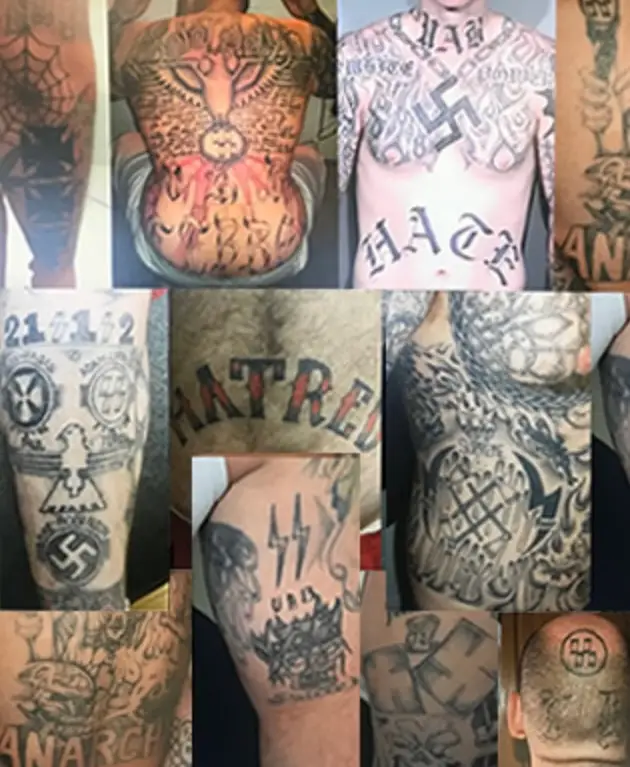
"Members of the AB typically can be easily identified by their tattoos.
"Popular tattoos among AB members include a shamrock inscribed with the number 666, swastikas, the abbreviation A.B., and double lightning bolts, which stand for Hitler’s SS."
 Olivia Burke