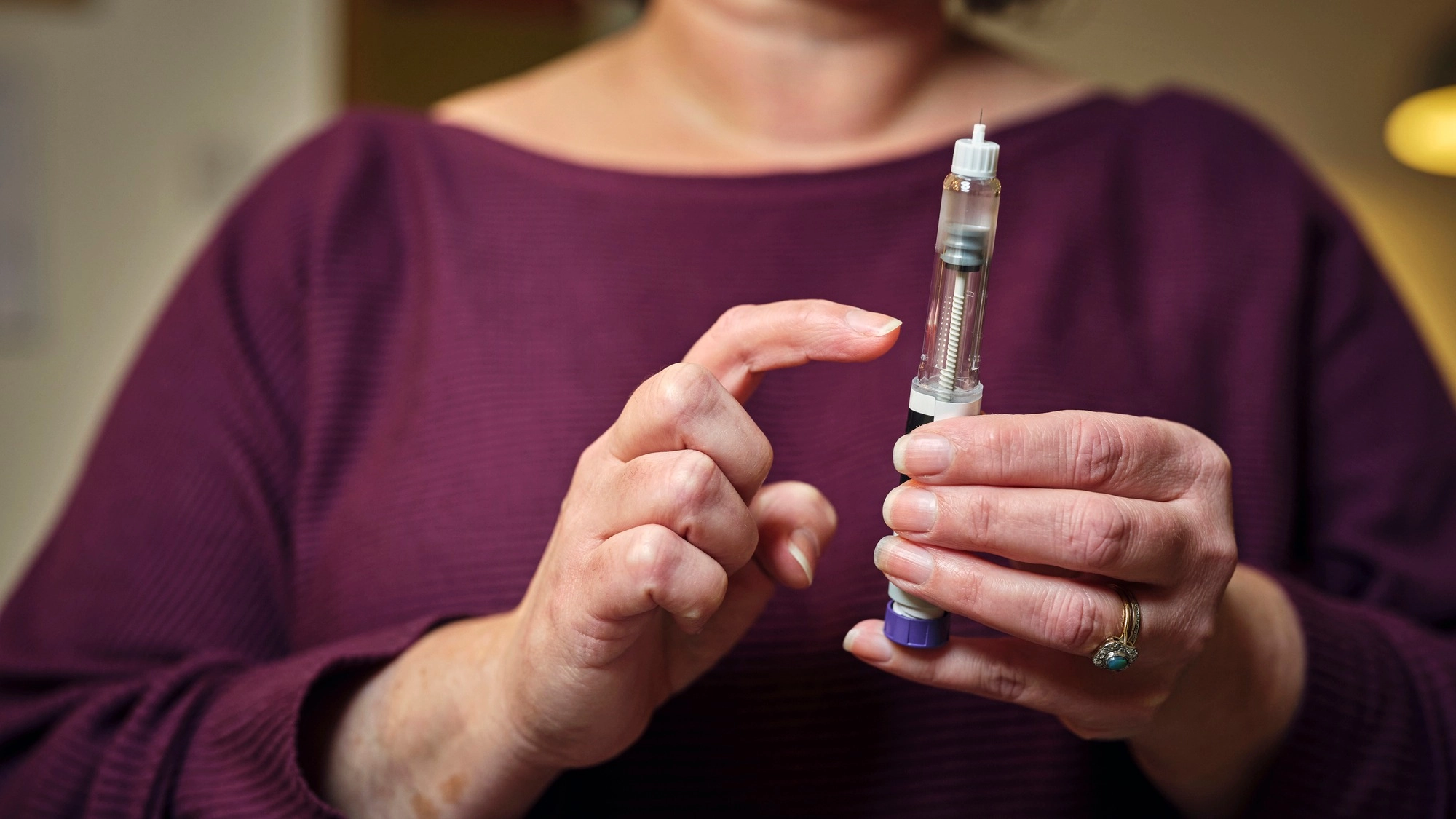
Weight loss jab users warned they might be 'worse off than before' when they stop them

A new study from Cambridge University has warned people on weight loss drugs that the work doesn't stop once they're no longer taking the jab.
Appetite-suppressing drugs are becoming more popular and they're very effective on most people while you're taking them, but once a person is no longer on the jab the weight loss doesn't always stay off.
Researchers published in eClinicalMedicine looked at six trials of 3,200 people and found that for people on weight loss drugs there was 'significant weight regain following cessation'.
Once people stopped taking the jab the researchers found that over the next 60 weeks they regained around 75 percent of what had been lost.
Advert
The jabs appear to be good for some permanent weight loss even if many people put a lot of it back on, but the weight regain could leave them worse off than when they started depending how they regain it.

School of Clinical Medicine and Trinity College, University of Cambridge, medical student Brajan Budini said: "If the regained weight is disproportionately fat, individuals may ultimately be worse off than before in their fat-to-lean mass ratio, which may have adverse consequences for their health."
Losing the weight and keeping it off are two different things, as fellow medical student Steven Luo said people on the jabs could be 'given advice on improving their diet and exercise' for when they stop taking them.
Reacting to the study, Dr Marie Spreckley of the University of Cambridge pointed out the researchers studied up to 52 weeks at which point the average person coming off a weight loss jab had regained 60 percent of what they lost.
She said: "Projection that weight regain will plateau at around 75 percent of the weight lost is based on extrapolation beyond 52 weeks using a nonlinear exponential recovery model.
"As with any modelling beyond observed data, uncertainty increases over time, and longer-term follow-up studies are needed to confirm whether this plateau occurs in routine practice."
More research would be needed but she said the researchers had found data 'consistent with previous withdrawal trials of semaglutide and tirzepatide, which have shown substantial regain after treatment cessation'.

Dr Adam Collins, Associate Professor of Nutrition at the University of Surrey, said based off the research it looked like 'weight change happens quickly at first, then slows and plateaus at a new weight'.
Nevertheless, he said people on weight loss jabs still ended up losing a 'clinically meaningful' amount of weight, though he had some words of caution.
He said: "The extent of weight regain varied significantly across the studies included.
"Those who showed the least regain also incorporated some form of support or intervention after stopping medication, including continuing to take smaller doses of weight loss drugs.
"This is compounded by the fact that participants in studies are likely to comply with or maintain healthy behaviours simply because they are being monitored."
He also pointed towards other studies which indicated that in some cases people 'not only regain the lost weight but also overshoot their original weight'.
Letting the weight loss drug do all the work without making other changes in your life means 'you may not have addressed any issues with your own diet and lifestyle', he warned.
 Joe Harker