ladbible homepage
ladbible homepage
  • Home
  • News
    • UK
    • US
    • World
    • Ireland
    • Australia
    • Science
    • Crime
    • Weather
  • Entertainment
    • Celebrity
    • TV
    • Film
    • Music
    • Gaming
    • Netflix
    • Disney
  • Sport
  • Technology
  • Travel
  • Lifestyle
  • Money
  • Originals
    • FFS PRODUCTIONS
    • Say Maaate to a Mate
    • Daily Ladness
    • UOKM8?
    • FreeToBe
    • Citizen Reef
  • Videos
  • Advertise
  • Terms
  • Privacy & Cookies
  • License Our Content
  • About Us & Contact
  • Jobs
  • Latest
  • Archive
  • Topics A-Z
  • Authors
Facebook
Instagram
X
Threads
Snapchat
TikTok
YouTube
Submit Your Content Here
  • GAMINGbible
  • LADbible Group
  • UNILAD
  • SPORTbible
  • Tyla
  • FOODbible
  • UNILAD Tech
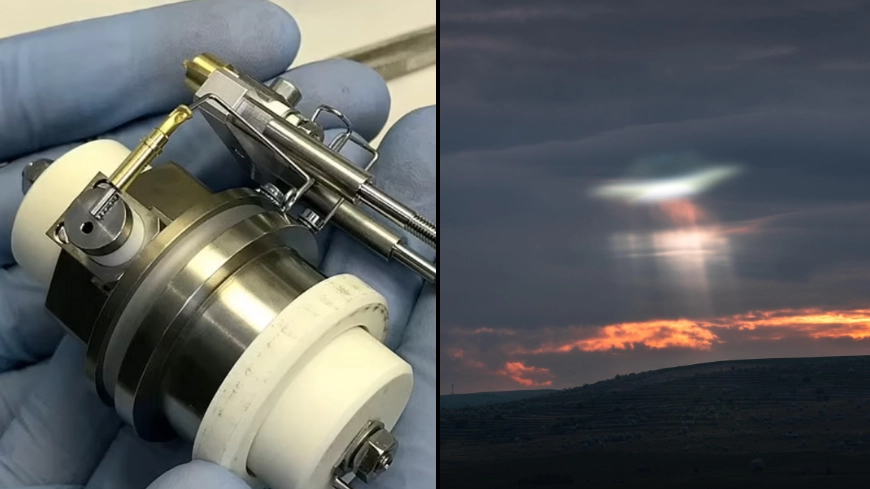
New laser which detects aliens life developed by scientists
Home>News
Published 08:03 17 Jan 2023 GMT

New laser which detects aliens life developed by scientists

Scientists hope to fly the laser into space within the next few years

Anish Vij

Anish Vij

google discoverFollow us on Google Discover

A new handheld laser could help scientists detect alien life.

Whether you believe in extraterrestrial life or not, it's always handy to make sure you're prepared for an alien invasion.

At 17 pounds, the updated handheld device is said to be small enough and light enough for astronauts to carry along with them on space missions.

Advert

The NASA-funded device - which was was announced by a University of Maryland led team - uses an ultraviolet laser to remove particles from planetary material.

These particles are then analysed with the hopes of finding organic compounds.

Scientists say the laser is much more suited to space travel than the previous, much larger, prototype and might be ready to launch into space in 'the next few years'.
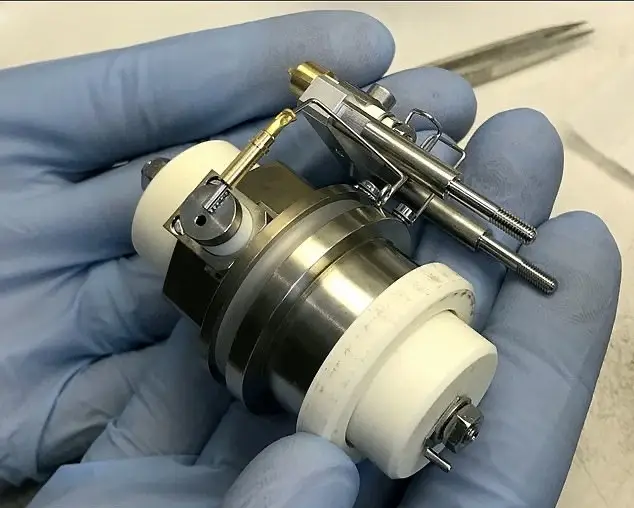
A new laser could help scientists detect alien life on Mars or Jupiter.
Ricardo Arevalo

"The Orbitrap was originally built for commercial use," explained lead author Professor Ricardo Arévalo of Maryland University.

"You can find them in the labs of pharmaceutical, medical and proteomic industries. The one in my own lab is just under 400 pounds - so they're quite large.

"It took us eight years to make a prototype that could be used efficiently in space - significantly smaller and less resource-intensive but still capable of cutting-edge science.

"The good thing about a laser source is anything that can be ionized can be analysed.

"If we shoot our laser beam at an ice sample we should be able to characterise the composition of the ice and see biosignatures in it.

"This tool has such a high mass resolution and accuracy that any molecular or chemical structures in a sample become much more identifiable."
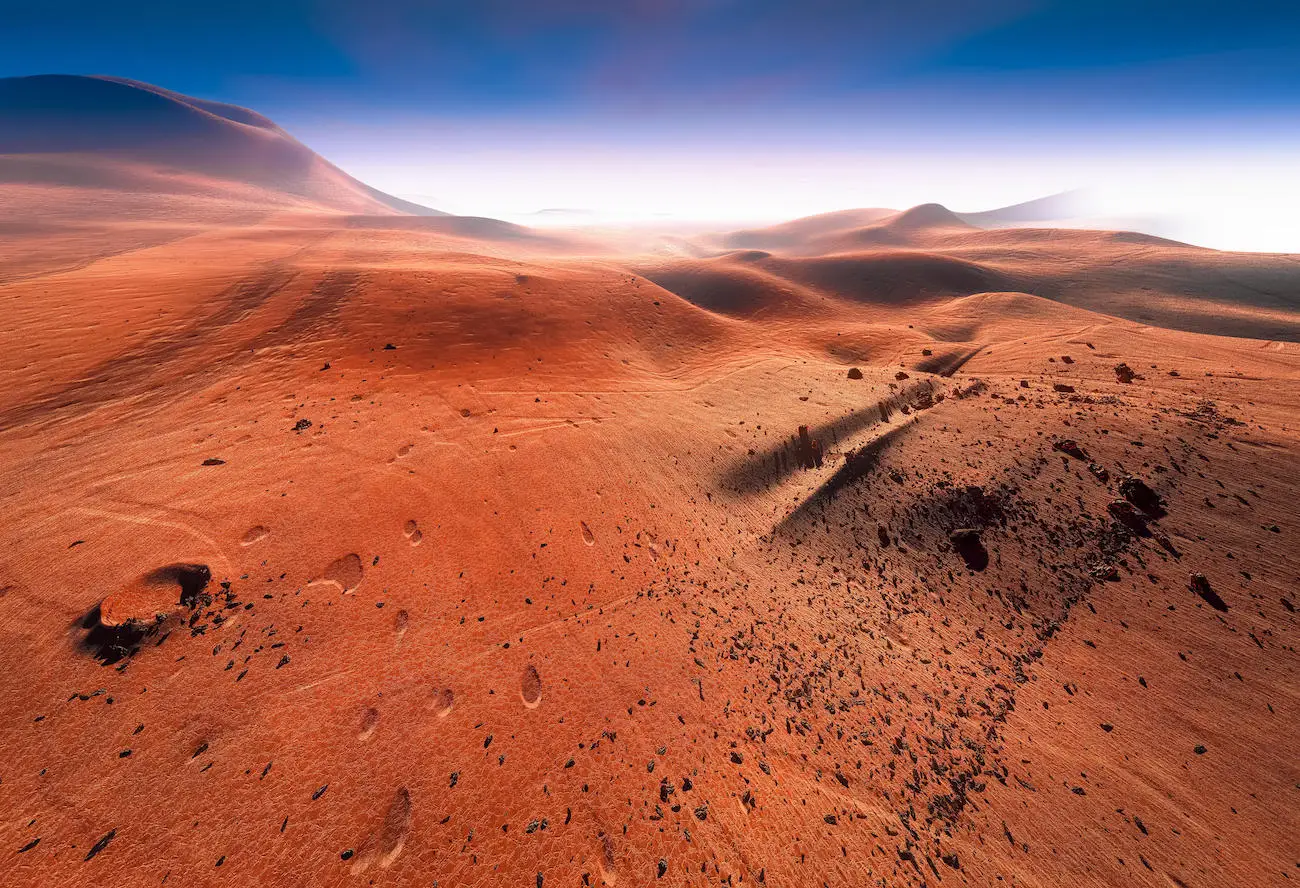
Artist's rendition of the red surface of Mars.
Plrang GFX / Alamy Stock Photo

The new alien-hunting laser allows scientists to access larger compounds with more complex properties in relation to biology.

Smaller compounds, such as amino acids, are a lot harder to analyse, the scientist cays.

"Amino acids can be produced abiotically, meaning that they're not necessarily proof of life," Arevalo added.

"Meteorites, many of which are chock full of amino acids, can crash onto a planet's surface and deliver abiotic organics to the surface.

"We know now that larger and more complex molecules, like proteins, are more likely to have been created by or associated with living systems.

"The laser lets us study larger and more complex organics that can reflect higher fidelity biosignatures than smaller, simpler compounds.

"I view this prototype as a pathfinder for other future LDMS and Orbitrap-based instruments.

"Our mini Orbitrap LDMS instrument has the potential to significantly enhance the way we currently study the geochemistry or astrobiology of a planetary surface."

Featured Image Credit: Ricardo Arevalo/Mihaila Cristian Ionut / Alamy Stock Photo

Topics: Science, NASA, Space

Anish Vij
Anish Vij

Anish is a Journalist at LADbible Group and is a GG2 Young Journalist of the Year 2025. He has a Master's degree in Multimedia Journalism and a Bachelor's degree in International Business Management. Apart from that, his life revolves around the ‘Four F’s’ - family, friends, football and food. Email: [email protected]

X

@Anish_Vij

Recommended reads

Concern grows among tourists as toxic fish with razor sharp teeth are invading holiday hotspotGetty Stock ImageDoctor shares five early warning signs of stomach cancer that most people missGetty stockMan who suffers from vicious hair pulling condition shares first sign he knew something was wrongSuppliedFIFA slammed after banning entire country from all football in 'unfair' and 'flawed' decisionTasos Katopodis - FIFA/FIFA via Getty Images

Advert

Choose your content:

an hour ago
2 hours ago
4 hours ago
  • Getty stock
    an hour ago

    Doctor shares five early warning signs of stomach cancer that most people miss

    Dr Yoga Andredi, a UK trained gastroenterologist, explained his major signs of stomach cancer

    News
  • Tasos Katopodis - FIFA/FIFA via Getty Images
    2 hours ago

    FIFA slammed after banning entire country from all football in 'unfair' and 'flawed' decision

    The entire country's international teams and clubs have been suspended from all football by FIFA

    News
  • INAH
    2 hours ago

    Lost Mayan city with sinister carvings discovered deep in jungle after 1,000 years

    Minanbé was discovered by researchers who said it was strangely well preserved despite being so old

    News
  • St Johns County Sheriff Office
    4 hours ago

    Footage exposes woman slapping crying child's face as she delivered package

    Kiah Lowery was arrested in May for the alleged assault

    News
  • Scientists believe they've developed drug to halt human ageing in major breakthrough
  • Scientist reveals exactly what first contact with aliens will look like and it's terrifying
  • New image of ‘potentially hostile alien threat’ shows it displaying incredibly unusual sign
  • NASA launches mission to find 100,000 new planets - and it plans to discover Earth-like worlds