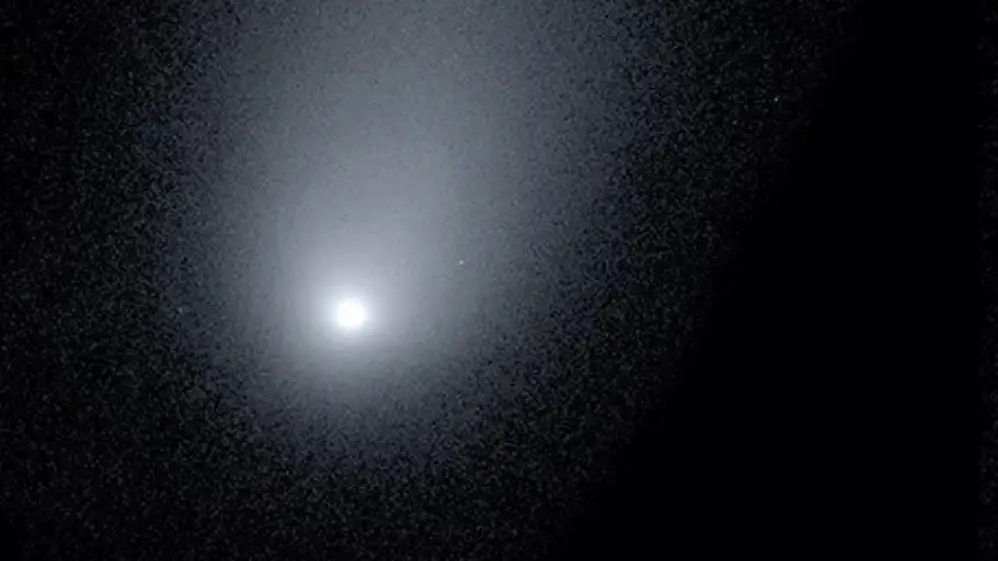
Astronomers have found a mysterious new object flying between 'hostile alien threat' and Earth

Another object has been found flying between the 'potentially hostile' comet 3I/Atlas and our small planet.
Like this year hasn’t been eventful enough up in space, there’s more drama going on.
Astronomers have recently found yet another thing floating about, and this too, doesn’t have the tell-tale tail of a comet.
According to the experts, this little thing is zooming between us, and something that another scientist has warned could be an alien mothership.
Advert
Discovered back in July, 3I/Atlas was dubbed as being a strange object Harvard by professor Avi Loeb, who claimed there was a 30 to 40 per cent scenario where it could be something other than a 'naturally formed' object.
Since then, 3I/ATLAS has continued on its erratic path deep in space, and we’re not going to find out if it’s aliens or not for some time.
Loeb shared it seems to be behaving rather unusually as it approached the sun, and he went one step forward by taking aim at NASA over their response to it.
Loeb criticised NASA's apparent refusal not to release a series of high resolution images captured of 3I/ATLAS in October by a camera onboard the space agency's Mars Reconnaissance Orbiter.
However, that’s just because of the US government shut down preventing them from being able to do so.
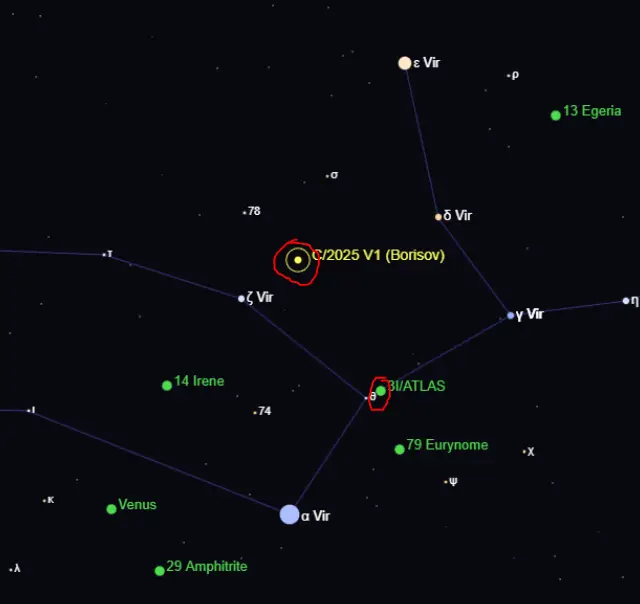
While we can’t see the possible alien mothership, we can see the mysterious new object scientists have named C/2025 V1 Borisov.
Moving between 3IATLAS and Earth with no tail, the ‘comet’ was found to be 105,078,392.0 kilometres away from Earth, or 0.7024056659 Astronomical Units, which is about five and a half months away.
Its closest approach to Earth is thought to occur on 11 November 2025, when it passes at about 103 million kilometres (0.68 AU) away from us, which is a safe distance away to see it in the sky.
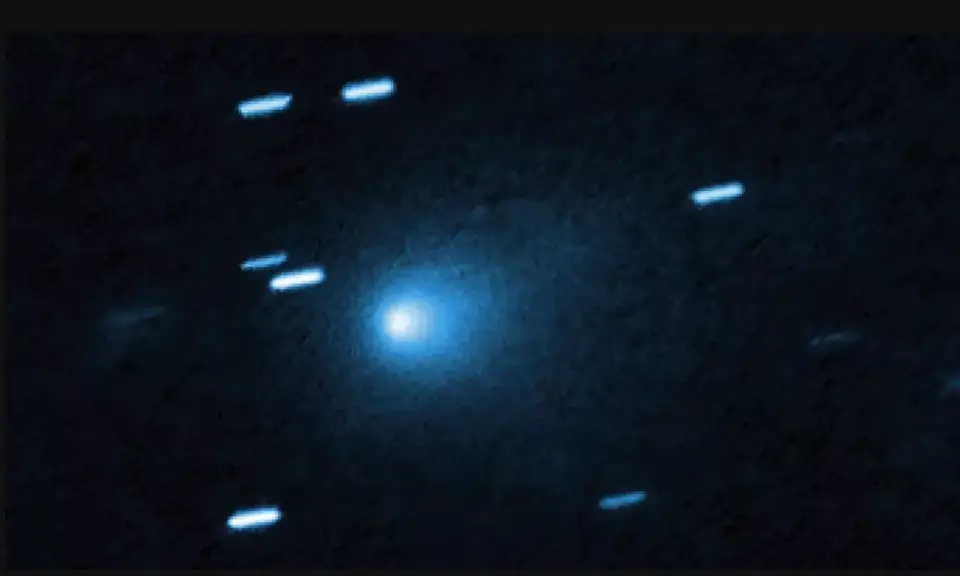
While it’s only just recently cropped up in the space scene, scientists have confirmed that C/2025 V1 Borisov originates within our own Solar System, and most likely came from the distant Oort Cloud.
According to data from the JPL Small-Body Database, C/2025 V1 Borisov is following a highly unusual orbit, with an eccentricity of 1.00958273 and an inclination of 112.7° at present.
This means it’s traveling along a steep, elongated trajectory around the Sun, and will reach the closest point to the Sun (perihelion) on 16 November.
Now, if you want to see it in the sky, just know that Borisov's light takes nearly six minutes to reach us, and the comet rises at 4:01 am, peaks at 10:01 am, and settles at 4:03 pm.
So, if you want to see it, make sure you’re there on time and looking from under clear skies.
Topics: NASA, Science, Space, World News, Weird
 Britt Jones