Overlooked Ancient Egyptian tool is reshaping everything we thought about the civilisation

A long-overlooked Ancient Egyptian tool is now reshaping what archaeologists know about the origins of human engineering.
A tiny copper-alloy tool discovered all the way back in the 1920s may prove to be a hugely significant discovery, as researchers believe it could completely change what we know about the Ancient Egyptians methods of engineering.
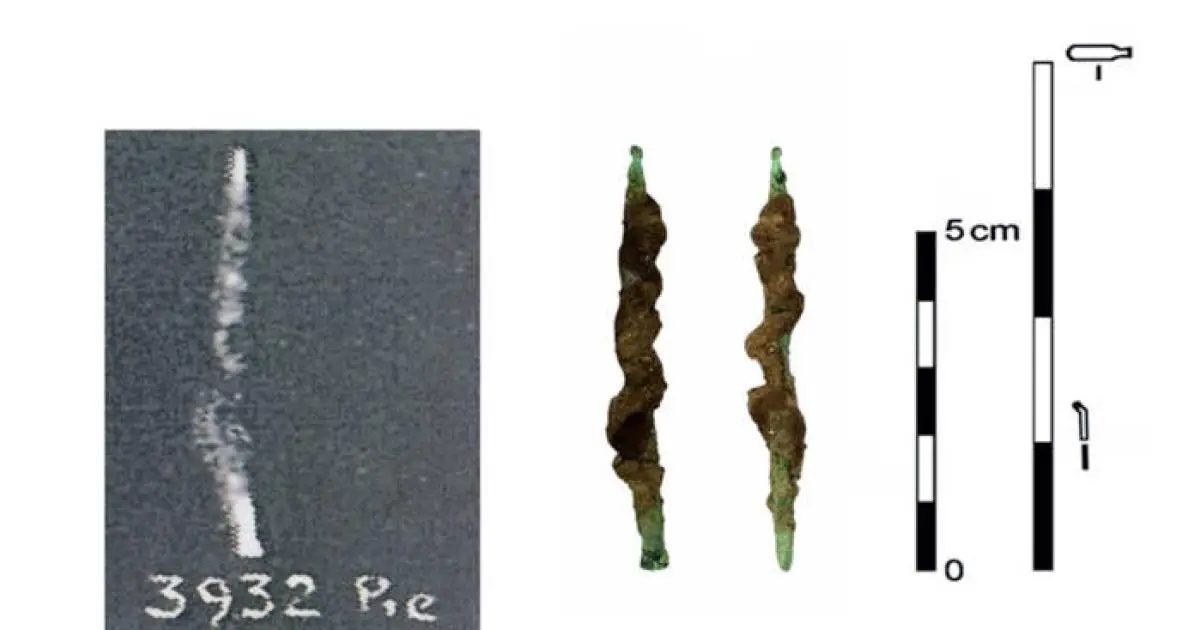
The concept of such an ancient society using mechanical modern tools such as drills might seem unlikely, but the tiny copper alloy has now been identified as exactly that, with researchers suggesting that it might be the earliest known metal drill.
Lead author Dr Martin Odler from Newcastle University said: "This re-analysis has provided strong evidence that this object was used as a bow drill, which would have produced a faster, more controlled drilling action than simply pushing or twisting an awl-like tool by hand.
Advert
"This suggests that Egyptian craftspeople mastered reliable rotary drilling more than two millennia before some of the best-preserved drill sets."
The wear on the tool is consistent with that of mechanical drilling and is now forcing scholars to completely rethink when complex tools such as these first emerged.
It's a relatively late discovery, considering the tool was first excavated from Egypt over a century ago and initially classified as a small copper awl with leather wrapped around it by archaeologist Guy Brunton.
It was thanks to microscopic analysis, which indicated that the tool was repeatedly rotated, as well as the six coils of extremely fragile leather thong that provided the significant evidence which scientists believe points towards a bow drill system.

This sees a string wound around the drill shaft, before being driven back and forth by a bow, in the spinning electric drill motion that we're all more familiar with today.
"Behind Egypt's famous stone monuments and jewellery were practical, everyday technologies that rarely survive archaeologically," Odler added.
"The drill was one of the most important tools, enabling woodworking, bead production, and furniture making."
Although these sorts of drills have been apparent in New Kingdom tombs for some time, this particular tool is dated from around two millennia before, something which completely rewrites what we knew about engineering in classic Egyptian civilisations.
It comes as other researchers think a relic in the British Museum could contain a reference to a mysterious race of giants mentioned in the Bible called the Nephilim, who were eight feet tall.
But doubters reckon the Papyrus Anastasi I scroll is talking about a military conflict rather than a bunch of supernatural giants.
Topics: Ancient Egypt, Archaeology, History, Technology, Science
 James Moorhouse