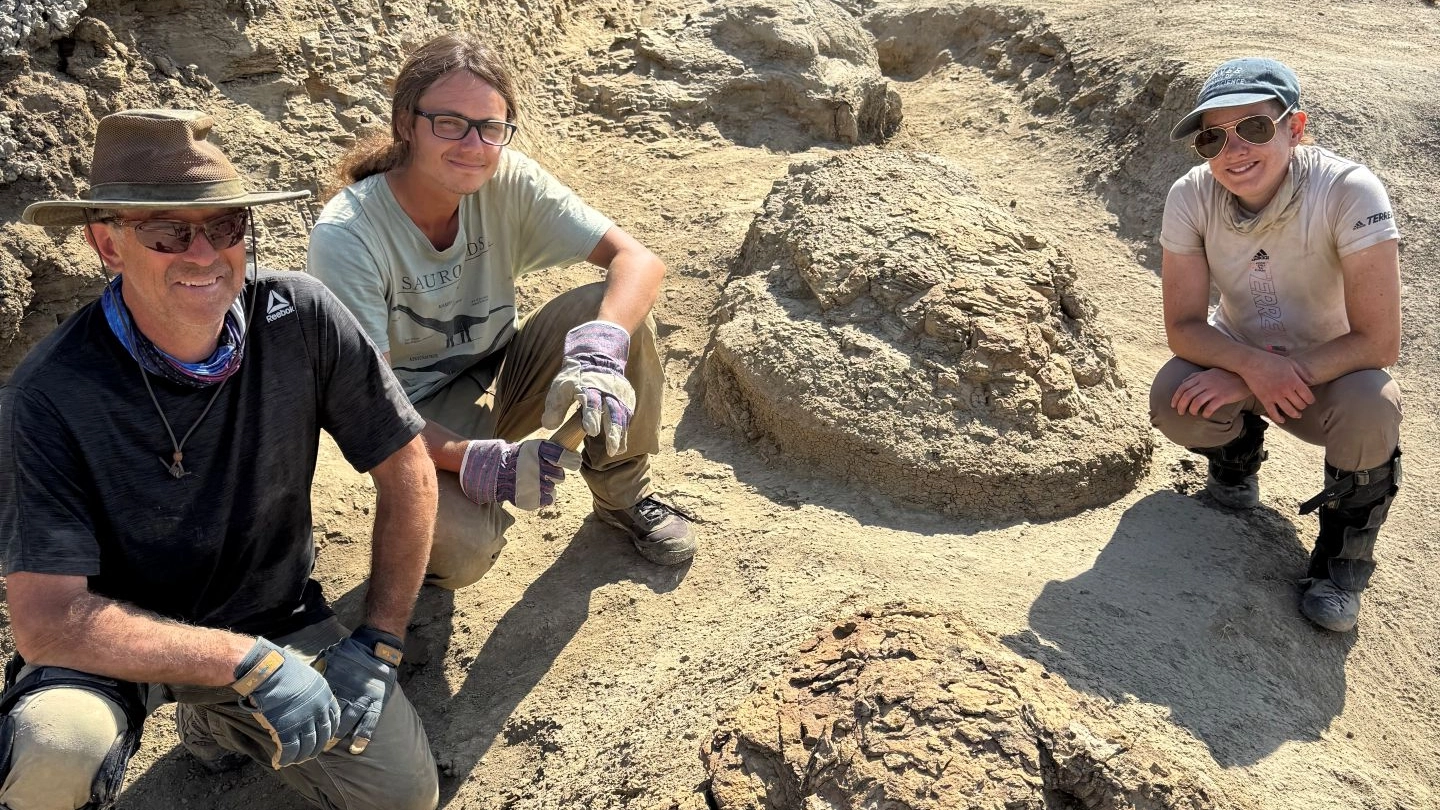
First ever known trackway of adult T-Rex discovered in North America dates back 66,500,000 years

An amateur fossil hunter discovered what scientists believe is the first known trackway made by an adult Tyrannosaurus rex.
The 66.5-million-year-old footprints were found in the rugged badlands of North Dakota, US by high school teacher Kent Hups in 2025.
While volunteering with paleontologist Tyler Lyson and recovering from knee replacement surgery at the same time, Hups was searching for an easier route out of a narrow valley when he noticed an unusual shape in the ground.
To him, the lumpy triangle looked like three enormous toes and Hups, who’s spent 30 years searching for ancient footprints, immediately suspected he had found something extraordinary, as reported by National Geographic.
Advert
Excited, he messaged Lyson: “Hey just found a t Rex footprint!!!!!!”

Lyson was doubtful at first because adult T. rex footprints are extremely rare, with only two isolated examples previously identified anywhere in the world: one in New Mexico and another in Montana.
But Hups also believed he could see a second print, suggesting this was not an isolated footprint but part of a trackway.
“I got very excited, and the problem with being very excited when you’re by yourself is that you can yell really loud, and there’s nobody to hear it,” he told the outlet.
Further investigation revealed four large, three-toed footprints stretching across about seven metres, with each track measuring roughly one metre long and between 60 and 80 centimetres wide.

It appears that two were most likely made by the dinosaur’s left foot and two by its right.
The footprints were discovered in the Hell Creek Formation, a rock layer extending across several western US states.
Around 66.5 million years ago, the region was a forested floodplain filled with rivers, streams and swamps.
Its soft sediments preserved many dinosaur bones, including numerous T. rex remains, but footprints are much less common.
Researchers say in their new paper titled ‘A large tridactyl trackway from the Upper Cretaceous Hell Creek Formation of North Dakota, likely attributable to an adult Tyrannosaurus rex’ that the tracks survived because the original depressions became filled with fine sandstone.

Calcium carbonate carried by groundwater later hardened the material into durable concretions. Over millions of years, the softer surrounding rock eroded, exposing the footprint casts.
Scientists cannot prove with complete certainty that a T. rex made the prints because their surfaces are cracked and preserve limited anatomical detail.
But because of their huge size, narrow toe impressions, age and location, all factors point to an adult T. rex.
“Future excavations may be able to expose more of the trackway and may be able to uncover more features that elucidate foot anatomy and motion or may present trackway parameters that indicate notable locomotor behavior,” the authors wrote.
“However, the considerable overburden means that further excavations may be unlikely.”
Topics: World News, History, Science
 Anish Vij