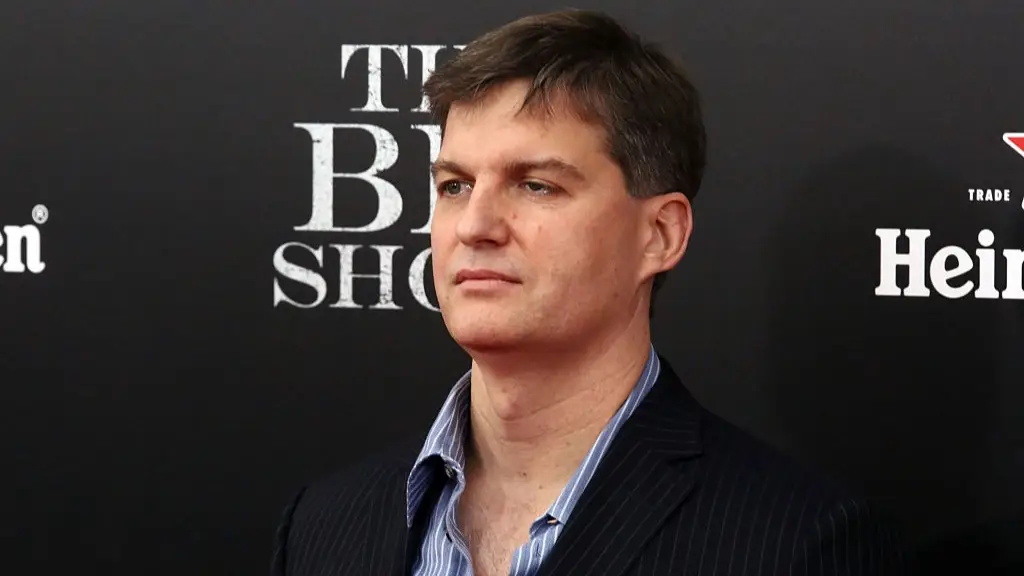
The Big Short's Michael Burry signals 'beginning of the end' as he takes new short position

US investor Michael Burry has got tongues wagging once again with his latest short.
Depicted by the chameleonic Christian Bale in director Adam McKay's celebrated comedy drama The Big Short, which itself was based on author Michael Lewis' 2010 book of the same name, Burry is widely recognised for predicting the housing crisis of 2008.
Released in 2015, The Big Short took home the Oscar for Best Adapted Screenplay, while it was also in the running for Best Picture, Best Director, Best Film Editing and Best Supporting Actor (Bale).
For the uninitiated, a 'short' is an investment strategy where you profit from an asset's price drop, allowing you to sell the asset first and redeem it later on at a lower cost.
Advert
So when Burry makes a play, the financially-minded are bound to take notice.

In his 'Cassandra Unchained' Substack letter published this week, the 55-year-old revealed that he'd activated a short position in major construction firm Caterpillar's stock at $1,060.98 (£795.19)
This came after shares in CAT dropped from 86 percent to between 4.4 and 6.65 percent yesterday (July 1).
Burry went on to highlight how the company had been a strong portfolio performer for him over the years, and that its current price was 'not supported by the actual business.'
CAT wrapped up the month of June at around $1,064.90 (£910.79), meaning the savvy investor clinched his short almost exactly at the pinnacle.
Meanwhile, his newsletter also disclosed newly made short positions in Nvidia, Tesla, Applied Materials and the iShares Semiconductor ETF (SOXX) stock.
This comes after Burry recently offered his two cents on the economic climate, suggesting we're mere minutes away from a 'bloody event' that'll devastate the world's economy.
What with our leaders perpetually just one push of a button away from total nuclear annihilation, there's an argument to say we're never not in danger, yet Burry appeared unconvinced by the current Nasdaq 100 index.
He wrote via Substack: "This, all of it, is the scene of the bloody car crash, minutes before it happens."
In his mind, history is disastrously repeating itself given the severe consequences of the economic crash nearly two decades ago.
Burry is one of many analysts who believe that a 2026 crash would be even more hellish due to the high levels of debt, geopolitical tensions and something known as the 'AI bubble'.
This is a theory that the noise around artificial intelligence is so high that people are staking significant amounts of money on its potential, but if this potential does not translate into success, there could be a terrible fallout.
"In the next two days, I will release a valuation exercise that seems to suggest almost no tech stock, not even bombed out software stocks, are inexpensive when held to strict accounting standards, more strict and more forensic in nature than GAAP," he added.
Topics: Money, Entertainment, Film
 Dan Seddon