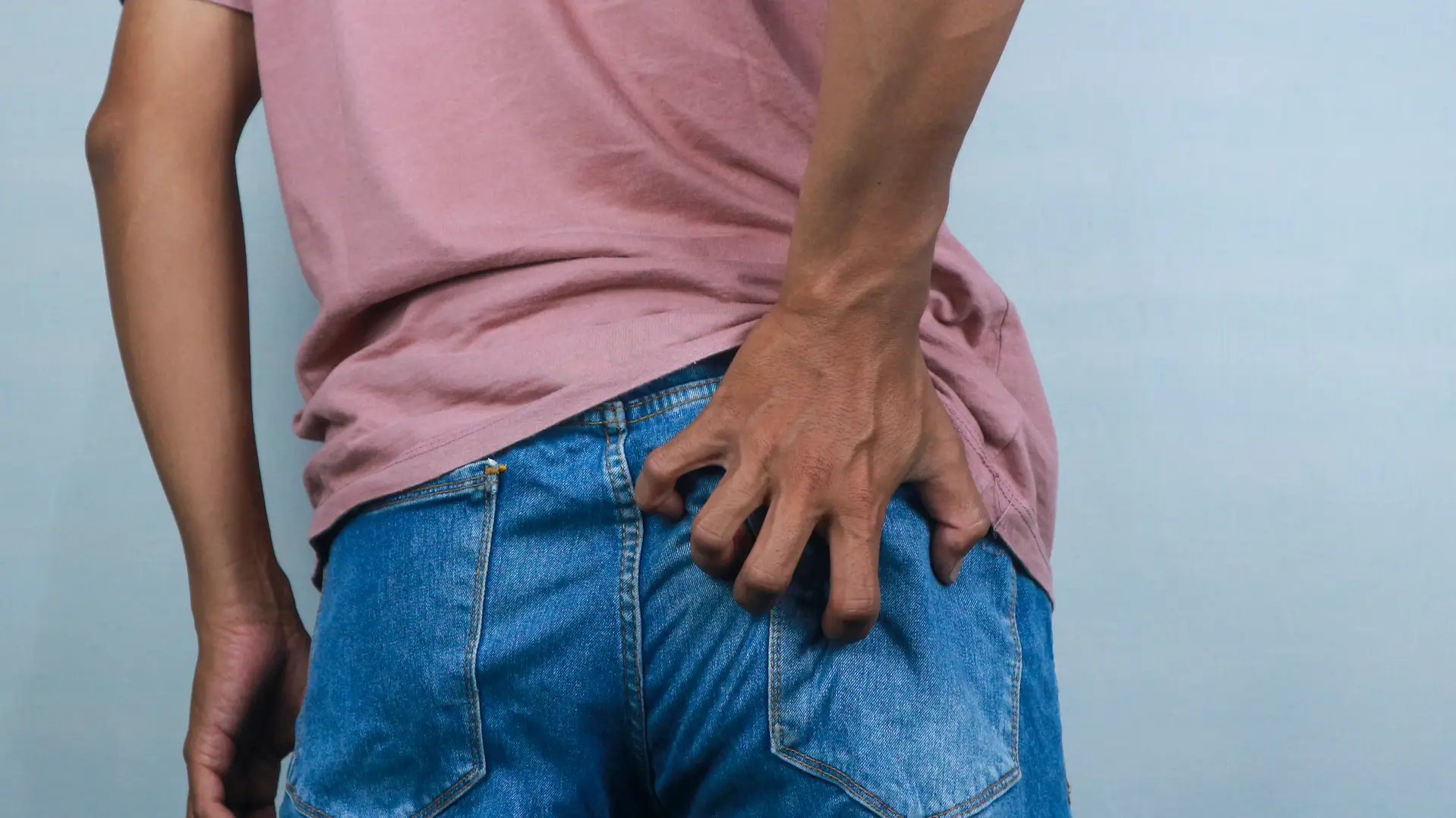
Doctor explains what to do if you have 'Pruritus ani' as two-thirds of men affected by bumhole issue

A doctor has detailed the range of remedies which can help treat pruritus ani - including anal tattooing.
This term is used by medics to describe 'any itch in or around the anal area', and a recent study revealed that a lot of blokes in Britain struggle with this.
A whopping 61 percent of men in the UK have experienced this intimate problem, but a big chunk of them said they were too shy to discuss it with their doctor.
Although you might feel a bit awkward while chatting to your GP about your rear end, you're much better off grinning and bearing it to get this itching issue sorted out.
Advert
As surgeon Shahab Siddiqi explains, pruritus ani can be minor and disappear on its own... but it can also be 'so severe and long-lasting that it can have a severe impact on the life of its sufferers'.
The colorectal surgeon, who is based in Essex, is pretty clued up on anything to do with your back passage.
Who does pruritus ani tend to effect and what causes it?
He explained that pruritus ani most commonly occurs in people aged 40 - 60 and tends to affect men more than women, although 'there is no obvious reason' which explains this.

"Pruritus ani can be classified as secondary or primary," Siddiqi said in a post on his website. "If a condition is found in the lower bowel, anus, or on the skin surrounding the anus that is suspected to lead to anal itching, pruritus ani is classified as secondary to that condition.
"If no abnormality can be found in these areas, then the pruritus ani is considered to be primary (or idiopathic, meaning 'no known cause').
"Traditionally, pruritus ani has been thought of as a symptom rather than as a condition in itself. However, there is recent research suggesting pruritus ani that is initially secondary to another condition causes changes in the nervous system that lead to the itch becoming permanent, even though the original cause of the itch has disappeared."
The NHS explains that the common cause of pruritus ani is minor leakage (AKA soiling) from the bottom - if small amounts of poo or liquid mucus leak from the bottom, this can irritate the delicate skin around this area.
Other causes include:
- Skin conditions such as dermatitis or psoriasis
- Infections
- Piles or haemorrhoids (lumps inside and around your bottom) and some skin conditions.
- Fissures
- Colorectal cancer (may occur with altered bowel habits and rectal bleeding)

Solutions to pruritus ani
The surgeon said that a lot of patients with pruritus ani find that it 'resolves spontaneously or with simple measures', which he then listed.
First of all, Siddiqi recommends sticking to strictly water when it comes to cleaning your backside, rather than using any 'chemicals' or products that might irritate it such as creams, soaps and bubble baths.
Explaining how to ensure you've got the cleanest a**hole on the block when you've got pruritus ani, the surgeon said: "The anal area should be cleansed with water alone in the squatting position, making sure to remove any faeces.
"The area should be patted dry with a soft flannel and dried using a hair dryer if necessary. Water-based creams and emollients can be used if more rigorous cleansing is required.
"Petroleum ointment, Sudocrem or Cavilon should be used as a barrier after cleansing."
Siddiqi said a lot of his patients carry a small tube of aqueous cream with them when they're out and about, too.
You should also eliminate any food or drink that you think might worsen the itching, with prime culprits including coffee, tea, chocolate, citrus fruits and dairy products, among others, to 'see if this helps'.
Sharing some other possible treatments, the surgeon continued: "Mild to moderate symptoms of pruritus ani without skin changes can respond well to hydrocortisone 1% ointment.
"How often the ointment is applied can be reduced as symptoms improve. This can be used at the same time as barrier creams. Severe symptoms and skin changes can be treated with stronger steroids for up to 8 weeks, and should be replaced with a weaker steroid ointment when symptoms have improved. Occasionally, creams to eradicate fungal infections such as thrush are useful."
And as a last resort, you could even try anal tattooing to scratch that pruritus ani itch once and for all.
Siddiqi explained he is one of the 'very few specialists in the UK' who are able to perform this procedure.
"It is generally reserved for patients who cannot be helped by other means and for those who have become steroid-dependent," the surgeon said.
"Anal tattooing is performed under general anaesthesia and uses methylene blue to reduce sensation in the anal area, cutting off the sensation of itch.
"The tattoo itself lasts only a matter of weeks, and the skin looks no different in the long term. The skin may have a reduced sensation for up to a year and the procedure can be repeated if necessary."
 Olivia Burke