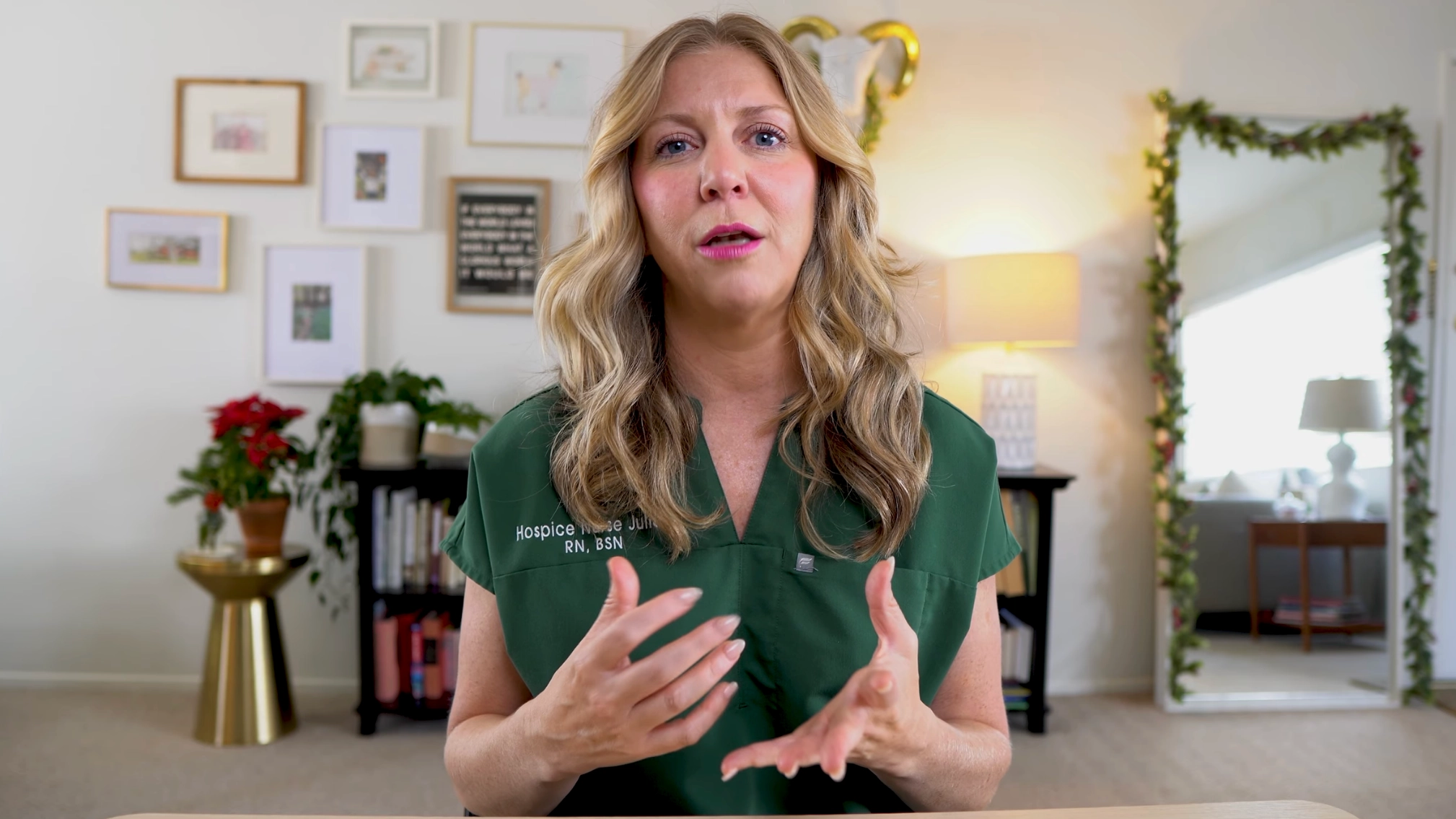
Hospice nurse shares the six signs someone is days away from death

A hospice nurse from California who has cared for hundreds of patients has shared the six signs most common signs that death isn't far away.
Julie McFadden, known for raising awareness online as Hospice Nurse Julie, works to make people in hospital and at home feel more comfortable about the thought of death.
A previous YouGov study revealed that 41 percent of Brits fear for their own death, while the vast majority (63 percent) are more worried about it happening to someone they love.
“I truly believe that education is key to decreasing fear around death and dying,” the health expert said in one of her recent YouTube videos.
Advert
She explained that 'hundreds of people' have told her that 'knowing the [six] signs that death is imminent really really helped them'.
End-of-life fevers
Although the exact cause is unknown, Julie believes the body loses the ability to regulate core temperature as systems shut down, causing a fever.
“We don't exactly know why people at the end of life spike fevers, but we do see it often,” she admitted.
“We think the body starts losing the ability to control its core temperature.
“Your loved one's temperature seems to fluctuate. They feel hot, but they say they're cold. They say they're cold, but they feel hot.”
Unconsciousness
One of the clearest indicators is when a patient is in a deep and persistent unconsciousness.
“So, not really waking up,” Julie explained.
“They may be arousable, right? But they're not going to open their eyes, make eye contact, talk to you.”

Stopping eating and drinking
“A dying body does not eat and drink. A dying body does not want food and water,” Julie added.
“Your loved one likely had not been eating and drinking for a few days prior to this and then they slowly grow more and more unconscious.”
Mottling (skin changes)
Mottling refers to a change in colour which indicates that 'the skin is at the end of life'.
“What you usually see is someone's skin being a little more purple, a little more gray, kind of marly, more vein, more veiny,” she said.
“You notice it in their feet, their hands, sometimes their nose, the top of their knees.”
Facial changes and muscle relaxation
Julie said families are often a little to see their loved one’s eyes partially open, not blinking and the mouth falling open. This happens because the muscles responsible for eyelid closure and jaw support fully relax near the end of life.
While the appearance can be unsettling, it is completely normal and not a sign of distress, she claims.
Breathing changes and the 'death rattle'
The 'death rattle' is caused by saliva pooling in the throat because the person can no longer swallow.
“The changes in breathing… are expected and normal. They are not going to breathe like you and I,” Julie said.
“You can see… deep rapid breaths but then a long pause where you almost think did they take their last breath but then they breathe again.
“Agonal breathing is a literal bodily reflex and your loved one is fully fully unconscious when this is happening. The sound is happening because the body is still creating moisture and saliva but is not telling us to swallow.
“Your loved one is not, I repeat, is not drowning on fluids.”
 Anish Vij