ladbible homepage
ladbible homepage
  • Home
  • News
    • UK
    • US
    • World
    • Ireland
    • Australia
    • Science
    • Crime
    • Weather
  • Entertainment
    • Celebrity
    • TV
    • Film
    • Music
    • Gaming
    • Netflix
    • Disney
  • Sport
  • Technology
  • Travel
  • Lifestyle
  • Money
  • Originals
    • FFS PRODUCTIONS
    • Say Maaate to a Mate
    • Daily Ladness
    • UOKM8?
    • FreeToBe
    • Citizen Reef
  • Videos
  • Advertise
  • Terms
  • Privacy & Cookies
  • License Our Content
  • About Us & Contact
  • Jobs
  • Latest
  • Archive
  • Topics A-Z
  • Authors
Facebook
Instagram
X
Threads
Snapchat
TikTok
YouTube
Submit Your Content Here
  • GAMINGbible
  • LADbible Group
  • UNILAD
  • SPORTbible
  • Tyla
  • FOODbible
  • UNILAD Tech
James Webb Space Telescope makes 'weird' discovery from beginning of the universe that has left scientists puzzled
Home>News>Science
Published 15:28 30 Sep 2024 GMT+1

James Webb Space Telescope makes 'weird' discovery from beginning of the universe that has left scientists puzzled

NASA has labelled the discovery as 'unprecedented'

Tom Earnshaw

Tom Earnshaw

google discoverFollow us on Google Discover

Humanity's best piece of technology when it comes to exploring the universe, the James Webb Space Telescope (JWST), has made a brand new discovery that scientists have been forced to label as 'weird'.

The bizarre discovery has seen American space agency NASA describe it as 'something unprecedented'.

Since late 2021, the $10 billion (£7.5 billion) satellite has been exploring the universe, sending back images of deep space to Earth.

Advert

Some of things it has found have been absolutely remarkable, with scientists labelling certain discoveries as 'jaw-dropping'.

Operated by NASA’s Jet Propulsion Laboratory, it is the heir to the Hubble Space Telescope that was first launched in to space back in 1990.

And after making discoveries from close to the beginning of time that feels like the stuff of science fiction, the discoveries keep on coming as Webb keeps on searching.

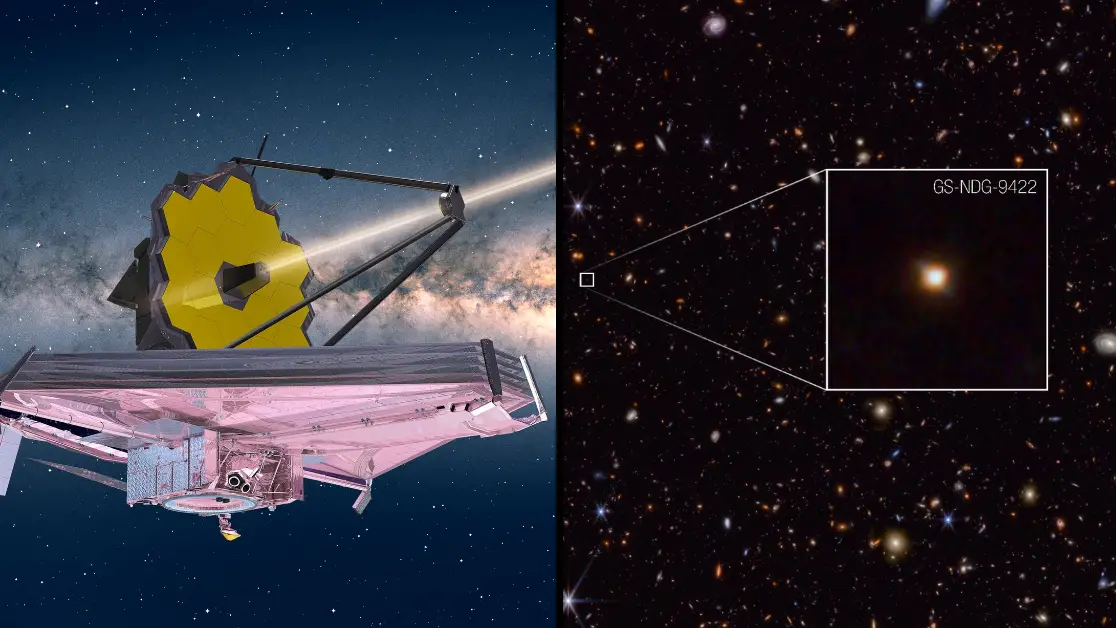
The latest discovery by JWST concerns a galaxy known as GS-NDG-9422 (9422), with the image in question coming from just one billion years after the Big Bang itself.

A faint dot? Nope - a clue to how the universe may have formed galaxies as we know them (NASA, ESA, CSA, STScI, Alex Cameron (Oxford))

The galaxy is full of huge stars burning twice as hot than anything close to our own galaxy.

And now, NASA says the discovery from Webb 'may be a missing-link phase of galactic evolution' in showing us how our galaxies looked before their current status. Mega.

Concerning the 'missing link', NASA explains that it could help us understand how we went from the universe’s first stars to 'familiar, well-established galaxies'.

Lead researcher Alex Cameron, of the University of Oxford, said: "My first thought in looking at the galaxy’s spectrum was, ‘that’s weird,’ which is exactly what the Webb telescope was designed to reveal: totally new phenomena in the early universe that will help us understand how the cosmic story began."

What does it mean in normal speak? Well, the stars in galaxy 9422 are terrorising huge gas clouds surrounding them with humungous quantities of light, which in turn heats the clouds. This then heats these clouds up, outshining the very stars themselves.
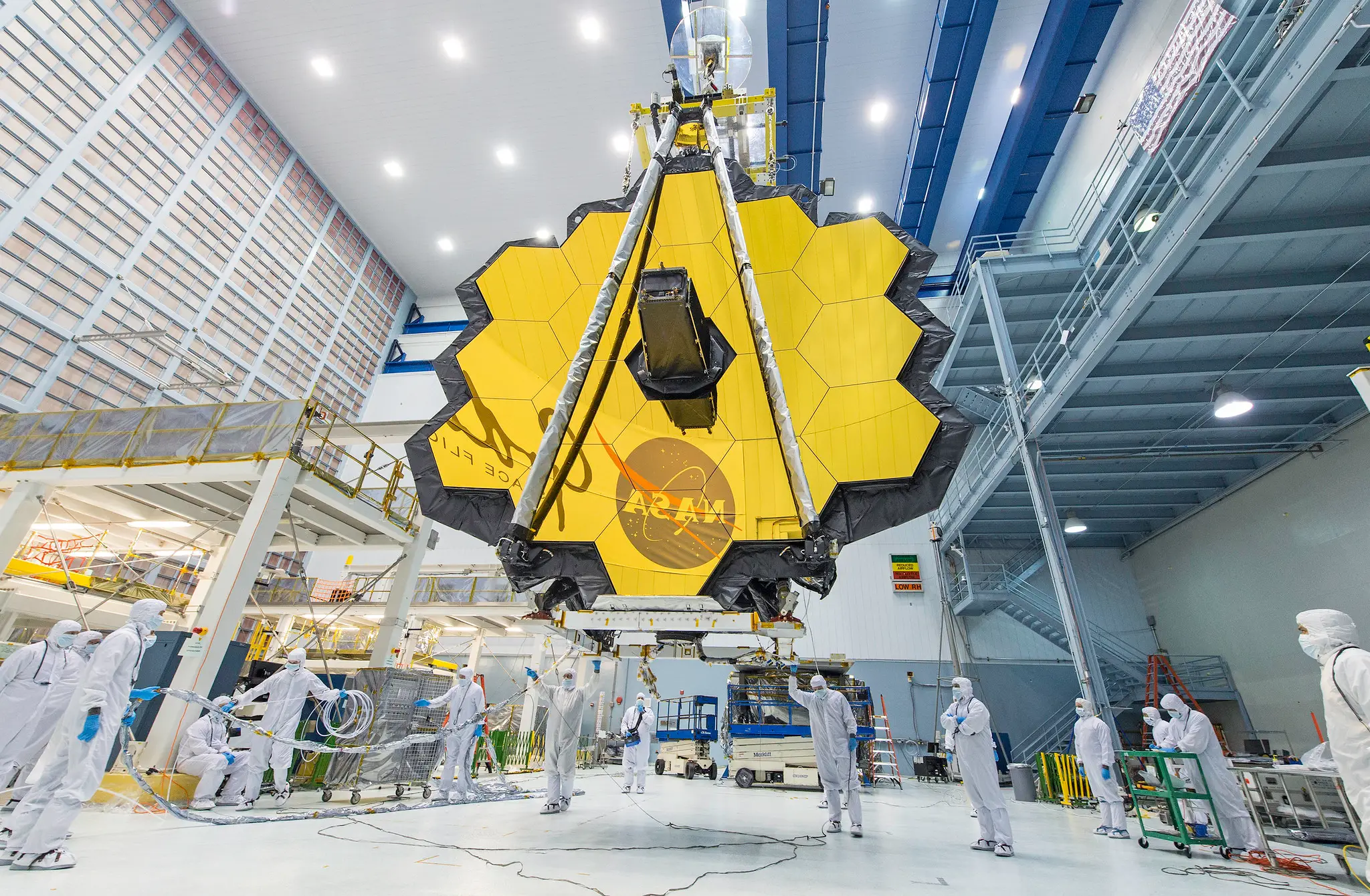
The James Webb Space Telescope being constructed before launching in to the cosmos (NASA/Desiree Stover)

This is big, and could be a indicator at to what comes after the stars shine bright, as scientists cannot be sure what comes after stars began coming together to form galaxies as we know them.

Cameron's colleague at Oxford, Dr Harley Katz, added: "It looks like these stars must be much hotter and more massive than what we see in the local universe, which makes sense because the early universe was a very different environment."

Cameron reached out to Dr Katz to discuss the 'strange' data.

Working together, their team found that computer models of cosmic gas clouds heated by very hot, massive stars, to an extent that the gas shone brighter than the stars, was nearly a perfect match to Webb’s observations.
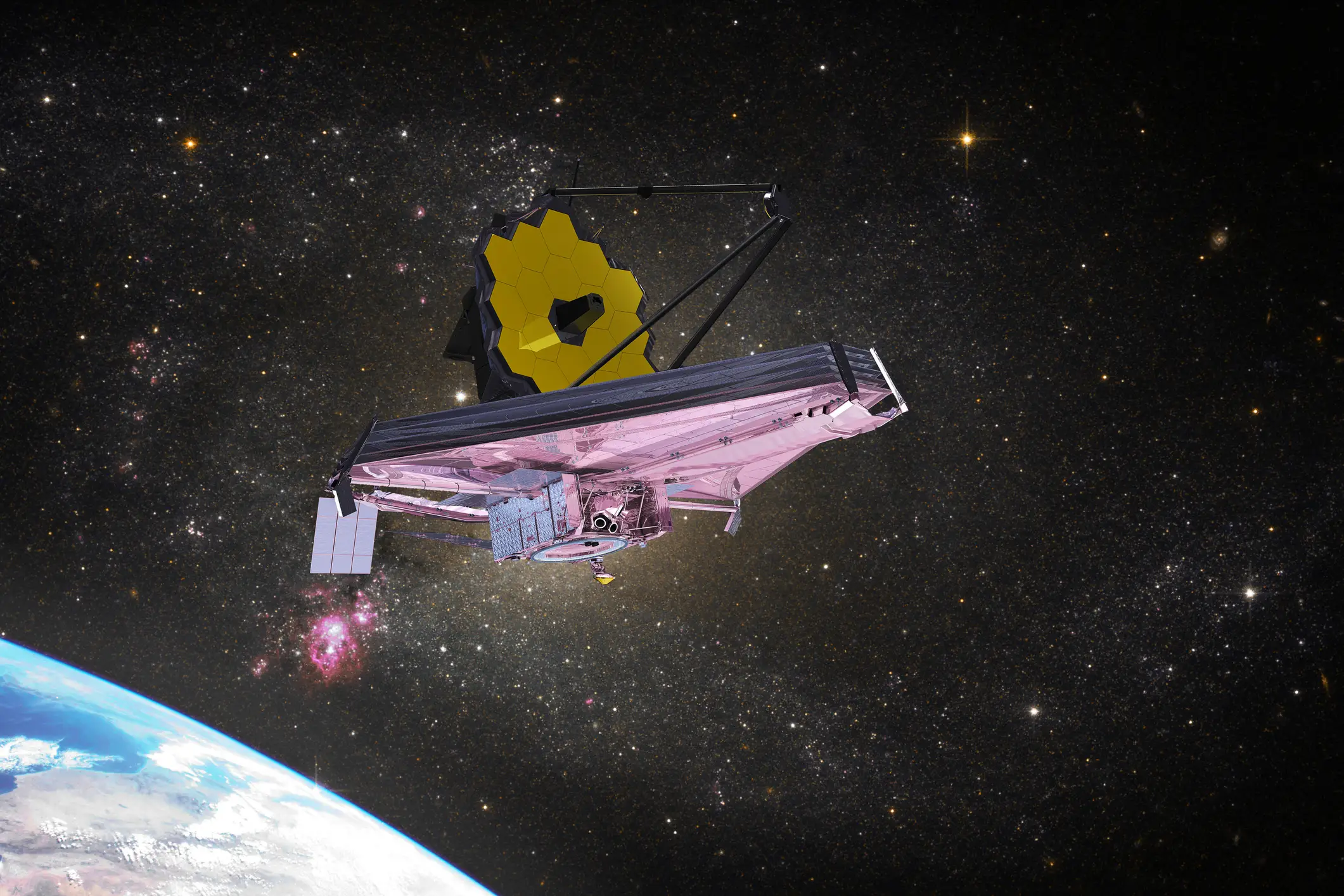
CGI of the James Webb Space Telescope in space (Getty Stock Image)

In the universe close to what we call home, your typical hot, massive stars have a temperature ranging between 70,000 to 90,000 degrees Fahrenheit (40,000 to 50,000 degrees Celsius).

According to the team, galaxy 9422 has stars hotter than 140,000 degrees Fahrenheit (80,000 degrees Celsius).

Dr Kats said: "The universe's stars are different than what we are familiar with - the exotic stars in this galaxy could be a guide for understanding how galaxies transitioned from primordial stars to the types of galaxies we already know."

Featured Image Credit: Getty Stock Images / NASA, ESA, CSA, STScI, Alex Cameron (Oxford)

Topics: James Webb Space Telescope, Space, NASA, Technology, Science

Tom Earnshaw
Tom Earnshaw

Tom joined LADbible Group in 2024, currently working as SEO Lead across all brands including LADbible, UNILAD, SPORTbible, Tyla, UNILAD Tech, and GAMINGbible. He moved to the company from Reach plc where he enjoyed spells as a content editor and senior reporter for one of the country's most-read local news brands, LancsLive. When he's not in work, Tom spends his adult life as a suffering Manchester United supporter after a childhood filled with trebles and Premier League titles. You can't have it all forever, I suppose.

X

@TREarnshaw

Recommended reads

England's most successful World Cup song is filled with NSFW innuendo and no one realisedNew Order/YouTubePriceless reason Joan Cusack quit Hollywood for 11 years before Toy Story 5 returnKarwai Tang/WireImageSimulation has just predicted who'll win the World Cup and it may upset fansEngland and Scotland will both be dreaming of World Cup glory. (Mandel NGAN - Pool/Getty Images)Man apologises to Jeremy Clarkson after 'throwing up in flowerbed' at pubPrime Video

Advert

Choose your content:

an hour ago
3 hours ago
4 hours ago
9 hours ago
  • England and Scotland will both be dreaming of World Cup glory. (Mandel NGAN - Pool/Getty Images)
    an hour ago

    Simulation has just predicted who'll win the World Cup and it may upset fans

    The 2026 World Cup will soon get under way but one prediction doesn't look good for England and Scotland.

    News
  • Omar Marques/SOPA Images/LightRocket via Getty Images
    3 hours ago

    Barclays offering 'free' £200 in next three months

    Barclays bank are offering a 'free' £200 and it's very easy to claim.

    News
  • Peter Dazeley/Getty Images
    4 hours ago

    New study discovers hidden reason why Ozempic doesn't work for everyone

    Scientists at Stanford Medicine said it's a 'genetic glitch'

    News
  • PA
    9 hours ago

    Homes and vehicles set on fire as violent disorder erupts across Belfast following knife attack

    Shocking footage showed properties, cars and a bus engulfed in flames across Belfast

    News
  • James Webb Telescope discovers ‘potentially hostile alien threat’ is 7 billion years old
  • NASA's James Webb Telescope discovers its first ever exoplanet
  • James Webb telescope findings suggest we might be living 'inside a black hole'
  • NASA telescope accidentally captures moment astronomers thought they would never see