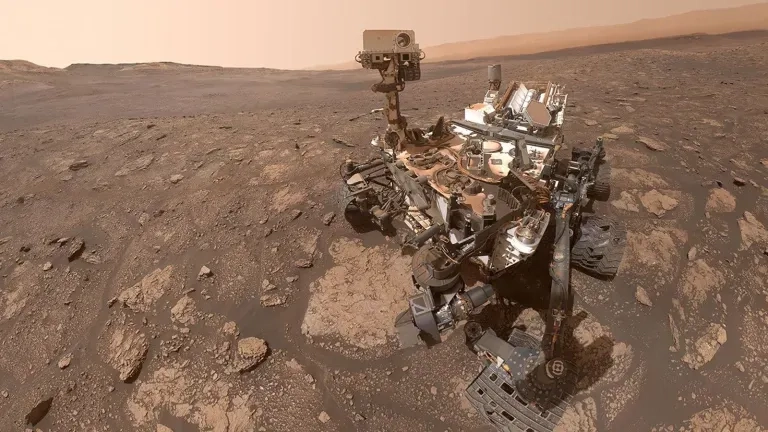
Curiosity rover finds best proof that there was life on Mars in groundbreaking discovery

NASA’s Curiosity rover has come across the best proof that there was once life on Mars.
The discovery from a rock sample Curiosity drilled in 2020 possessed the largest variety of organic molecules ever found on the Red Planet.
When scientists studied the sample, they found 21 different carbon-containing molecules, seven of which had never been seen on Mars before.
Organic molecules are important because they are the basic chemical building blocks needed for life.
Advert
While researchers say this discovery does not 100 percent prove that life existed on Mars, they said these molecules can be created through natural chemical or geological processes.
And their presence shows that ancient Mars had the right chemistry to potentially support living organisms.
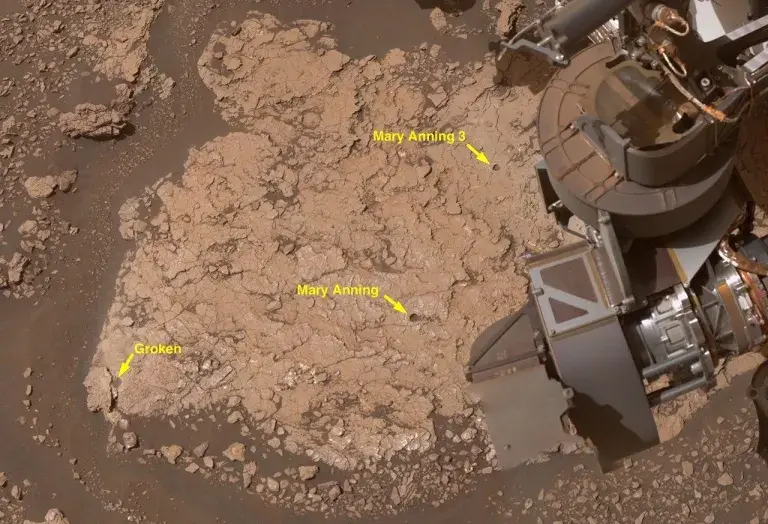
The rock sample 'Mary Anning 3' was collected from the slopes of Mount Sharp, and billions of years ago, this area likely had lakes and streams.
One of the most interesting discoveries in the rock was a nitrogen heterocycle, a type of molecule that contains carbon and nitrogen arranged in a ring.
These structures are important because they can be early building blocks of RNA and DNA, the molecules that carry genetic information in living things.
“That detection is pretty profound because these structures can be chemical precursors to more complex nitrogen-bearing molecules,” said Amy Williams, the lead author of the new paper which published the findings in Nature Communications.
“Nitrogen heterocycles have never been found before on the Martian surface or confirmed in Martian meteorites.”
"We think we're looking at organic matter that's been preserved on Mars for 3.5 billion years," Williams added.
"It's really useful to have evidence that ancient organic matter is preserved, because that is a way to assess the habitability of an environment. And if we want to search for evidence of life in the form of preserved organic carbon, this demonstrates it's possible."
Another molecule discovered was benzothiophene, which contains carbon and sulfur.
This compound has also been found in meteorites and scientists believe meteorites may have helped spread the chemicals needed for life throughout the early solar system.
“This is Curiosity and our team at their best. It took dozens of scientists and engineers to locate this site, drill the sample, and make these discoveries with our awesome robot,” said the mission’s project scientist, Ashwin Vasavada of NASA’s Jet Propulsion Laboratory in Southern California.
“This collection of organic molecules once again increases the prospect that Mars offered a home for life in the ancient past.”
 Anish Vij