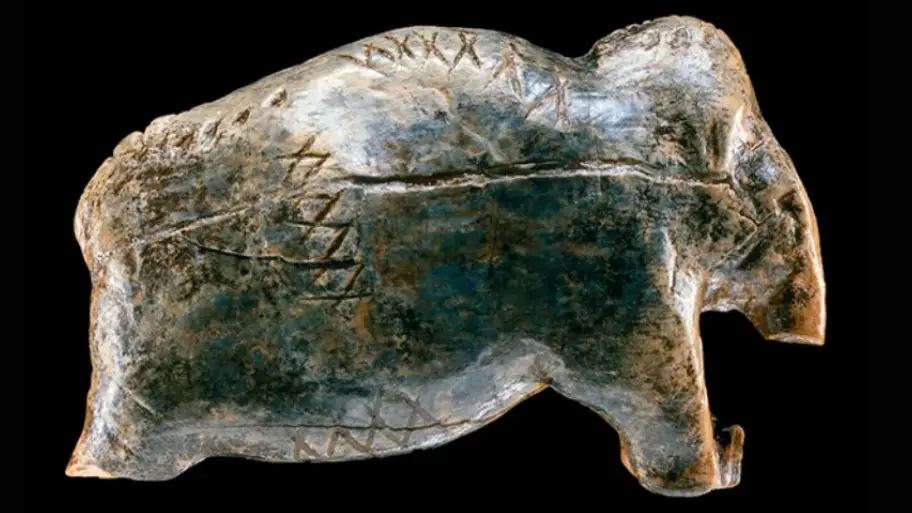
40,000-year-old missing chapter in human history revealed in major finding

The discovery of artefacts from 40,000 years ago may shed some light on a largely missing chapter in human history which could teach us more about how our species developed one of its most fundamental skills, the written word.
Through a few lines we have assigned meaning to in relation to language I'm able to communicate this discovery to you, and it's likely the source of most of your knowledge.
How do you know things? Probably because you read it somewhere, and writing had to start at some point with a study into 40,000-year-old items from linguist Christian Bentz of Saarland University and the Berlin State Museums archaeologist Ewa Dutkiewicz suggesting markings on the items could be an early form of written communication.
Written language is not universal to every people throughout history, but once we started we've never really stopped and many places created their own form of writing things down to pass along information.
Advert
These studied artefacts include carvings etched into bones and crafted ornaments, and the experts say the markings aren't directly connected to spoken language as we'd understand modern words, but nonetheless may have been used to convey information.
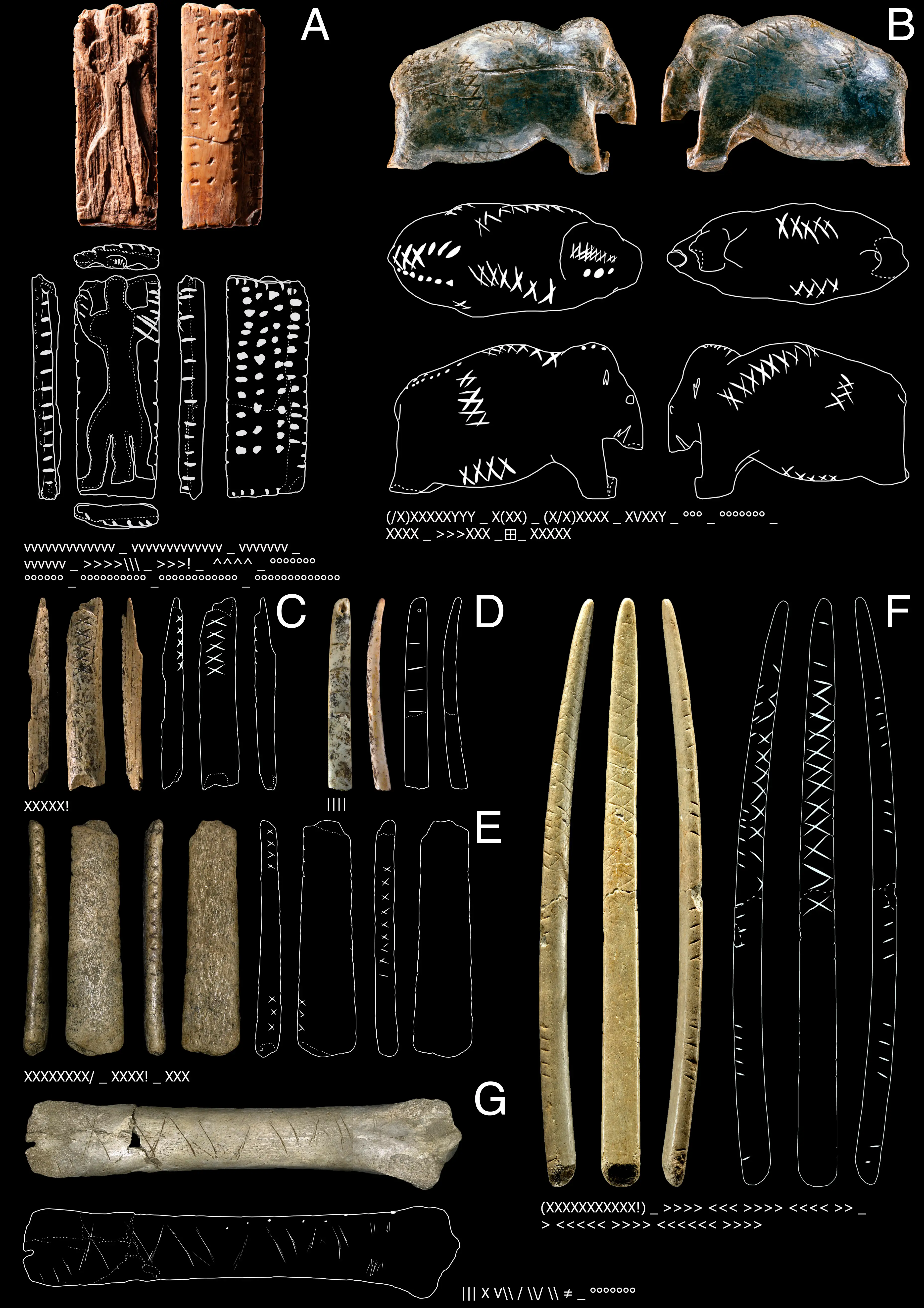
They compared this discovery from 40,000 years ago with something called 'protocuneiform', which is an early proto-writing system found in Mesopotamia as far back as the fourth millennium BC.
The researchers said: "These results cannot be taken to strictly prove that Aurignacian sign sequences encoded numero-ideographic information as in the case of protocuneiform.
"However, they prove that the first hunter-gatherers arriving in Europe already applied sign sequences of comparable complexity in a deliberate, systematic, and conventional manner - several ten thousand years before the advent of genuine writing."
By studying the markings the researchers found that they seemed not to be random, instead showing observable patterns.
Ancient peoples who carved these markings did not inscribe direct parallels with the spoken word, as far as we know that started about 5,000 years ago.
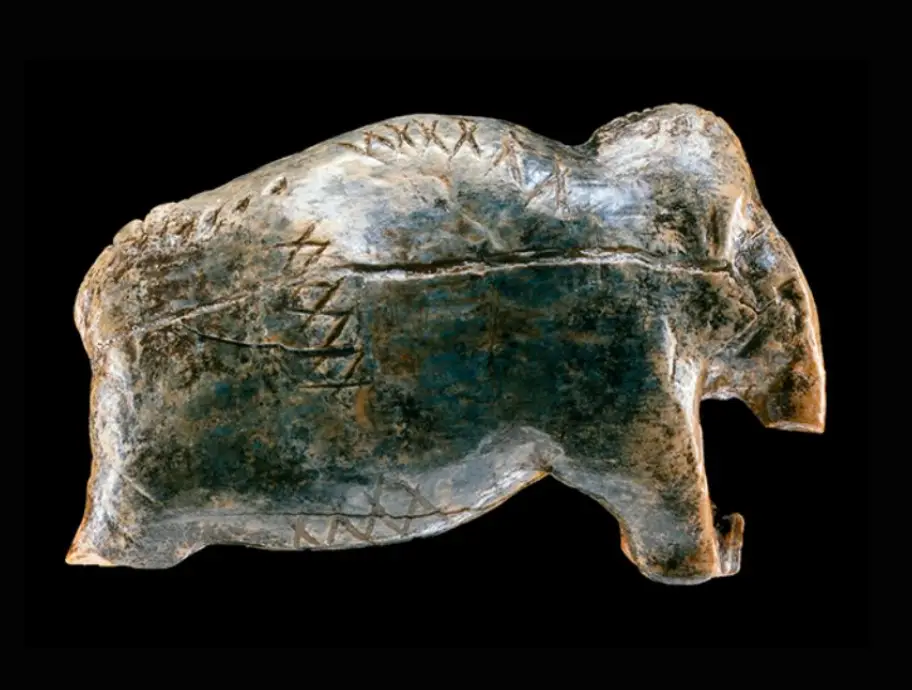
If you're wondering who the Aurignacians were, they're early modern humans living around Europe from around 43,000 years ago to 26,000 years ago.
Unfortunately we'll almost certainly never know what the markings meant since they don't correspond to language and we just don't know enough about them to learn more.
The researchers said it was 'hard' or even 'impossible' to prove the symbols served the same purpose as protocuneiform, and they pointed out another key difference.
While that early 'proto-writing' system developed into the Sumerian language, the oldest recorded written language, over the course of 1,000 years, this much earlier system of carvings and markings did not.
Instead, the researchers noted that the Aurignacian markings stayed 'stable in terms of information density' for 10,000 years and then disappeared.
While the markings are a sign of human craftsmanship and intent we'll probably never know what they were supposed to mean.
Topics: Archaeology, History, Science
 Joe Harker