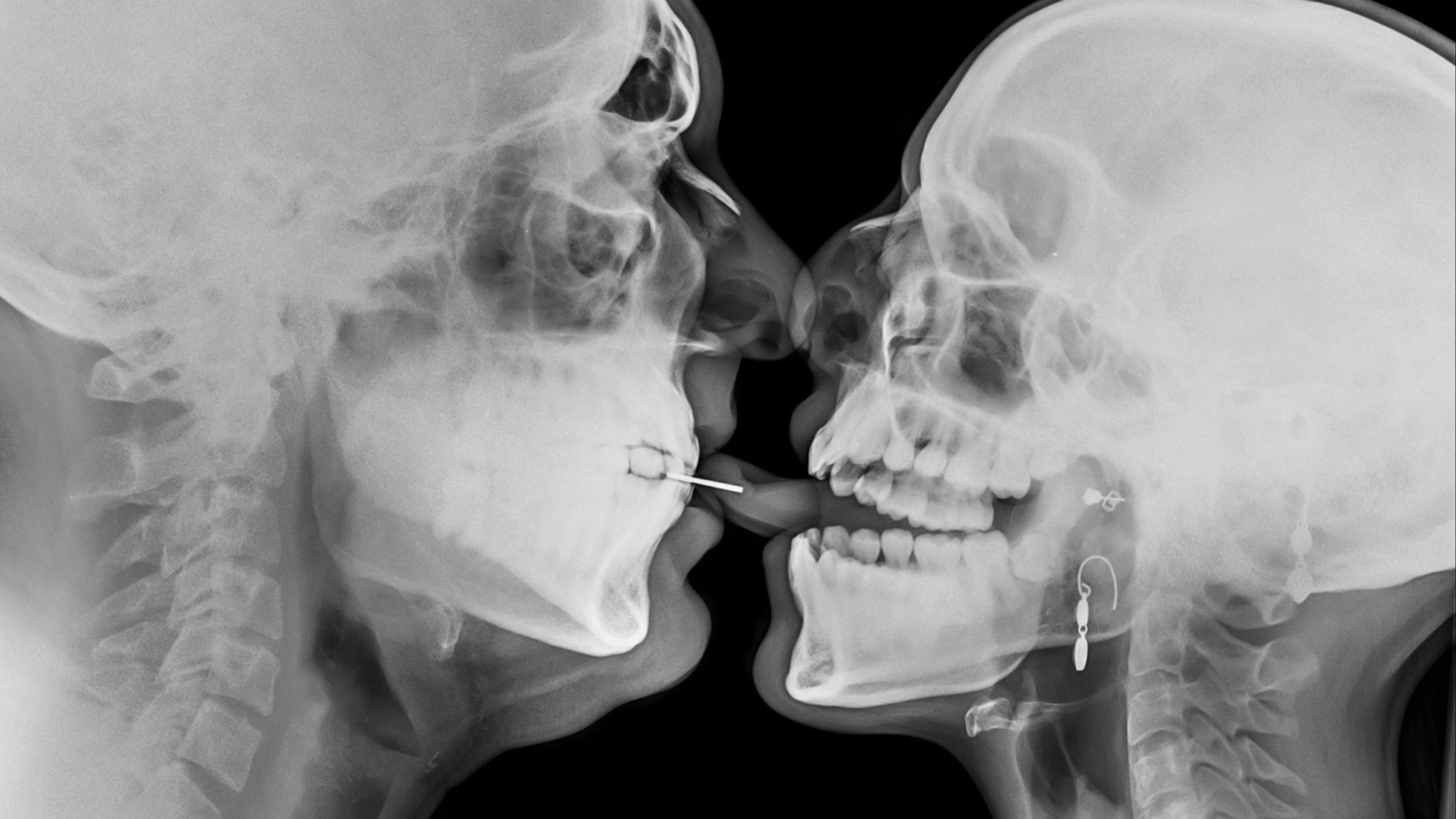
Man and woman had sex in MRI scan machine to show what really happens to body

There are plenty of unusual places that people have done the deed, on the beach, in a festival portaloo, or the mile high club, but few people can honestly claim to have had sex inside an MRI scanner.
Ida Sabelis and her boyfriend Jupp however, are one couple who actually can in all honesty make this claim, as they did the deed inside an MRI machine.
Most of us are familiar with what sex looks like outside the body, assuming you're not the sort to turn the lights off of course, but this unusual experiment allowed scientists to produce a scan and get internal images of what happens to our bodies while doing the deed.
Advert
Science obviously had a good knowledge of what goes on, but getting a live image of coitus is significantly more useful that those diagrams in the biology textbook, you know the ones.
Anyone who has had an MRI scan will know that the mechanical whirs and hums aren't exactly romantic, to say nothing of the rather cramped conditions.
But back in 1991 Ida and Jupp climbed inside a polo mint like MRI scanner and, impressively, managed to find it in themselves to overcome the less than ideal conditions and perform what has to be one of the most unusual liaisons.
The findings were published in the British Medical Journal (BMJ) eight years later.

The research paper - which had the catchy title 'Magnetic resonance imaging of male and female genitals during coitus and female sexual arousal' - went on to become one of the most popular studies shared by the BMJ, for reasons which remain a mystery.
The aim of this raunchy research was to 'find out whether taking images of the male and female genitals during coitus is feasible', as well as looking into 'whether former and current ideas about the anatomy during sexual intercourse and during female sexual arousal are based on assumptions or on facts'.
Enter Ida and Jupp, who were the guinea pigs who helped experts such as van Andel get a better grasp of what unfolds inside the body during sex.
Thankfully, this took place at a time when metallic and magnetic sex toys were far more of a luxury, so there were no unfortunate accidents inside the machine, and both adults came out unharmed - if not a little squished.
Things were certainly a little claustrophobic inside the MRI machine, so some of the more modern positions might not have been possible.

Instead, the couple opted for the spooning position while taking part in this experiment at a hospital in the Netherlands.
The images that were subsequently created actually helped to change a lot of people's minds about what happens to the body during sex.
Ida was interviewed on the What Was It Like podcast in April 2024, where she shared more about her experience and admitted that she had no idea of the impact that the experiment would have.
“This was one of the first MRI machines ever, so taking the photos took some time,” she told the host. "There was a command from the control room to keep in position for, I don’t know, a minute.
"So it was hilarious in that sense."

Although many men and women might struggle to perform in front of someone else, let alone several scientists while literally inside a very small machine, the images created by Ida and Jupp showed those in the medical industry that the vaginal canal was, in fact, curved.
“Jupp and I wriggled into that machine and started doing our thing,” she shared.
“It wasn’t romantic, it was more like an act of love and a performance. Thankfully, we didn’t get claustrophobic.”
The conclusion
The couple, who are still together to this day, were more focused on how cute they 'fit together.
However, a lot of credit must go to both for teaching the world more about the body, as it revealed that the man's penis bends to fit the shape of the woman's vaginal canal.
This was in direct contrast to a painting from Leonardo da Vinci, which had left people believing that the vagina was a straight cylinder for more than 500 years.
In wake of the study involving Ida and Jupp, researchers concluded that the MRI machines did 'contribute to the understanding of anatomy'. Nice one, lads!
In total, van Andel used eight couples and three single women as his subjects while carrying out research into what happens when humans have sex inside of an MRI machine.
Topics: Health, Science, Sex and Relationships
 James Moorhouse


