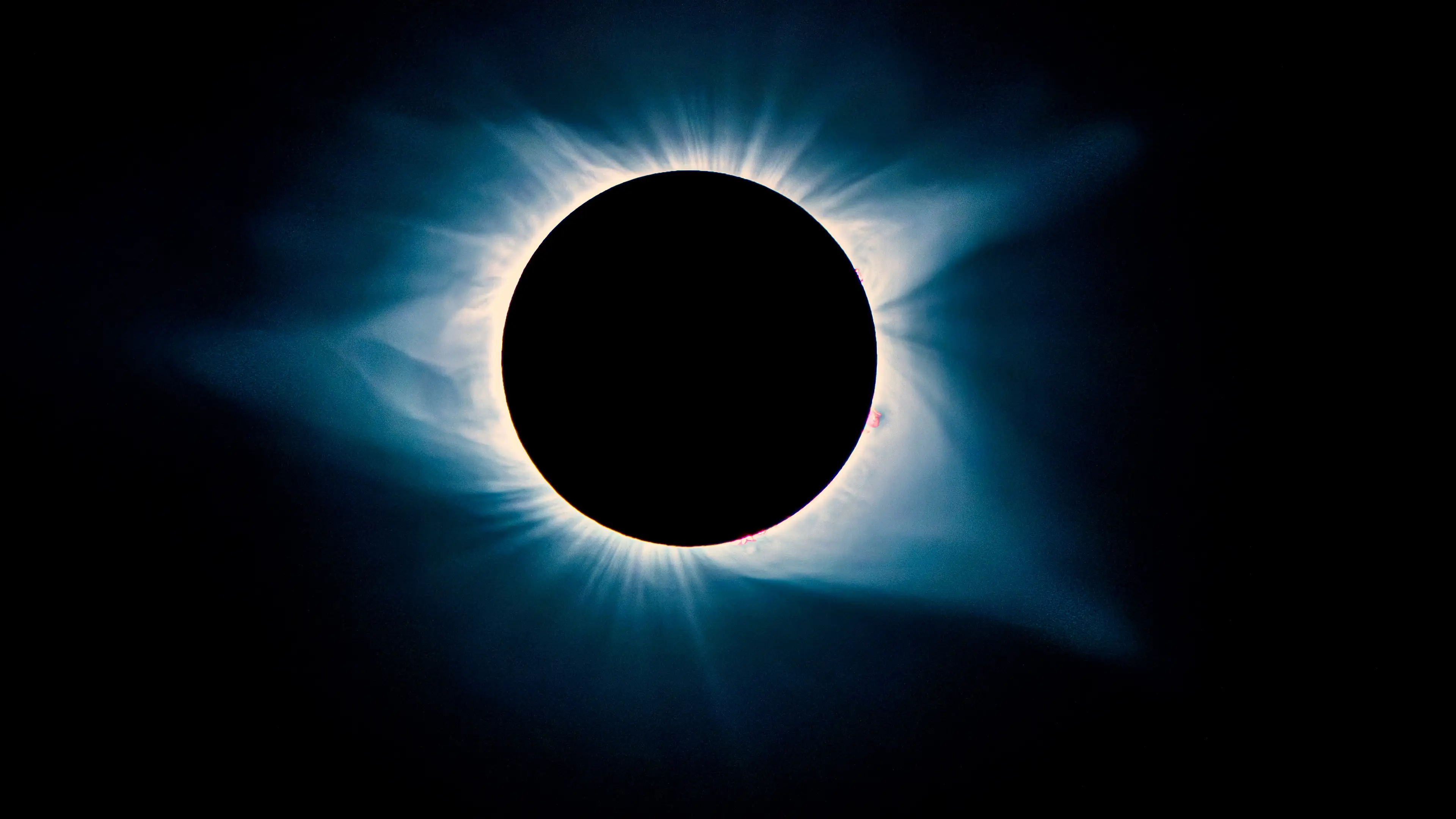
NASA addresses wild theory that 'gravity will switch off for seven seconds' after solar eclipse

NASA has issued a statement debunking a wild theory which claimed that Earth will lose gravity for seven seconds on Wednesday causing the deaths of millions.
The bizarre conspiracy theory has been kicking around the internet for several months claiming that as parts of Europe, including the UK, get a solar eclipse, the Earth would be hit by an ‘intersection of gravitational waves’ which were produced when two black holes collided millions of years ago and gravity would be cancelled out for seven seconds.
According to the online rumours, which have spread like wildfire on TikTok and Instagram, information about the event is allegedly detailed in a NASA programme called Project Anchor, which claims the US space agency had earmarked $90 billion dollars to prepare and deal with the fallout.
Advert
However, as you might have already suspected, the whole thing isn’t true.
NASA has since issued a statement in an attempt to shut down the conspiracy theory.
A spokesperson said: “The Earth will not lose gravity on August 12, 2026. Earth's gravity, or total gravitational force, is determined by its mass. The only way for the Earth to lose gravity would be for the Earth system, the combined mass of its core, mantle, crust, ocean, terrestrial water, and atmosphere, to lose mass."
NASA went on to explain that an eclipse won't interfere with gravity on Earth in any way.
The spokesperson added: “A total solar eclipse has no unusual impact on Earth's gravity. The gravitational attraction of the Sun and Moon on the Earth, which doesn't impact Earth's total gravity, but does impact tidal forces, is well understood and is predictable decades in advance.”
As for the so-called Project Anchor, the BBC reports that there are no public records about the programme at all.
Many of the accounts that originally shared the conspiracy have since been removed, while others have been shown to post nothing but AI-generated conspiracy theories.
And there have been plenty of folks who have been quick to pick holes in the black hole theory.
Dr William Alston, a black hole expert from the University of Hertfordshire, has explained why gravitational ripples that reach Earth aren’t capable of majorly affecting gravity on our planet.
"These ripples are so weak that we have had to build the most sensitive detection equipment to see them – known as the LIGO and Virgo observatories,” he told the Daily Star.
"These ripples routinely pass through Earth and ourselves, very subtly squeezing and stretching us; however, this is so small – many times smaller than the size of an atom – that this change goes by completely unnoticed."
So there you go.
You can go out and enjoy the solar eclipse without any concerns of suddenly floating off into the sky. Just make sure that you do it safely.
How to watch a solar eclipse safely
When watching a partial or annular solar eclipse directly with your eyes, you must look through safe solar viewing glasses, which are known as 'eclipse glasses', or a safe handheld solar viewer at all times.
Eclipse glasses are not regular sunglasses; regular sunglasses, no matter how dark, are not safe for viewing the Sun.
Always make sure to inspect your eclipse glasses or handheld viewer before use; if torn, scratched, or otherwise damaged, discard the device.
Never look at the Sun through a camera lens, telescope, binoculars, or any other optical device while wearing eclipse glasses or using a handheld solar viewer - the concentrated solar rays will burn through the filter and cause serious eye injury.
Of course, if you do not have eclipse glasses or a handheld solar viewer, you can use an indirect viewing method, which usually consists of a pinhole projector. This has a small opening and projects an image of the Sun onto a nearby surface.
With the Sun at your back, you can then safely view the projected image.
 Claire Reid