Clearest Banksy 'sighting' to date as years-long investigation finally 'unmasks' artist

After decades of mystery, the veil has finally been lifted - and a bombshell investigation claims to have uncovered the true identity of graffiti artist Banksy.
Anonymity is a key basis of his whole brand, as his lawyer pointed out while disputing the accuracy of the fact-finding mission which allegedly led to the discovery of his real name.
But if the findings are to be believed, they do add some weight to previous claims that the elusive artist was spotted lingering around one of his works a couple of years ago.
According to Reuters, spending a year sifting through court records and police reports, as well as interviewing a dozen insiders and experts, paid off big time.
Advert
The news agency claim that all the evidence it acquired led them to one firm conclusion - that Banksy is in fact a bloke named Robin Gunningham.
If you've got your finger on the pulse of the underground art world, you might have heard that moniker before, as it previously cropped up back in 2008.
Nearly two decades ago, media reports circulated which claimed that Gunningham was actually the guy who whipped up extraordinary murals with cans of spray paint in the shadows.
The name then cropped up again a few years later when a lawsuit which was launched against Banksy's company, Pest Control Ltd.
Reuters claims that Banksy ended up legally changing his name to David Jones in 2008 to try and throw the scent off of him.
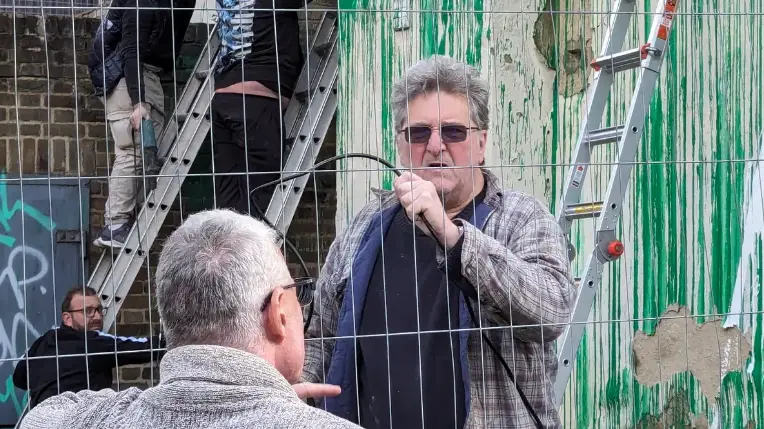
Further fuelling speculation that Gunningham is the Bristol-born artist, a bloke who is apparently the double of him was spotted at the site of one of his famous artworks in London.
In March 2024, a mural which depicted a woman blasting green paint onto a peeling white wall that sits behind a bare tree - to mimic foliage - appeared on the side of a residential building in Finsbury Park.
One of the many fans who flocked to see this piece in the flesh claimed that they noticed a man who bore a 'striking resemblance' to Gunningham lurking around.
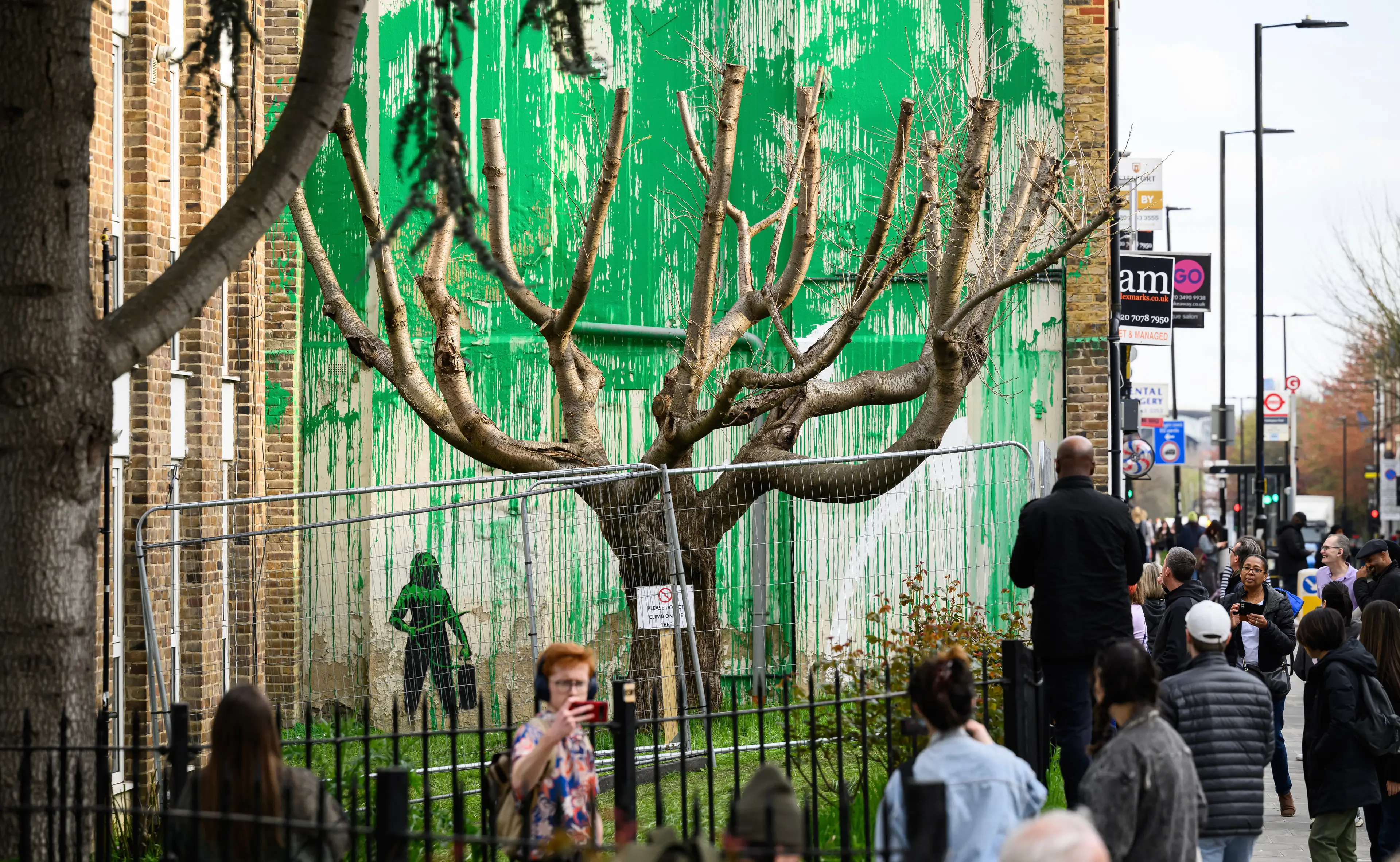
The Banksy-obsessed local said at the time: "I have been going to the mural for a whole week. On Saturday there were more security fences and CCTV up and a few people putting up Perspex over the artwork.
"I went back at 10am to go have another look at what they were doing and saw this man who looks exactly like the photo I saw 20 years ago of Banksy.
"I found it weird he was putting up his own Perspex. The people putting it up weren’t wearing council uniforms or anything, one was wearing a Nirvana t-shirt. He must have been there for hours."
However, the fella who was pictured at the mural later told The Sun that the idea that he was actually Banksy was 'nonsense'.
He insisted his name was actually George Georgiou and claimed he was the father of the man who owned the residential building which was adorned with the artwork.
He told the publication: "Instead of just whipping a picture, they should’ve just said who are you? Would’ve been so much easier."
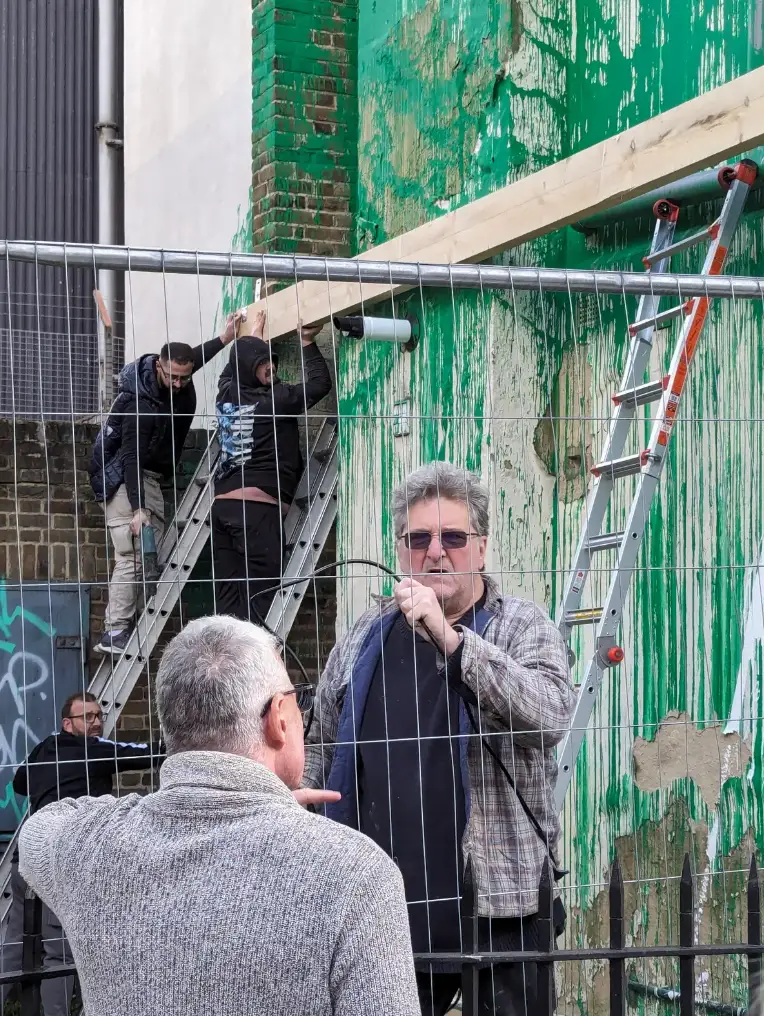
Speaking of the artwork, he added: "I’d like to get a roller and go over it, get it over and done with, just paint it. It’s not a masterpiece by any stretch of the imagination.
"It’s for the public really. Am I fan? I dunno, not a thing I have ever really thought about. We are running round like headless chickens trying to protect it."
Despite Georgiou's denials, this incident has still gone down in history as one of the clearest supposed Banksy sightings to date.
Although we're still not necessarily 100 percent sure of the name that the secretive artist is apparently operating under, what we can be sure of is what he thinks of people trying to expose his true identity.
In response to the Reuters investigation, Banksy's lawyer Mark Stephens said that his client 'does not accept that many of the details contained within [the] enquiry are correct'.
Stephens said that sharing the alleged findings 'would violate the artist’s privacy, interfere with his art and put him in danger'.
He added: "It protects freedom of expression by allowing creators to speak truth to power without fear of retaliation, censorship or persecution."
For years, Stephens wrote, Banksy has 'been subjected to fixated, threatening and extremist behaviour'. He also suggested that unmasking him would harm the public, too.
Working 'anonymously or under a pseudonym serves vital societal interests,' he wrote. "It protects freedom of expression by allowing creators to speak truth to power without fear of retaliation, censorship or persecution - particularly when addressing sensitive issues such as politics, religion or social justice."
 Olivia Burke