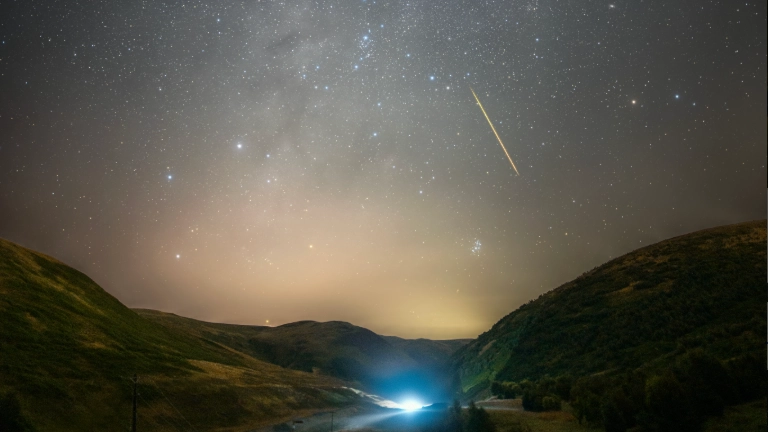
This is how to see the strongest meteor shower of the year tonight

A meteor shower predicted to be the ‘strongest’ of the year will peak tonight (14 December).
Astronomers have said conditions could make for a rather striking show of the Geminid meteor shower – if the British weather allows it.
Visible all over the world, it’s said that those in the Northern Hemisphere will have the best views, and there are plenty of tips available if you’re hoping to catch a glimpse.
And if we just so happen to actually have clear skies in the UK tonight, the waning crescent moon rising after midnight means there could be several hours of dark skies for decent views of the meteors.
Advert
One expert has said the Geminids is ‘pretty much the strongest meteor shower of the year’ with an impressive volume and frequency of its ‘shooting stars’.

The Geminid meteor shower
Active between 4 and 20 December, the Geminid meteor shower peaks tonight and has been known to produce over 120 meteors per hour at this time. Although light pollution and other factors, of course, mean that the actual number visible is a lot less.
The meteors of the shower are described as being very bright, moderately fast and ‘unusual’ in that they are multi-coloured – typically white with some yellow and a few green, red and blue.
Royal Museums Greenwich explains: “These colours are partly caused by the presence of traces of metals like sodium and calcium, the same effect that is used to make fireworks colourful.”
The Geminids are set apart from other showers due to their origin, as while most originate from comets, Geminids are ‘leftover bits and pieces of the asteroid known as 3200 Phaethon’.
However, there is some uncertainty about how and when the Geminid dust was formed.
Tips for watching it
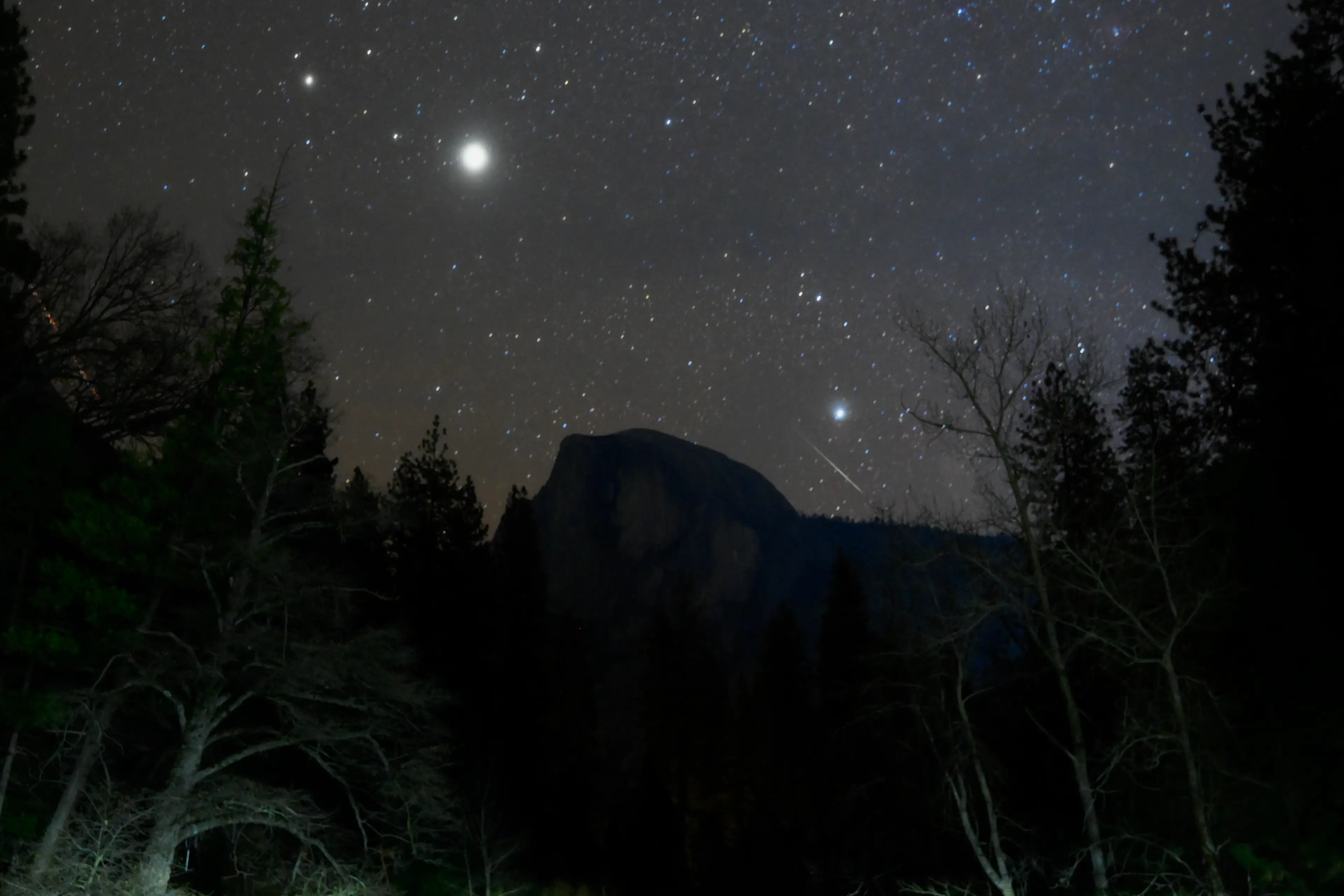
Describing this meteor shower as 2025’s ‘strongest’, Dr Robert Massey of the Royal Astronomical Society told the BBC: “What you'd be looking at in a nice dark sky without clouds would be, say, 100 [‘shooting stars’] an hour, which is amazing.”
The shower tends to show good activity before midnight, and that’s helped by the waning crescent Moon. The Geminids can be seen by the naked eye, but you will need to let your eyes adjust to the dark.
The pros at Royal Museums Greenwich add: “It is best not to look directly at the radiant as this can limit the number of meteors you see.
"Try instead to look just to the side in a dark area of sky, and you will be more likely to catch sight of some meteors.”
It’s thought that those in northern Scotland and the Northern Isles, as well as parts of East Anglia and southeast England, will likely have the best chance of a decent showing tonight. But it’s worth to keep checking on the weather for the potential of clear gaps in the sky.
The best viewing time is said to be between 10pm and 2am, looking east-northeast in the sky.
And as tends to be the case with these kinds of things, it’s best to go to a wide open space away from street lights and other sources of light pollution.
 Jess Battison