Putin's terrifying new weapon could plunge Earth into darkness and send world into nuclear war

A terrifying weapon could be used by Russia, striking at the heart of modern communications and information.
The prospect of detonating a nuclear weapon anywhere is a horrifying prospect, and one way of doing this would not be used in a way to directly aim at targets on the ground, but up in space.
Western military worry that Russia is currently not far from being able to send nuclear warhead into space for precisely this reason.
Nuclear weapons are about as horrifying a prospect as it gets, with not just the immediate destruction but also the utter breakdown of civilisation.
Advert
In this case however the target would not be anyone on the ground, but the huge network of satellites which orbit the Earth, providing the infrastructure for communications, scientific research, and navigation, among other things.
The nuclear explosion in space could be aimed at causing widespread destruction in satellites, destroying them indiscriminately and sending out an electro-magnetic pulse which fries their electronics.
Dr Stephen Blank is a Senior Fellow at the Foreign Policy Research Institute who has written extensively on Russian nuclear strategy, and said that such an attack could affect millions.
"Such a detonation would knock out many if not all LEO [low earth orbit] satellites but could also knock out GPS and ordinary electric use for millions of people," he told LADBible.
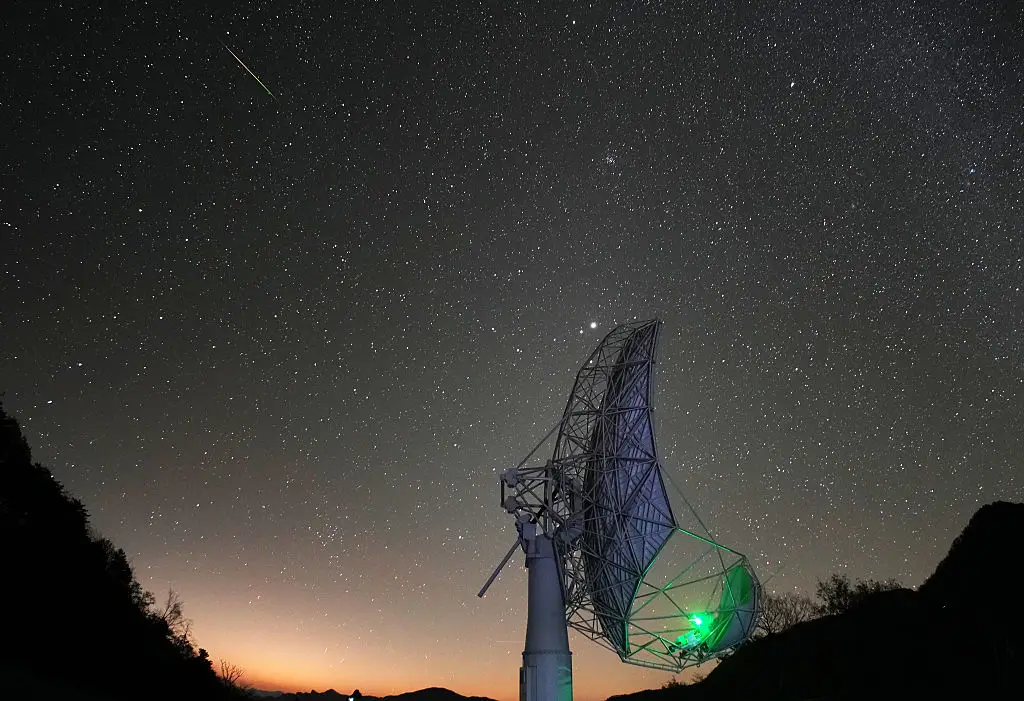
As for whether Russia is capable of carrying out such an attack, he said: "Russia is reportedly close to having a nuclear weapon in space, though nobody knows for sure."
Nonetheless, he said that Russia is 'unlikely to strike first unless NATO strikes first, especially at its nuclear systems'.
Dr Blank went on to say that if Russia were to attack in this way then it 'would also trigger proportionate, if not more than that military responses against Russian targets'.
There are some suggestions, such as German intelligence agency BND claiming that the new weapon could be deployable in as little as two months, though of course it is not clear just how close Moscow is to having this weapon ready.
The effect of the attack would be to seriously damage infrastructure which relies on satellites, including both military and civilian uses.
Space is something which strategists at NATO, the alliance originally founded as a deterrent to the Soviet Union, and which now exists as a bloc against Putin's Russia, has said that it is actively looking to secure against Russia.
Shelli Brunswick is the Founder and CEO at SB Global LLC and former Chief Operating Officer of Space Foundation, who also has 29 years experience in the US Air Force specialising in space acquisition, and said that she 'take the reports seriously'.
“Some satellites could fail straight away," she said. "Others could suffer damage over time as they pass through lingering radiation.
"On Earth, someone who relies on satellite broadband could notice a service drop as soon as their provider loses coverage.
"Other problems could show up later, if equipment on the ground loses its satellite timing signal and its backup clock can no longer keep it in sync.”
But while an attack like this has the potential to cause chaos, Dr Blank said that unless tensions escalate with Russia it may be an immediate concern.
"Frankly I’m not deeply concerned about this threat unless Russia escalates to a point where NATO including the UK are attacked in this manner or with force majeure-direct force," he said.
While such direct attacks might not be a point of immediate concern, another area of security problems is in 'Grey Zone' attacks, which aim to disrupt the target country's infrastructure but fall short of being an outright act of war.
This might be something like a cyber attack on public transport, or targeting food supply chains, and has the potential to cause serious damage and disruption.
Topics: World News, Vladimir Putin, News
 Kit Roberts