
People ‘most at risk’ as four contaminated wet wipe brands linked to six deaths

The people who are most likely to be contaminated with a deadly bacteria from certain brands of banned wet wipes, have been revealed.
Brits have been advised to steer clear of these brands, as their use has led to the deaths of six people.
You should probably have a look through the first aid kits and medicine cabinets in your house to make sure you don't have these four brands lying around.
Using these wet wipes could lead to death, as the UK Health Security Agency (UKHSA) and the Medicines and Healthcare products Regulatory Agency (MHRA) have issued warnings in relation to 'an ongoing risk of infection associated with their use' in February.
Advert
A study in Eurosurveillance reveals that at least six deaths have been linked to using potentially contaminated skin cleansing wipes in the UK since 2018.
These wipes have been found to be susceptible to contamination by a strain of bacteria called Burkholderia stabilis (B. stabilis), with serious cases sometimes leading to sepsis or even death.
Which wipes have been contaminated?
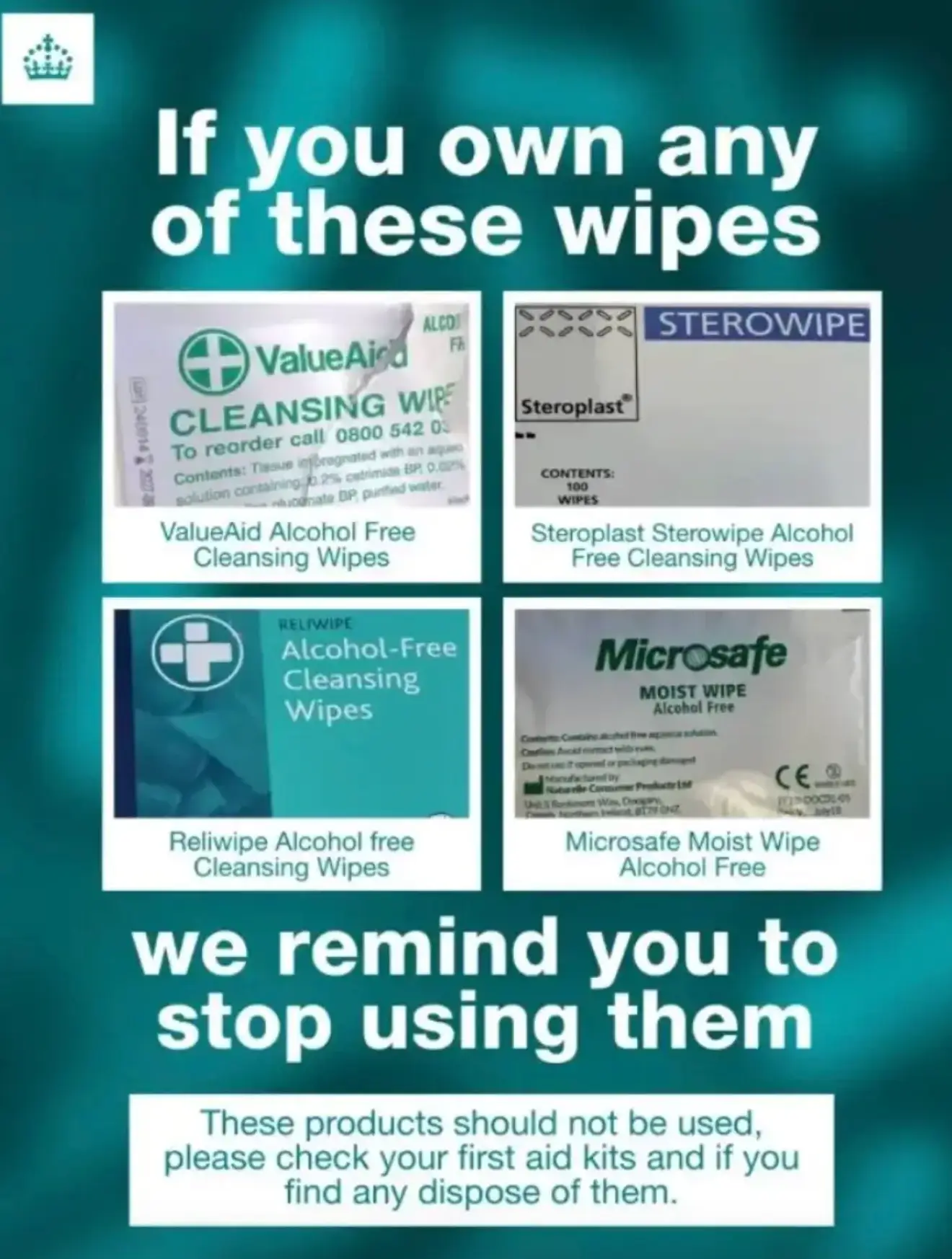
According to the UKHSA, there are four brands of non-sterile wipes which were 'found to be contaminated' with B. stabilis.
They are:
- ValueAid Alcohol Free Cleansing Wipes
- Microsafe Moist Wipe Alcohol Free
- Reliwipe Alcohol Free Cleansing Wipes
- Steroplast Sterowipe Alcohol Free Cleansing Wipes
Health experts highlight that non-sterile alcohol-free wipes shouldn't be used for first aid purposes, and especially not on broken or damaged skin, or used to clean intravenous lines.
These wipes were withdrawn from sale in July 2025 after the MHRA got involved, and they should be discarded if found around your home or medical kits.
Who is most at risk of contracting the virus?
Those who have intracascular devices, such as IV lines, immunocompromised patients, and individuals with conditions such as cystic fibrosis, are more at risk of developing serious health conditions if exposed to the bacteria.
This also includes those undergoing chemotherapy and those having organ transplant recipients.
B. stabilis is an environmental organism after all, which doesn't usually cause ingection in healthy people, though they can cause serious, invasive infections if introduced into normally sterile body sites, say ESC First Aid.
Contaminated wipes used on broken skin or medical devices could lead to infection.
What is B. stabilis?
The bacteria is normally found in the environment, such as in soil and water, though it can cause big problems if it finds a way into your body, especially with a weakened immune system.
Infections can occur following 'contact with contaminated products on broken or damaged skin', or through 'introduction of bacteria through medical devices such as intravenous lines'.
What are the symptoms of a B. stabilis infection?
"There have been 59 confirmed cases in an outbreak of Burkholderia stabilis identified in the United Kingdom from 2018 and up to 3 February 2026, associated with several non-sterile alcohol-free wipe products," the
The UKHSA confirmed that there have been 59 confirmed cases of an outbreak of B. stabilis from 2018 to 3 February 2026, as patients were aged between 0 and 93, with 15 of them aged 19 or younger.
They explained that the main symptoms are as follows:
- Wound or skin symptoms - includes swelling, redness, increased pain, warmth around a wound or break in skin, and pus or other drainage from this
- Serious cases may reveal indicators of sepsis - this can include pale or blotchy skin, a rash that does not fade when glass is rolled over it, or a shortness of breath
- IV line infections - any redness, pain or swelling around the insertion site
- Symptoms of an infection - fever, chills, or feeling unwell
 Joshua Nair