
'Red line' every parent should know about as boy given lethal diagnosis after grazing elbow

A mum is warning other parents to be aware of a 'red line' after her son grazed his elbow and then had a mark appear on his skin.
Samantha Silver posted on social media that her son Leo had grazed his elbow in the playground on a Thursday, with the mark cleaned and dressed by the school nurse.
The mum changed her son's plaster later that night, but the next evening the boy said his armpit was aching.
Thinking he was 'trying to delay bedtime', she gave him some Calpol and told him to go to sleep, and by the Saturday he was well enough to go out with his friends though said his arm ached after playing padel.
Advert
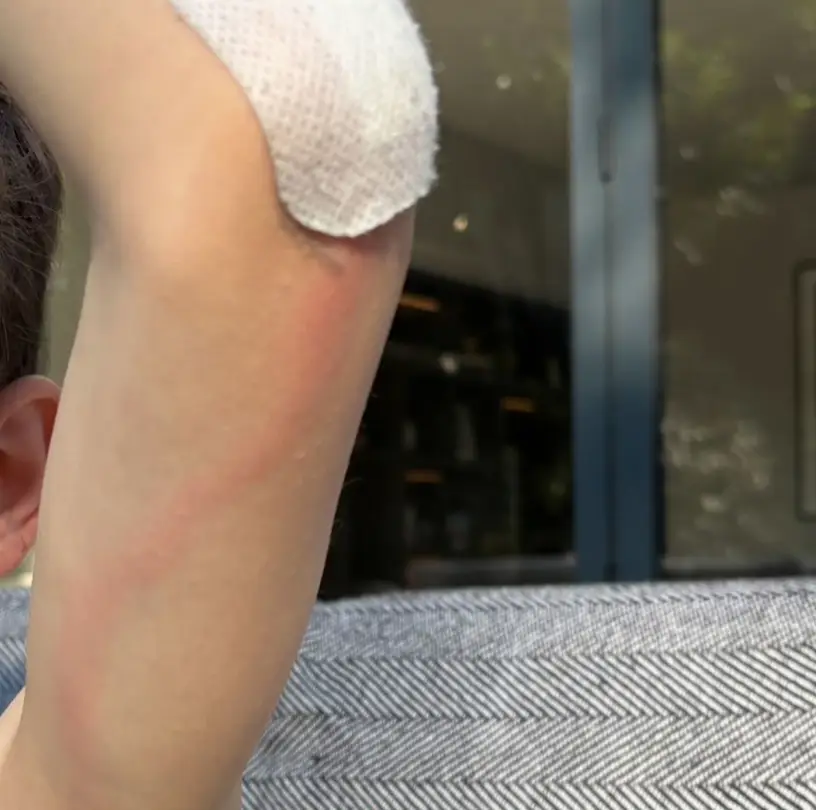
While he didn't have a fever and mostly felt fine, at 5pm that evening he complained about his arm and said he had a red line going from his elbow up to his armpit.
Samantha had heard a red line was a possible sign of sepsis and decided not to take any chances, so the mum took Leo to A&E to get him admitted to hospital.
That turned out to be the right decision as the red line coming from an injury is a sign of lymphangitis, a sign an infection moving along a person's lymph vessels.
It shows how an infection can get from the point where it entered the body and spread further within a matter of hours, and the red lines are a warning not worth ignoring as the infection can enter the bloodstream and cause sepsis.
Fortunately for Leo they caught the lymphangitis in time and a course of antibiotics sorted him right out, with Samantha saying her son was 'absolutely fine'.
She's glad she didn't leave it longer and is hoping other parents listen to their instincts when something like this comes up.
Symptoms of sepsis
Sepsis is a life-threatening condition and one of the most dangerous aspects of the disease is that it can be hard to spot.
Fortunately for Samantha and Leo the red mark from the lymphangitis served as an early warning system which allowed the boy to avoid sepsis from an injury as seemingly minor as a graze on his elbow.
The NHS says many of the symptoms can also be confused for other illnesses, which makes spotting it even tougher.
The common symptoms of sepsis for babies and younger children are:
- Blue, grey, pale or blotchy skin, lips or tongue
- A rash that doesn't fade with glass on it, similarly to meningitis
- Difficulty breathing
- Weak, high-pitched crying
- Abnormal responses, a lack of interest in feeding or normal activities
- Being sleepier than usual
In older children and adults the signs are a little different, and include:
- Confusion, slurred speech, nonsensical speech
- Blue, grey, pale or blotchy skin, lips or tongue
- A rash that doesn't fade with glass on it, similarly to meningitis
- Difficulty breathing
If you feel very unwell, have swelling or pain around a cut, very high or very low temperature then even if you're not sure it's sepsis you should call for help.
 Joe Harker