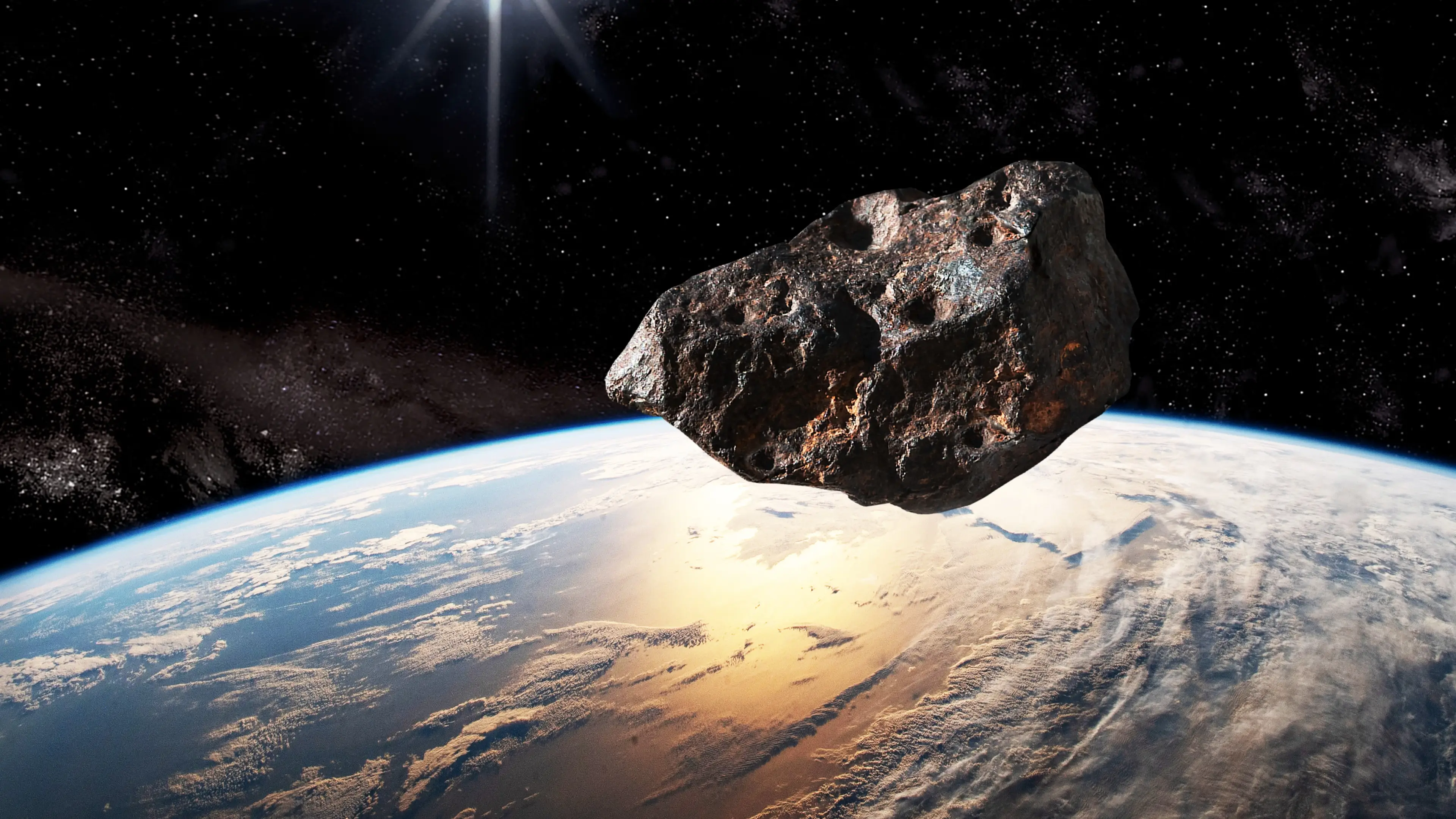
NASA launching mission to combat '100% chance' of killer asteroids hitting Earth

NASA is launching a mission to combat '100% chance' of killer asteroids hitting Earth as it hit the tenth anniversary of International Asteroid Day.
The anniversary, celebrated on 30 June, marks a decade since the United Nations established the observance and now, scientists say Earth is better prepared to defend itself from the dangerous impact of one of the celestial bodies, which can range in size from a few feet across to a few hundred miles.
However, experts also warn that more needs to be done to protect us, including adding more eyes fixed on space.
"There's an 100 percent chance that if we don't do something, a dangerous asteroid will hit and people will be hurt and killed," Bruce Betts, chief scientist and LightSail program manager for The Planetary Society, told ABC News. "And it may be tomorrow and it may be 100 years from now."
Advert
The mission launches the Near-Earth Object Surveyor,(NEO) a space telescope designed to detect asteroids and comets that could pose a threat to Earth, was conceived in the early 2000s and finally got the green light in 2022.
The Surveyor can detect the heat asteroids and comets absorb from the sun, making them far easier to identify.
Its components are now being built, tested, and assembled in clean rooms across the United States ahead of its planned launch in September 2027.
"We’re in the thick of building everything,” Amy Mainzer, NEO Surveyor’s principal investigator and now an astronomer at the University of California, Los Angeles (UCLA) told Science.
“It’s really amazing to see things we’ve seen on PowerPoint slides and on cocktail napkins for years and years and years now as real pieces of hardware.”
The mission has one major goal: to help planetary defenders find nearly all near-Earth asteroids at least 140 meters in length.
Scarily, these asteroids are sometimes called 'city killers' due to the fact that a direct strike on a large metropolis could unleash the destructive energy of 300 million tons of TNT.
To put that into perspective it's six times the volume of the Tsar Bomba, the most powerful nuclear bomb ever detonated.
Many of these asteroids are invisible to astronomers as they can hide in the light of the sun, loop about on eccentric orbits most telescopes can't detect and camouflage themselves with dark coatings. But the NEO Surveyor will see them as clear as day.
One such celestial threat facing Earth is an asteroid named Apophis. Roughly 1,500 feet across and larger than the Empire State Building is tall according to NASA, it's on track to pass within about 20,000 miles of Earth in April 2029.
Hundreds of miles closer to us than the moon, this huge asteroid will even be visible to the naked eye.
"Although Apophis was identified as one of the most hazardous asteroids that could impact Earth, astronomers have since ruled out an impact for the next 100 years," NASA's Office of Inspector General wrote in a June 2025 report. "It has the potential destructive power to take out a metropolitan area."
Launching as early as fall 2027, the Surveyor spacecraft is being tasked with finding at least 'two-thirds of potentially hazardous asteroids' during its five-year mission.
Topics: NASA, Space, Technology
 Louisa Gregson