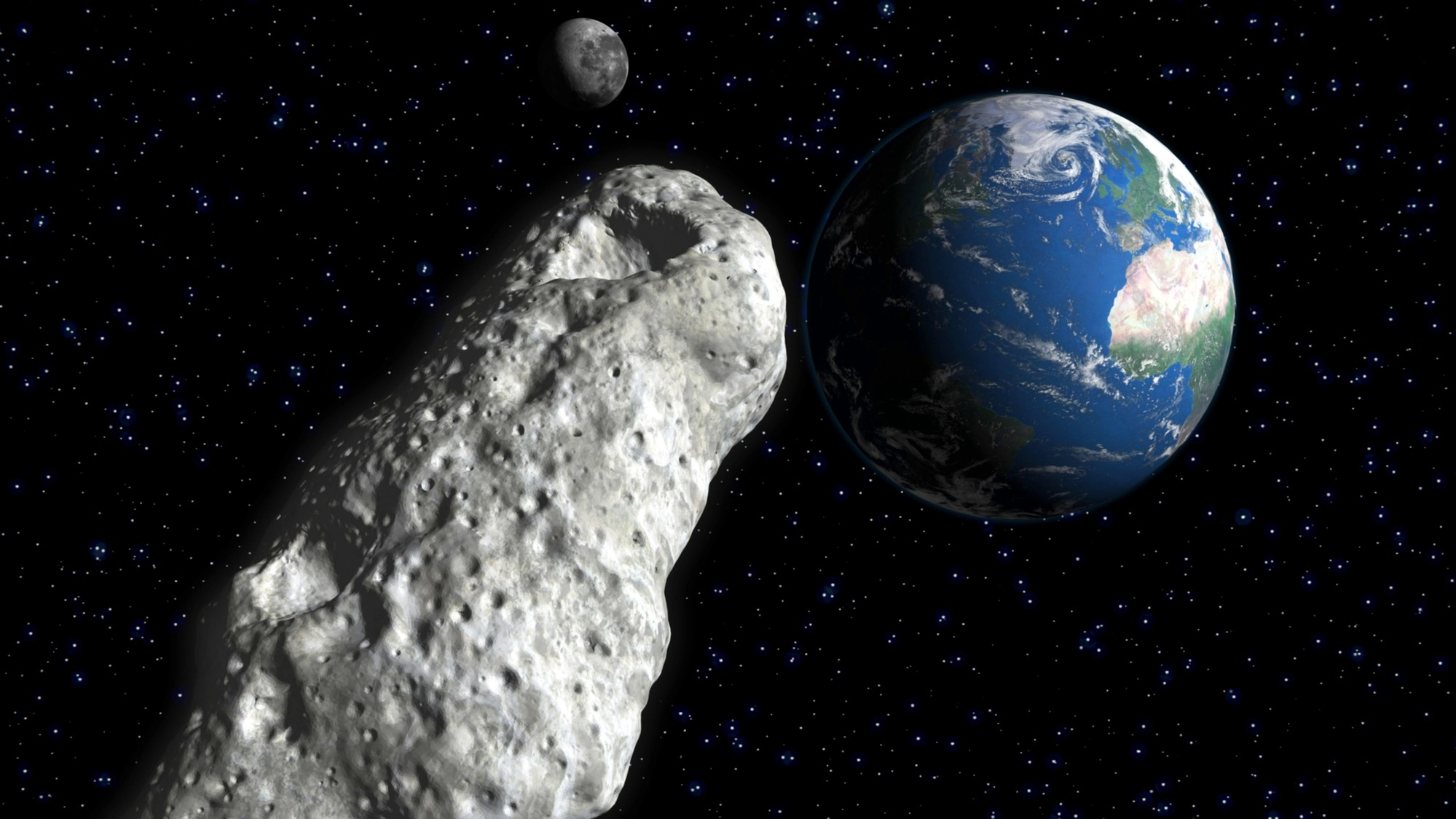
NASA updates odds of 'city killer' asteroid hitting the Moon in six years' time

NASA has issued a pretty welcoming update on the asteroid with a 4.3 percent chance of colliding with the Moon in six years.
Earlier estimates of the trajectory of asteroid 2024 YR4 suggested that it could have been heading towards ol' Luna, which plays a crucial role in supporting life on Earth.
Scientists, however, have used new observations from NASA’s James Webb Space Telescope to provide us with some good news.
Experts at NASA’s Center for Near-Earth Object Studies have been able to refine calculations of the asteroid’s orbit, and have now confirmed that it will not hit the Moon on 22 December 2032. Yay.
Advert
Instead, it is now expected to pass about 13,200 miles (21,200 km) above the Moon’s surface.
While the new data didn’t change the asteroid’s path, it simply improved the accuracy of scientists’ measurements, allowing them to predict its position more accurately.
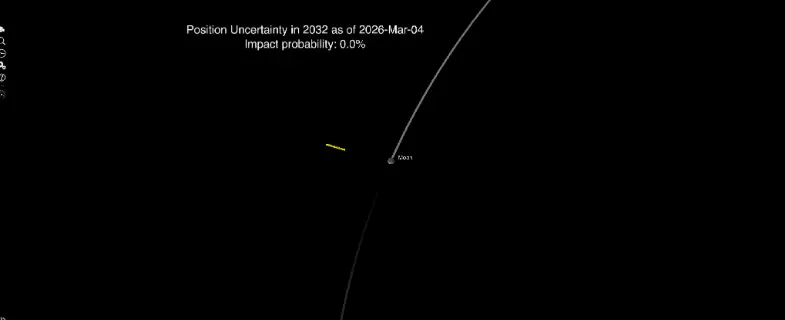
A team led by the Johns Hopkins Applied Physics Laboratory were focused on using the Webb telescope because the asteroid has been extremely difficult to observe since last year.
Asteroid 2024 YR4 was first discovered in late 2024 by the Asteroid Terrestrial-impact Last Alert System (ATLAS) in Chile. Early tracking data suggested a small possibility it could hit Earth, which attracted attention from scientists.
We now know it has no chance of colliding with the Earth, or the Moon.
Prof Martin Ward, Emeritus Temple Chevallier Professor of Astronomy, Durham University, said: “The way these percentages for the chance of impact are calculated are based on extrapolations of the asteroid trajectory and the position of the Earth when the asteroid arrives.
“They get more accurate with time as we get more data.
“Think of it as a circle in the sky (much bigger than the asteroid itself). The direction of future travel plus the position of the Earth could take any line out of the circle towards the Earth.
“Most lines are projected to miss, but a few would hit.”
Dr Darren Baskill, Physics & Astronomy Lecturer, University of Sussex, explained why predicting an outcome in space is very difficult.
“An asteroid passes by the Earth, within the orbit of the Moon, typically every month – which is very close in cosmic terms.
“The last time this happened was when a 26m asteroid passed us by on the 4th of February 2025," Dr Baskill said.
“Watching an asteroid approach is a bit like watching a long pot in snooker – you don’t know if the ball will go in a pocket until the very last moment, and there is always a good chance of the ball rattling in the jaws of the pocket and missing.
“This is why there is so much uncertainty surrounding this asteroid.
“Of course, the distances involved in astronomy are much, much larger, making accurate long-term predictions difficult.”
 Anish Vij