
Horrifying simulation shows treadmill torture method that was banned from British prisons for being too brutal

Ask someone what pops into their head when you mention the word 'treadmill' and they'll probably think of the cardio machine in most gyms around the world.
But did you know the treadmill actually originated as a labour device used to punish prisoners?
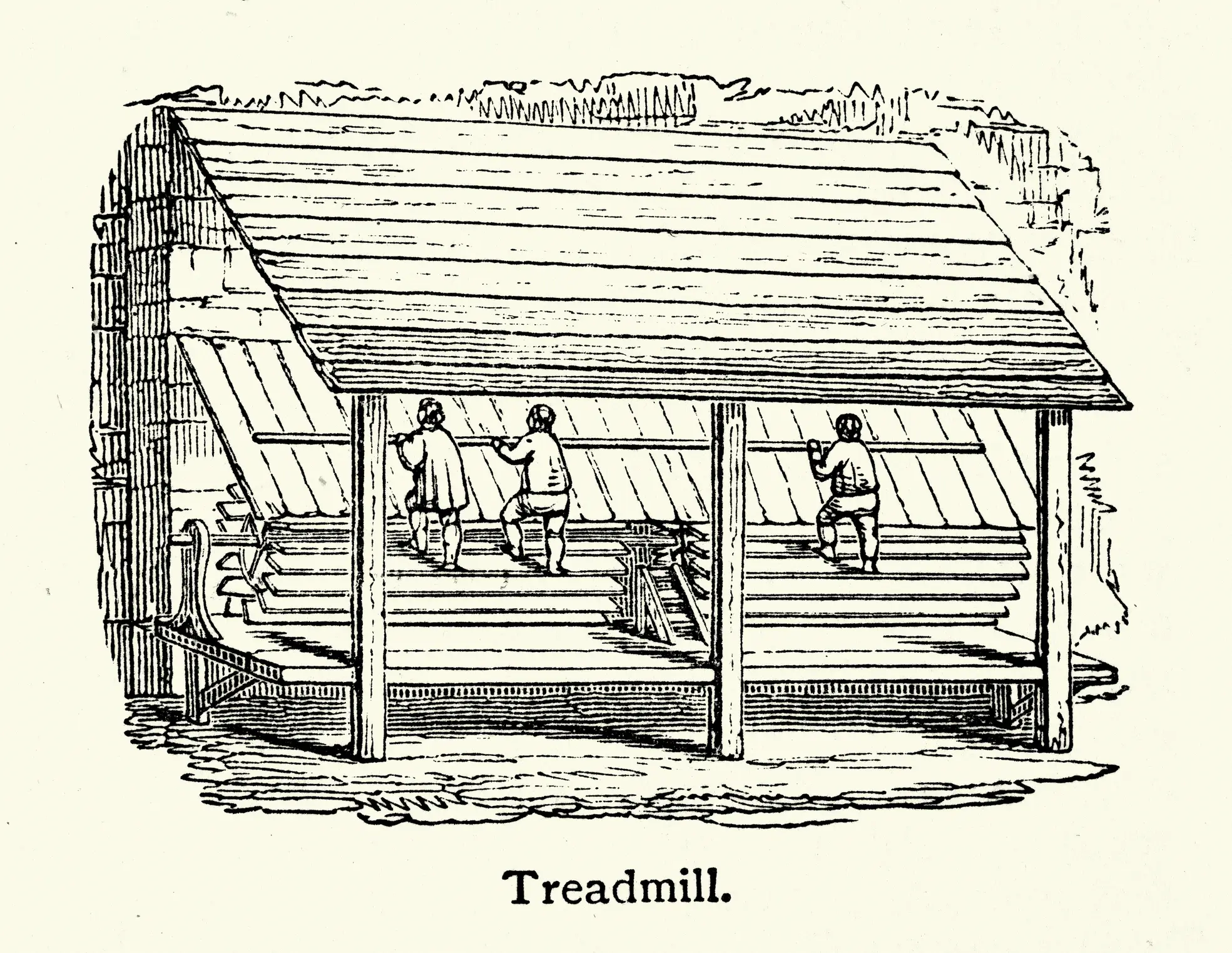
Invented by Victorian engineer Sir William Cubitt in 1818, the treadmill - or everlasting staircase as it was known then - was designed as a way to punish inmates by subjecting them to hours of hard labour.
That's right, the exercise machine that very much feels like a torture machine during an intense workout was originally designed as a method of torture.
Advert

What did the original treadmill look like?
The treadmill looked a little different to the one you're likely familiar with at the gym, as Cubitt's design involved a large rotating wheel with steps, allowing multiple prisoners to climb the machine at the same time.
Prisoners would often be forced to walk on the treadmills for an average of six hours a day, getting an average of 12 minutes' rest for each hour walked.
If you're struggling to visualise how grim the punishment would've been, Zack D. Films has created a handy simulation revealing exactly what the prisoners were subjected to, which you can watch below:
I'd argue the contraption more closely resembles a step machine than the modern treadmill but either way, you can imagine it was pretty unpleasant to spend several hours a day on there.
According to academic Vybarr Cregan-Reid, the Victorian treadmill was the 'perfect punishment' of the time, with some of the devices created with the sole purpose of wearing out the prisoners rather than grinding corn or pumping water.
"They were invented to solve a problem," he told BBC Radio 4. "It came out of the Enlightenment... this idea that punishment should be fair and appropriate, and it should teach the criminal to behave in a certain way.
"The idea was, they would walk, and they would do nothing and just go round and round and round... What they were doing was literally pointless."
The treadmill punishment was typically handed down to inmates sentenced to hard labour for their crimes, with Cregan-Reid noting that author Oscar Wilde was forced to walk on a treadmill after being sentenced to two years of hard labour in 1895.
In Wilde's case, two years of hard labour on the treadmill would cause irreparable damage to his health, as he died a couple of years after being released from prison.
The penal treadmill was eventually abolished in 1902.
One to think about next time you're working out at the gym.
 Brenna Cooper