Millions received false alert on phones warning about an imminent nuclear attack

Civilians across war-torn Ukraine were told that a nuclear attack was imminent after the country's air raid systems were hacked.
Last night saw Russia and Ukraine seemingly launch a series of cyberattacks on each other, with each nation claiming that its respective emergency alert systems were hacked.
Ukraine was first to report a cyberattack, after its Air Alert system sent out messages nationwide to roughly 38 million people across the Eastern European country.
The messages included a red-alert warning that an 'Oreshnik' nuclear missile was headed towards the country.
Advert
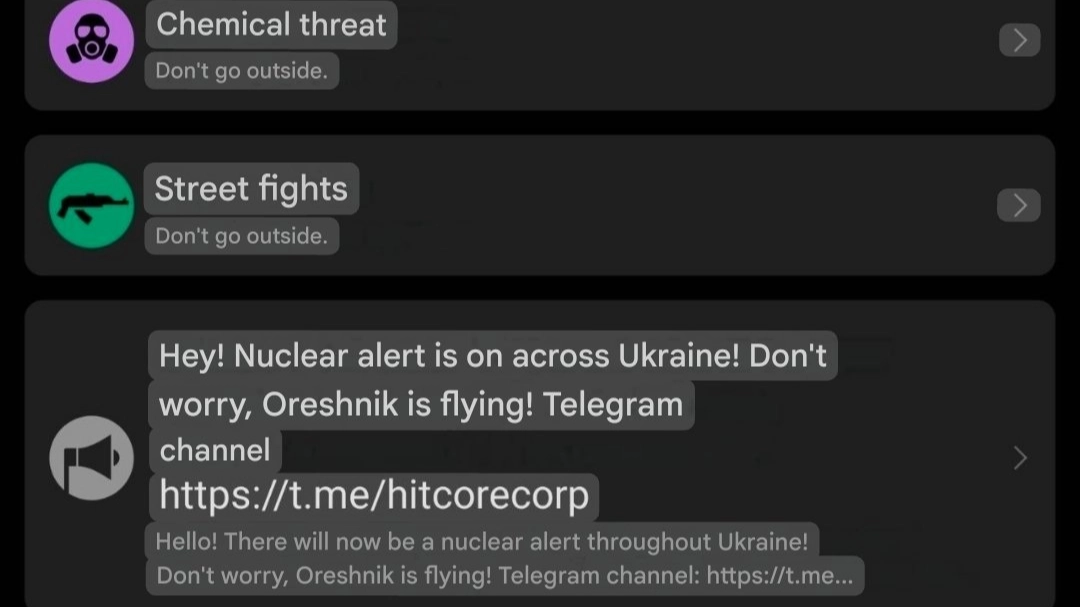
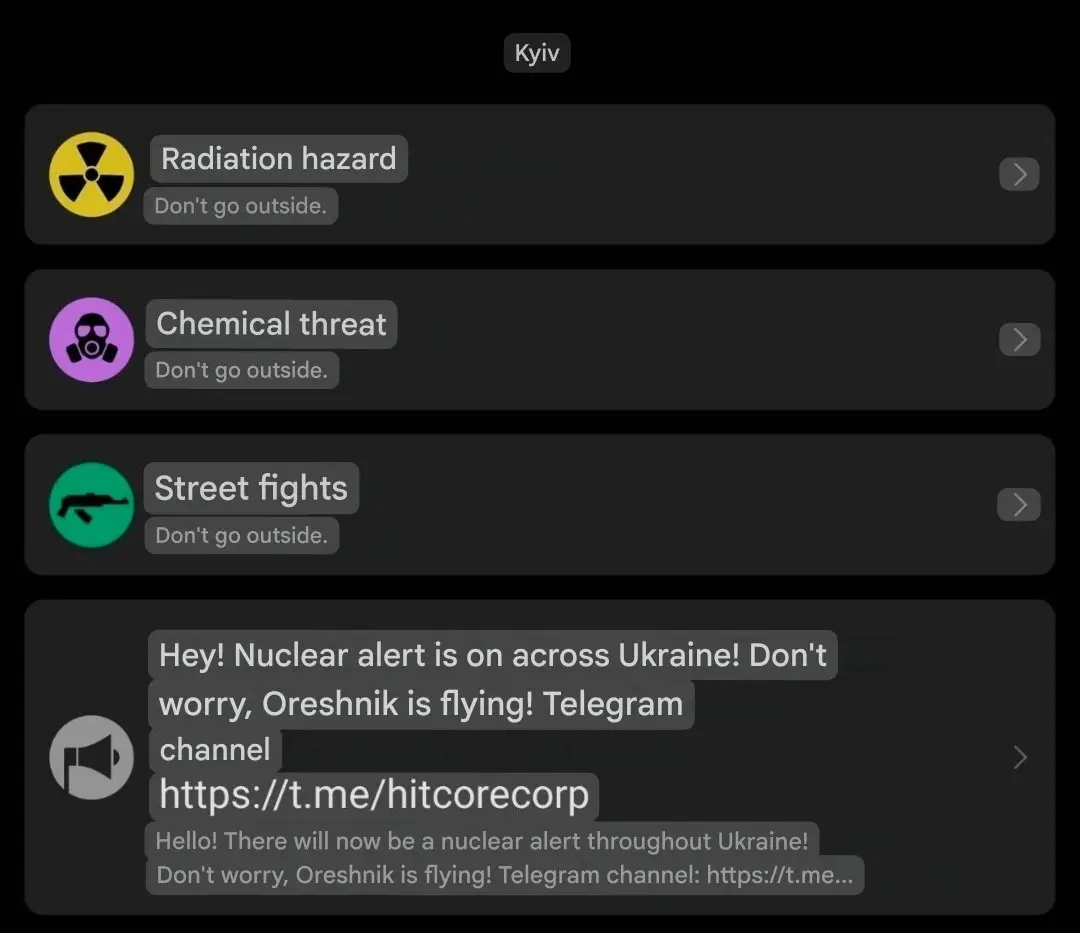
"Hi! A nuclear alert is about to go off all across Ukraine! Don't worry, the Oreshnik is on its way," the ominous message, which had been broadcast in Russian, read, per Kyiv Independent.
Ukrainians in several cities, including its capital, Kyiv, also received warnings for radiation and chemical hazards, as well as messages claiming that street fighting was ongoing.

Air raid sirens also sounded across the country.
Ukraine's intelligence services later confirmed via Telegram that the alerts were false and the result of a cyberattack, while the Ministry of Digital Transformation of Ukraine confirmed that the Air Alert app had been compromised.
Meanwhile, Russia also reported a cyberattack on its emergency app, which allegedly told citizens that a nuclear warhead had been directed at 'all regions of Russia'.
The false alert also told Russians to stock up on essential supplies and take shelter.
Responding to the alert, Kremlin spokesman Dmitry Peskov said that all Russian state agencies were under the threat of cyberattacks, adding that all 'government bodies must take steps to improve the cybersecurity of our digital resources'.
What is the 'Oreshnik' missile?
The Oreshnik is a Russian intermediate-range ballistic missile which has the capability to carry a nuclear warhead.
It's reported that the Oreshnik can travel as fast as 10 times the speed of sound, according to Vladimir Putin, and is believed to be difficult to intercept. The missile, carrying conventional warheads, has been previously deployed against Ukraine.
What does the cyberattack mean for the conflict going forward?
Reacting to the news, Herbert Lin, a senior research scholar for cyber policy and security at Stanford University, told BBC World Service that it's unlikely to be the last time that official Ukrainian apps are targeted by cyberattacks.
"I think it's the first time it's happened to an official Ukrainian information app, but I suspect it won't be the last," he explained.
Topics: World News, Ukraine, Russia
 Brenna Cooper