
Biohacker Bryan Johnson's girlfriend diagnosed with endometriosis in just 42 days without surgery

Biohacker Bryan Johnson says girlfriend Kate has been officially diagnosed with endometriosis in just 42 days and without the need for surgery.
Johnson is known for his extreme efforts to 'de-age' himself, which seems him sticking to an incredibly rigorous daily routine as well as trying out unusual experiments, such as injecting himself with his son's blood.
But back in May he turned his attentions to his girlfriend Kate Tolo and hit headlines after he shared the results of her ‘top one percent vagina’ on social media.
However, while some folks were left reeling by the TMI post, Johnson shared an update to say that Tolo had ‘suspected endometriosis’ and was on a mission to get her answers.
Advert
The move was widely praised by many as the condition affects millions of women worldwide, but typically takes a very long time to get a diagnosis.

“Historically you needed surgery just to diagnose it (incisions are made in the abdomen),” he wrote in May.
“We're doing a non-invasive route. Typically women live with endometriosis for 7-10 years before being diagnosed. It’s the leading reason women aged 30 to 34 get hysterectomies (permanent surgery to entirely remove the uterus).
“This condition is where endometrial-like tissue starts growing outside the uterus, in ovaries, bowel, bladder, even the diaphragm. This tissue inflames, scars, and glues organs together.”
In a new update today Johnson announced that his team had officially confirmed an endometriosis diagnosis for Tolo within just six weeks and without invasive surgery.
Sharing some context, Johnson said that it usually takes an average of 6.6 years to get a diagnosis.
He wrote: “Over the past 6 weeks, we’ve sprinted to confirm or deny Kate’s suspected endometriosis. Endo is notoriously challenging to diagnose.
It’s one of the most gnarly diseases and affects 15 percent of women.”
Johnson said they started with an MRI and a transvaginal ultrasound, both of which came back negative.
“At this point, Kate’s patient journey had followed the archetype precisely,” he explained.
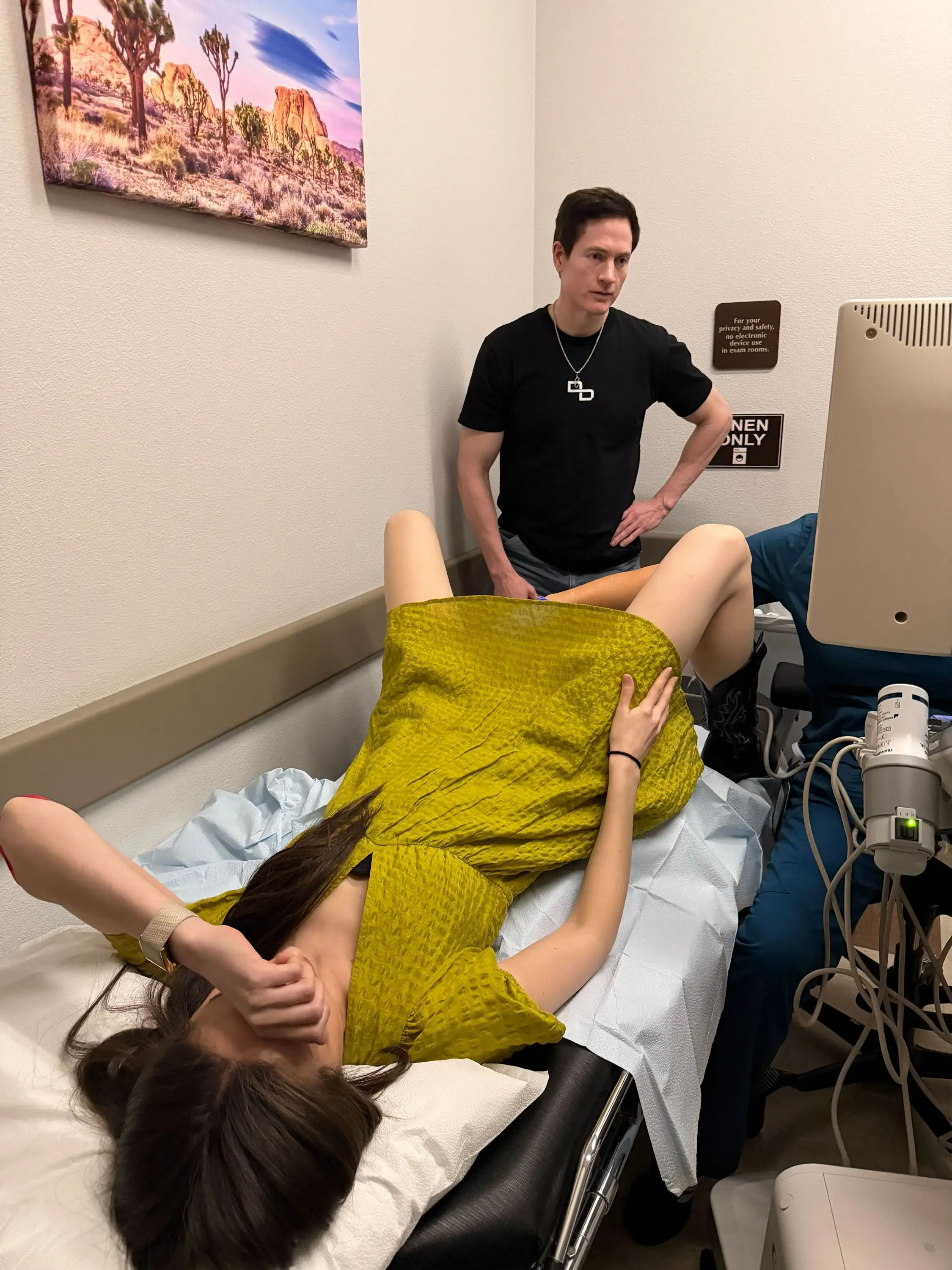
“Most women don’t get diagnosed for 7-10 years. For Kate, it’s been 7 years. And, like most women, her imaging came back clear even though now we know that she has endo.
“This is why diagnosis has traditionally happened via surgery. There has been no other way than to open her up and look inside.
“We wanted to avoid surgery so we went back to the drawing board.”
This time around they used an endo-specific ultrasound, an endo blood test, an AI MRI, and a saliva test.
Johnson this second set of tests was ‘was successful’.
“We were able to confirm her endo via ultrasound, blood test, and MRI. Confirmed simultaneously by three unique modalities, as far as we know, a world-first approach.”
Johnson said this diagnosis is just ‘phase one’ and that ‘phase two is curing endometriosis’.
He added: “We’ve already started working.”
What is endometriosis and what are the signs?
In his post, Johnson wrote: “Men, to get you on the same page, having endo is akin to an alien growing in your guts and balls, self replicating, and glueing everything together. Causing you constant pain and discomfort.”
And while that isn’t exactly how medics would describe it, he’s not wrong about the pain and discomfort.
Endometriosis occurs occurs when cells similar to the ones in the lining of the womb are found elsewhere in the body.
These can grow and change in response to hormones in the menstrual cycle, potentially causing inflammation, pain and scar tissue.
While it’s most commonly found on the lining of the pelvis, it can also occur in the ovaries, bowel and bladder. But it’s also been found on other organs across the body, such as in the chest.
Symptoms vary from person to person but the common ones include, pelvic pain, painful periods, pain during or after sex, heavy menstrual bleeding, difficulty getting pregnant, pain when urinating and having a poo and fatigue.
You can find out more about this condition, estimated to impact over 1.5 million women in the UK, on the Endrometriosis UK website.
Topics: Bryan Johnson, Health, Science
 Claire Reid